
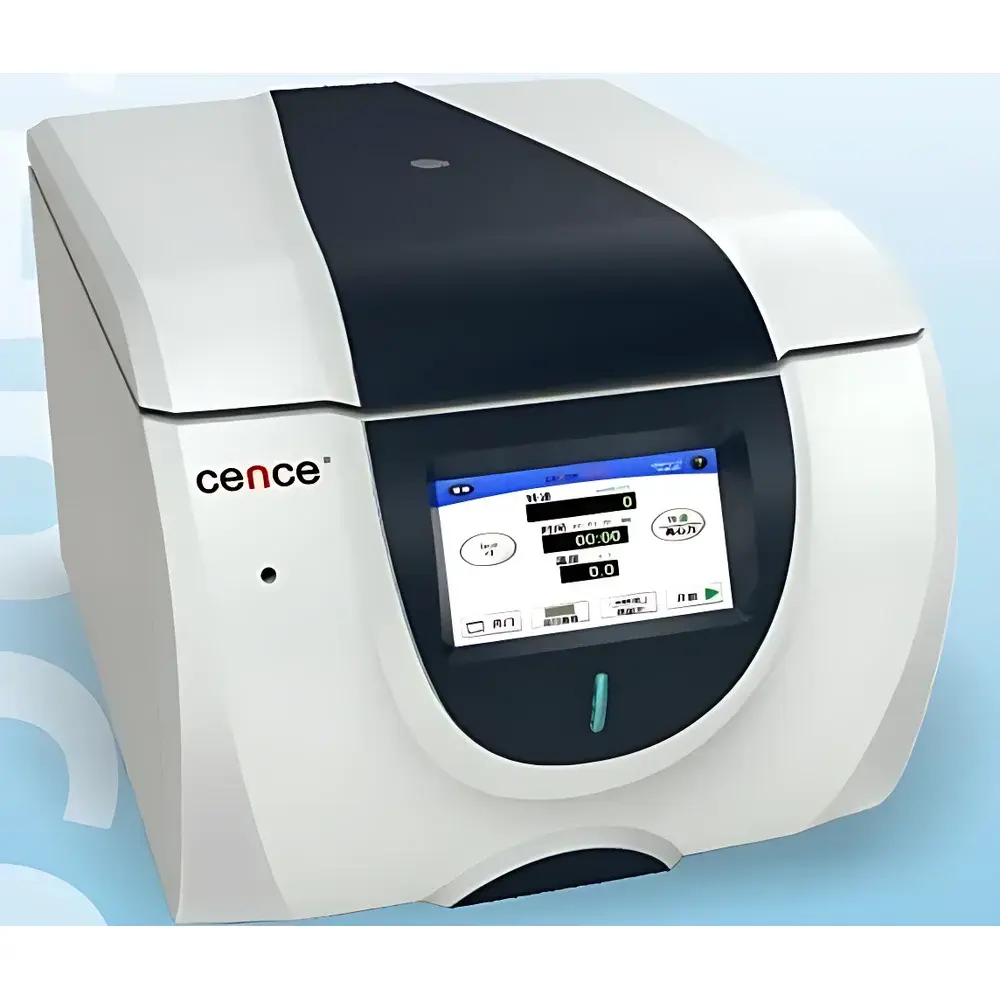
Xiangyi LT53 Benchtop Low-Speed Centrifuge
| Brand | Xiangyi |
|---|---|
| Origin | Hunan, China |
| Manufacturer Type | Direct Manufacturer |
| Product Category | Domestic |
| Model | LT53 |
| Instrument Type | Benchtop Centrifuge |
| Speed Range | Up to 5,300 rpm |
| Max RCF | 5,010 × g |
| Max Capacity | 4 × 250 mL |
| Rotor Configuration | Horizontal (Swinging-Bucket) |
| Application Class | Cell & Bacterial Separation |
| Dimensions (W×D×H) | 436 × 560 × 380 mm |
| Display | 7-inch High-Brightness Touchscreen |
| Safety Features | Auto-Latching Electronic Door Lock, Rotor Recognition, Multi-Stage Fault Diagnostics, Over-Speed & Over-Temperature Protection |
| Acceleration/Deceleration Profiles | 11 Accel + 12 Decel Curves (including customizable decel at Level 10) |
| Data Logging | Operational History & Fault Logs Stored Onboard |
| Sample Compatibility | Tubes from 0.2 mL to 250 mL via Interchangeable Adapters |
| Thermal Management | Optimized Airflow for Chamber Temperature Stability |
| Acoustic Design | Aerodynamic Cup Geometry & Structural Damping for Reduced Noise |
Overview
The Xiangyi LT53 is a precision-engineered benchtop low-speed centrifuge designed for routine separation tasks in clinical diagnostics, cell biology, microbiology, and basic life science laboratories. Operating on the principle of sedimentation under controlled centrifugal force, the LT53 delivers reproducible separation of cells, bacteria, platelets, and other particulate suspensions without inducing shear-induced damage typical of high-speed or ultracentrifugation. Its maximum rotational speed of 5,300 rpm generates a relative centrifugal force (RCF) of up to 5,010 × g—sufficient for pelleting mammalian cells, yeast, and bacterial cultures while preserving structural integrity and viability. The horizontal rotor configuration ensures uniform sedimentation across all tubes and supports large-volume processing (up to 4 × 250 mL per run), making it suitable for batch processing in hospital labs, quality control units, and academic core facilities.
Key Features
- 7-inch high-resolution capacitive touchscreen interface with glove-compatible operation—enables direct numeric entry of speed, time, and RCF parameters without mechanical dials.
- Auto-latching electronic door lock system: door seals automatically upon closure; motor remains disabled unless latch engagement is verified, preventing accidental operation during loading/unloading.
- Intelligent rotor recognition technology prevents inadvertent overspeeding by cross-referencing installed rotor ID against permissible speed limits stored in firmware.
- Programmable multi-step protocols support up to five sequential centrifugation stages within a single run—ideal for density gradient preparation or staged pelleting/wash cycles.
- Comprehensive safety architecture includes real-time monitoring of door status, motor temperature, rotational stability, communication integrity, and power supply fluctuations—with automatic shutdown and diagnostic code display upon anomaly detection.
- Optimized aerodynamic chamber design features elliptical sample cup contours and directional airflow channels to minimize turbulence, reduce acoustic emission (<58 dB[A] at 1 m), and maintain thermal stability during extended runs.
- Onboard data logging captures operational history (start/stop timestamps, setpoints, actual RCF/time profiles) and fault events—including timestamps and error codes—for traceability in GLP-compliant environments.
Sample Compatibility & Compliance
The LT53 accommodates a broad range of tube formats—from microcentrifuge tubes (0.2 mL) to clinical-scale conical tubes (250 mL)—via interchangeable adapters compatible with standard polypropylene, polycarbonate, and glass vessels. Its horizontal rotor accepts swing-out buckets certified for use with ISO 8573-1 Class 3 compressed air–free environments and meets IEC 61010-1:2010 safety requirements for laboratory electrical equipment. While not FDA-cleared as a medical device, the instrument adheres to ISO 13485-aligned manufacturing practices and supports audit-ready documentation through its embedded event log—facilitating internal SOP validation and alignment with CAP/CLIA pre-analytical workflow standards.
Software & Data Management
No external PC software is required for routine operation; all configuration, execution, and review occur natively on the embedded Linux-based HMI. Parameter sets can be saved as named methods (up to 99 user-defined programs), each supporting independent acceleration/deceleration curve selection (11 accel + 12 decel profiles, including user-configurable deceleration at Level 10). The system retains the last 100 operational records and 50 fault logs with ISO 8601 timestamps. Export functionality is limited to USB-stick-based CSV dump of method libraries and recent run logs—ensuring data sovereignty and compatibility with offline QC review systems. Audit trail capabilities satisfy basic 21 CFR Part 11 readiness when paired with institutional electronic signature policies.
Applications
- Clinical hematology: isolation of plasma, serum, and peripheral blood mononuclear cells (PBMCs) from whole blood using density gradient media (e.g., Ficoll-Paque).
- Microbiology: harvesting bacterial pellets for DNA extraction, antibiotic susceptibility testing, or culture supernatant clarification.
- Tissue culture: recovery of adherent or suspension cells prior to lysis or cryopreservation.
- Food & beverage QA: sediment analysis, fat separation in dairy emulsions, and yeast removal in fermentation broths.
- Environmental testing: concentration of waterborne pathogens or particulates from large-volume environmental samples.
FAQ
What is the maximum recommended runtime for continuous operation?
The LT53 is rated for uninterrupted operation up to 99 minutes per cycle; for extended protocols, cooling intervals between consecutive runs are advised to maintain motor longevity and thermal stability.
Does the centrifuge support refrigeration?
No—the LT53 is a non-refrigerated model. Its passive thermal management system maintains chamber temperature within ±3°C of ambient during typical 15–30 minute runs.
Can third-party rotors be used with the LT53?
Only Xiangyi-certified horizontal rotors with integrated RFID tags are recognized and enabled; unauthorized rotors will trigger immediate interlock and display “Rotor Not Valid.”
How is calibration verified?
Speed calibration is factory-traceable to NIM (National Institute of Metrology, China) standards; users may perform periodic verification using an externally calibrated tachometer—no field recalibration interface is provided.
Is remote monitoring or network connectivity available?
The LT53 lacks Ethernet, Wi-Fi, or RS-232 ports; all interaction is local via touchscreen or optional USB keyboard input for alphanumeric entry.



