
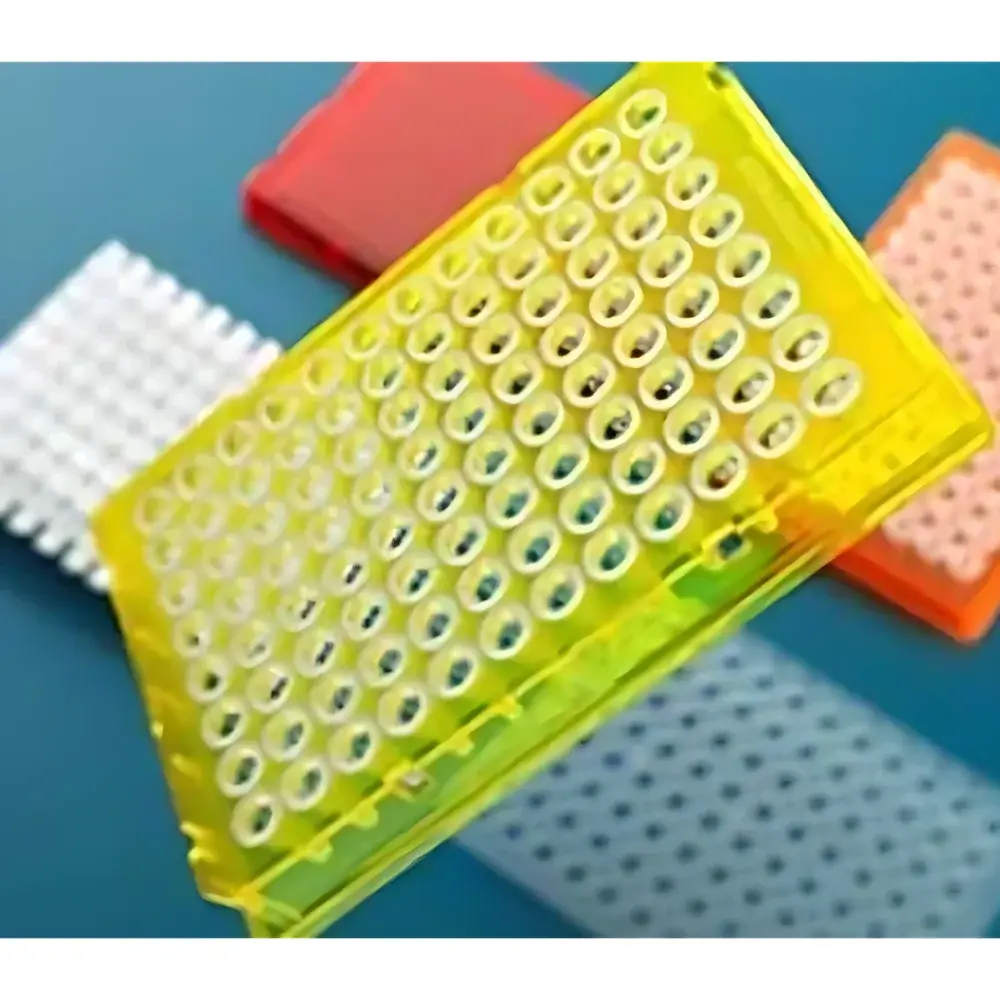
Thermo Scientific Armadillo PCR Plate
| Brand | Thermo Fisher |
|---|---|
| Origin | USA |
| Manufacturer Type | Authorized Distributor |
| Origin Category | Imported |
| Model | Armadillo PCR Plate |
| Pricing | Upon Request |
Overview
The Thermo Scientific Armadillo PCR Plate is an engineered consumable platform designed for demanding thermal cycling applications in high-throughput molecular biology workflows. Unlike conventional PCR plates, the Armadillo plate integrates a rigid polycarbonate frame with ultra-thin-walled polypropylene wells to achieve exceptional dimensional stability across repeated thermal cycles (typically −10 °C to 100 °C). Its structural architecture mitigates warping—a common failure mode in automated liquid handling and thermal cycler compatibility—by distributing thermal stress uniformly across the frame. This design ensures consistent well-to-well sealing integrity with standard optical seals and thermal lids, minimizing evaporation loss and cross-contamination risk. The plate operates within standard ANSI/SLAS footprint specifications (96-well: 127.76 × 85.48 mm; 384-well: 127.76 × 85.48 mm), ensuring full interoperability with commercial thermal cyclers, qPCR instruments, robotic workstations (e.g., Hamilton STAR, Tecan Freedom EVO), and integrated nucleic acid extraction platforms.
Key Features
- Rigid polycarbonate frame engineered to resist thermal deformation during rapid ramping (up to 5 °C/s) and prolonged hold phases at extreme temperatures
- Thin-walled polypropylene wells (wall thickness ≤ 0.25 mm) optimized for rapid heat transfer, reducing cycle time without compromising reaction fidelity
- Well geometry refined to maximize sample recovery (>98% recovery for 10–50 µL volumes using standard positive-displacement pipettes)
- Available in both transparent and white well configurations: transparent for standard endpoint PCR and sequencing library amplification; white for enhanced fluorescence detection sensitivity in quantitative real-time PCR (qPCR)
- Multiple formats: 96-well full-skirted, 384-well low-profile, and 96-well semi-skirted divisible into eight individual 8-tube strips—each compatible with barcode scanning systems
- Barcode options include standardized 128-format linear barcodes pre-applied to the frame or custom alphanumeric labeling per customer specification
- Color-coded frames (natural, blue, green, yellow) support visual workflow segregation in multi-assay environments without affecting thermal performance
Sample Compatibility & Compliance
The Armadillo PCR Plate demonstrates full compatibility with all major DNA polymerases (including hot-start and high-fidelity variants), reverse transcriptases, and intercalating dyes (e.g., SYBR Green I) as well as hydrolysis probe chemistries (e.g., TaqMan). It is certified DNase-, RNase-, and human DNA-free per ISO 13485 manufacturing controls. Each production lot undergoes rigorous quality verification including thermal cycling validation (100 cycles at 95 °C/55 °C/72 °C), seal integrity testing (helium leak rate <1 × 10⁻⁸ mbar·L/s), and optical flatness measurement (deviation <±5 µm across entire plate surface). The product complies with ANSI SLAS-1-2019 (Microplates — Dimensions and Interchangeability) and meets EU Directive 2002/95/EC (RoHS) requirements for restricted substances.
Software & Data Management
While the Armadillo plate itself is a passive consumable, its standardized dimensions and barcode integration enable seamless traceability within LIMS and ELN ecosystems. When used with Thermo Fisher’s Cloud-based SampleManager or third-party platforms such as LabVantage or Benchling, the 128-barcode enables automated sample mapping, audit trail generation, and electronic batch record linkage. All barcode data adhere to GS1 standards and support 21 CFR Part 11-compliant electronic signatures when deployed in regulated environments (e.g., clinical diagnostics labs operating under CLIA or CAP accreditation).
Applications
- High-throughput genotyping and SNP screening in population genetics studies
- qPCR-based gene expression profiling across tissue panels or time-course experiments
- NGS library amplification and indexing prior to Illumina or Ion Torrent sequencing
- Automated pathogen detection assays (e.g., SARS-CoV-2, influenza A/B) in diagnostic reference laboratories
- Digital PCR partitioning workflows requiring precise well volume consistency and thermal uniformity
- CRISPR-Cas9 editing efficiency quantification via amplicon-based NGS or T7E1 assays
FAQ
Is the Armadillo PCR Plate compatible with all thermal cyclers and qPCR instruments?
Yes—its ANSI/SLAS-compliant footprint and flat-bottom well geometry ensure mechanical and thermal compatibility with Applied Biosystems, Bio-Rad, Roche LightCycler, and QuantStudio platforms.
Can Armadillo plates be sterilized using autoclaving?
No—autoclaving exceeds the thermal tolerance of polypropylene wells. Sterilization is achieved via gamma irradiation (25–35 kGy) during manufacturing; no further sterilization is required.
What is the maximum recommended centrifugation speed for Armadillo plates?
Up to 4,000 × g for 5 minutes at room temperature—validated using Beckman Allegra X-15R and Eppendorf 5424R centrifuges with compatible plate carriers.
Do white-well Armadillo plates exhibit higher background fluorescence than transparent versions?
No—white wells use proprietary titanium dioxide dispersion technology that minimizes autofluorescence while maximizing reflectivity, resulting in >3× improved signal-to-noise ratio versus generic white plates.
Are custom well volumes or non-standard well geometries available?
Standard offerings cover 0.1–0.2 mL well capacity. Custom geometries require minimum order quantities and are subject to engineering review for thermal and robotic compatibility validation.



