
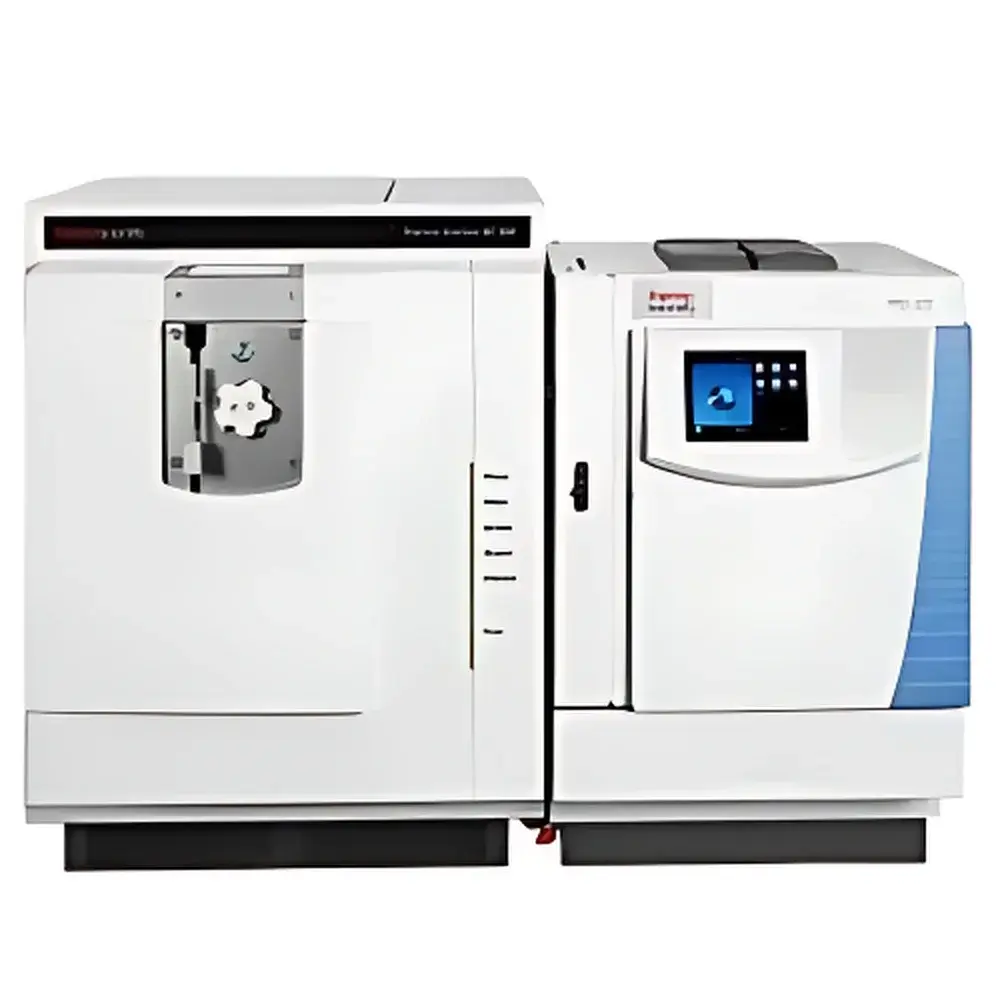
Thermo Scientific Orbitrap Exploris GC 240 High-Resolution Gas Chromatography Mass Spectrometer
| Brand | Thermo Fisher |
|---|---|
| Origin | Imported |
| Manufacturer Type | Authorized Distributor |
| Instrument Type | Orbitrap Mass Spectrometer |
| GC Configuration | Conventional GC-MS |
| Mass Range | m/z 30–3000 |
| Resolution | Up to 240,000 at m/z 200 |
| Scan Speed | Up to 40 Hz at R = 7,500 (m/z 200) |
Overview
The Thermo Scientific Orbitrap Exploris GC 240 is a high-resolution gas chromatography mass spectrometry (GC-MS) system engineered for precision molecular characterization in complex matrices. At its core lies the Orbitrap mass analyzer—a high-field electrostatic trap that achieves ultra-high mass resolution and sub-ppm mass accuracy through image current detection and Fourier transform signal processing. Coupled with a robust quadrupole front-end and advanced electron ionization (EI)/chemical ionization (CI) sources—including Thermo Scientific ExtractaBrite technology—the system delivers exceptional spectral fidelity, structural confidence, and quantitative reproducibility. Designed for research laboratories engaged in environmental analysis, metabolomics, food safety, forensic toxicology, and petrochemical profiling, the Orbitrap Exploris GC 240 enables confident compound identification, isomeric differentiation, and retrospective data mining without re-injection.
Key Features
- Ultra-High Resolution Performance: Delivers up to 240,000 resolving power (FWHM) at m/z 200—enabling baseline separation of isobaric interferences and accurate mass determination for elemental composition assignment.
- Dynamic Scan Flexibility: Supports scan speeds up to 40 Hz at R = 7,500, ensuring compatibility with fast GC gradients and narrow peak widths while maintaining sufficient data points across chromatographic peaks.
- Mass Range Coverage: Operates across m/z 30–3000, accommodating small volatile organics to semi-volatile and thermally labile compounds with minimal fragmentation or adduct interference.
- Modular Ion Source Architecture: Integrates ExtractaBrite EI/CI dual-mode ionization with rapid, tool-free source exchange—allowing seamless switching between hard and soft ionization for complementary spectral information.
- Compact, Robust Platform: Engineered with reduced footprint and enhanced thermal stability; features active vibration damping and sealed optical path design to maintain long-term mass calibration integrity under routine laboratory conditions.
- Quadrupole-Orbitrap Hybrid Architecture: Enables targeted MS/MS acquisition with high selectivity and sensitivity, supporting both data-dependent (ddMS²) and data-independent (DIA) acquisition strategies for comprehensive sample interrogation.
Sample Compatibility & Compliance
The Orbitrap Exploris GC 240 supports standard 0.25–0.32 mm ID fused-silica capillary columns and accommodates common GC inlet configurations including split/splitless, PTV, and direct insertion probes. It is compatible with derivatized and underivatized polar analytes when paired with appropriate stationary phases (e.g., polyethylene glycol or cyanopropylphenyl columns). From a regulatory standpoint, the system supports audit-trail-enabled method execution and raw data archiving compliant with 21 CFR Part 11 requirements when used with Thermo Scientific Compound Discoverer and Chromeleon CDS software. Method validation workflows align with ISO/IEC 17025 and ASTM E2968–22 guidelines for qualitative and semi-quantitative GC-MS analysis. Routine performance verification follows internal SOPs referencing NIST-traceable tuning standards and retention index libraries (e.g., NIST MS Search, Wiley Registry).
Software & Data Management
Data acquisition and processing are managed via Thermo Scientific Tune and Xcalibur software platforms, which provide intuitive method setup, real-time spectral monitoring, and automated calibration routines. Compound Discoverer 3.3+ enables untargeted feature detection, statistical filtering, and in silico fragmentation prediction using CFM-ID and SIRIUS integration. All raw files (.raw) are stored in an open, vendor-neutral format compliant with mzML 1.1 specifications, facilitating third-party informatics interoperability. The system supports centralized instrument control through Thermo Scientific Dashboard, enabling remote monitoring, queue-based acquisition scheduling, and GLP/GMP-compliant electronic lab notebook (ELN) integration. Audit trails record user actions, parameter changes, and calibration events with time-stamped, immutable logs—fully traceable for regulatory submissions.
Applications
- Non-targeted screening of environmental contaminants (e.g., PFAS, pesticides, brominated flame retardants) in water, soil, and biota extracts.
- Structural elucidation of unknown metabolites in biological fluids using retention time alignment, accurate mass filtering, and MS/MS spectral library matching.
- Comprehensive profiling of essential oils, flavors, and fragrance compounds with co-elution resolution and stereochemical insight via retention index correlation.
- Forensic toxicology workflows requiring confirmatory identification per SWGTOX and ENFSI guidelines, including low-abundance drug metabolites in hair or blood.
- Petrochemical fingerprinting of crude oil fractions and refined products using Kendrick mass defect analysis and heteroatom class separation.
FAQ
What is the maximum achievable resolution in full-scan mode?
The Orbitrap Exploris GC 240 achieves up to 240,000 resolution (FWHM) at m/z 200 under optimized acquisition conditions, with typical operational settings ranging from 60,000 to 120,000 depending on transient length and duty cycle requirements.
Does the system support both EI and CI ionization in a single run?
No—EI and CI modes require physical source configuration changes; however, dual-source modules allow rapid (<5 min) manual swapping without venting the mass spectrometer, enabling sequential analysis within the same analytical session.
Is the instrument compatible with legacy GC hardware?
Yes—it interfaces with most modern Agilent, Shimadzu, and Thermo GC systems via analog/digital I/O and Ethernet-based communication protocols (e.g., GC-MS Link), supporting synchronized temperature programming and event triggering.
How is mass calibration maintained over extended operation?
Internal lock-mass correction using perfluorotributylamine (PFTBA) or custom calibrants is performed automatically before each sequence or at user-defined intervals, ensuring sub-2 ppm mass accuracy over multi-day acquisitions.
Can raw data be processed outside Thermo software environments?
Yes—native .raw files can be converted to open formats (mzML, mzXML) using msConvert (ProteoWizard), enabling compatibility with OpenMS, MZmine 3, and Skyline for independent reprocessing and statistical evaluation.
Related Products






