
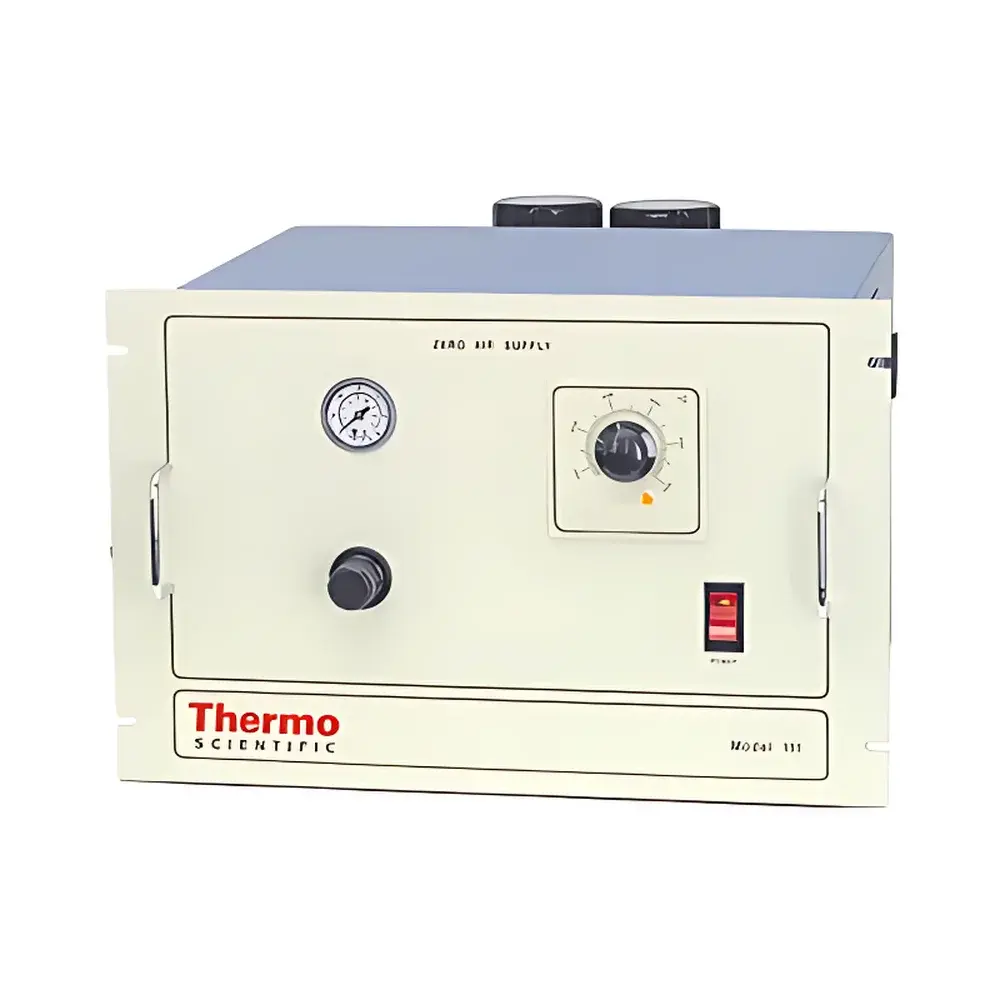
Thermo Scientific 111 Zero Air Generator
| Brand | Thermo Fisher |
|---|---|
| Origin | USA |
| Model | Thermo Scientific 111 |
| Zero Air Purity | SO₂ ≤ 0.5 ppb, NO ≤ 0.5 ppb, NO₂ ≤ 0.5 ppb, O₃ ≤ 0.5 ppb, CO ≤ 0.1 ppm, HC ≤ 0.1 ppm |
| Flow Rate | 5, 10 (standard), or 20 SLPM |
| Output Pressure | 10–30 PSI |
| Dew Point | 0 °C |
| Flow Measurement Accuracy | ±1% of reading (0–10 SLPM range) |
| Configuration | Integrated generator unit with external air compressor |
Overview
The Thermo Scientific 111 Zero Air Generator is a precision-engineered source of ultra-pure compressed air specifically designed for calibration, blanking, and zero-point verification in ambient air quality monitoring systems. It operates on a multi-stage purification principle: ambient air—supplied by an externally connected oil-free compressor—is sequentially treated through catalytic oxidation (to convert CO and hydrocarbons), high-efficiency particulate filtration, activated carbon adsorption (for residual VOCs and ozone), and chemisorptive media (targeting NO, NO₂, SO₂, and trace oxidants). This architecture ensures consistent generation of zero air meeting stringent regulatory thresholds required by U.S. EPA Methods IO-3, IO-4, and Annex A of 40 CFR Part 53 for reference and equivalent methods. The system delivers stable, traceable zero air without reliance on bottled gas cylinders—reducing operational risk, logistical overhead, and long-term cost of ownership in continuous emission monitoring (CEMS) and ambient air monitoring stations.
Key Features
- Triple-stage purification train: Catalytic converter + dual-bed chemisorption + activated carbon filter ensures sub-part-per-trillion reactivity and minimal baseline drift.
- Selectable flow output: Configurable at 5, 10 (default calibration setting), or 20 SLPM—optimized for single-instrument zeroing or multi-analyzer manifold distribution.
- Pressure-regulated output: Adjustable 10–30 PSI delivery with integrated pressure relief and downstream pressure stabilization—compatible with analyzers requiring precise inlet pressure control (e.g., UV photometric O₃ monitors, CLD NOₓ analyzers).
- Dew point control: Integrated refrigerated dryer maintains ≤0 °C dew point, preventing condensation in sample lines and ensuring compatibility with cold-trap-based instrumentation.
- Flow accuracy validation: Built-in thermal mass flow sensor calibrated to NIST-traceable standards, with ±1% full-scale accuracy across the 0–10 SLPM operating range—supporting audit-ready flow documentation per ISO/IEC 17025 requirements.
- Low-maintenance architecture: No consumables beyond periodic filter replacement (typically every 6–12 months under continuous operation); no internal moving parts other than the external compressor interface.
Sample Compatibility & Compliance
The Thermo Scientific 111 is validated for use with EPA-certified ambient air analyzers—including UV fluorescence SO₂, chemiluminescence NO/NO₂, UV photometry O₃, non-dispersive infrared CO, and flame ionization HC detectors. Its zero air purity specifications align with U.S. EPA Performance Specification 2 (PS-2) for zero air used in calibration gas generators and satisfy the zero air requirements defined in ASTM D6348-22 (Standard Test Method for Determination of Gaseous Compounds by Extractive Direct Barometric Pressure Ionization Time-of-Flight Mass Spectrometry). All internal wetted materials are electropolished stainless steel or fluoropolymer-lined to prevent leaching or catalytic interference. The unit is CE-marked and compliant with IEC 61000-6-2 (EMC immunity) and IEC 61000-6-4 (EMC emissions) standards.
Software & Data Management
While the 111 is a standalone hardware system with analog status indicators (flow, pressure, power), it is fully compatible with facility-wide data acquisition systems via optional 4–20 mA analog outputs for real-time flow and pressure telemetry. When integrated into Thermo Scientific’s TraceFinder™ or Qtegra™ environmental data management platforms, zero air delivery parameters can be time-stamped, logged alongside analyzer zero-check events, and archived with full audit trail functionality. This supports GLP/GMP-aligned workflows and satisfies FDA 21 CFR Part 11 requirements for electronic records when paired with appropriate system validation protocols and user access controls.
Applications
- Zero calibration of continuous ambient air monitors (CAMs) deployed in national air quality networks (e.g., U.S. EPA AIRNow, EU EEA AirBase).
- Baseline verification for mobile monitoring platforms and low-cost sensor calibration laboratories.
- Reference zero gas supply in laboratory-grade photolysis chambers and smog chamber experiments requiring inert background air.
- Zero-air purge gas for Fourier-transform infrared (FTIR) spectroscopy and cavity ring-down spectroscopy (CRDS) systems where spectral interference from ambient contaminants must be eliminated.
- Support gas for ozone generators used in calibration transfer standards (e.g., in accordance with ISO 14644-3 cleanroom testing protocols).
FAQ
What is the recommended maintenance schedule for the Thermo Scientific 111?
Filter cartridges should be replaced every 6–12 months depending on ambient air quality and duty cycle; the catalytic converter has a typical service life of ≥2 years under continuous operation with clean intake air.
Can the 111 be used with ozone analyzers requiring <0.1 ppb O₃ background?
Yes—the system achieves ≤0.5 ppb O₃ consistently, verified by independent third-party testing per EPA IO-4; for sub-0.1 ppb applications, optional post-purification ozone scrubbers are available as field-installable accessories.
Is the 111 compliant with ISO 8573-1 Class 1 for compressed air purity?
It exceeds Class 1 requirements for solid particles and water content (dew point ≤0 °C), though ISO 8573-1 does not define gaseous contaminant limits; its SO₂/NOₓ/O₃/CO/HC specifications are aligned with ISO/IEC 17025 method validation criteria for zero gas.
Does the unit include an integrated air compressor?
No—the 111 requires connection to an external oil-free, desiccant-dried air compressor (recommended minimum capacity: 30 SLPM at 35 PSI) to ensure consistent feed air quality and avoid introducing hydrocarbon or moisture contamination.
How is zero air purity verified during installation and routine operation?
Certified zero air test reports are provided with each unit; users may verify performance using a calibrated multi-gas analyzer (e.g., Thermo Scientific 42i-TL) or by conducting scheduled zero-checks per EPA QA Handbook Volume II, Chapter 3.
Related Products







