
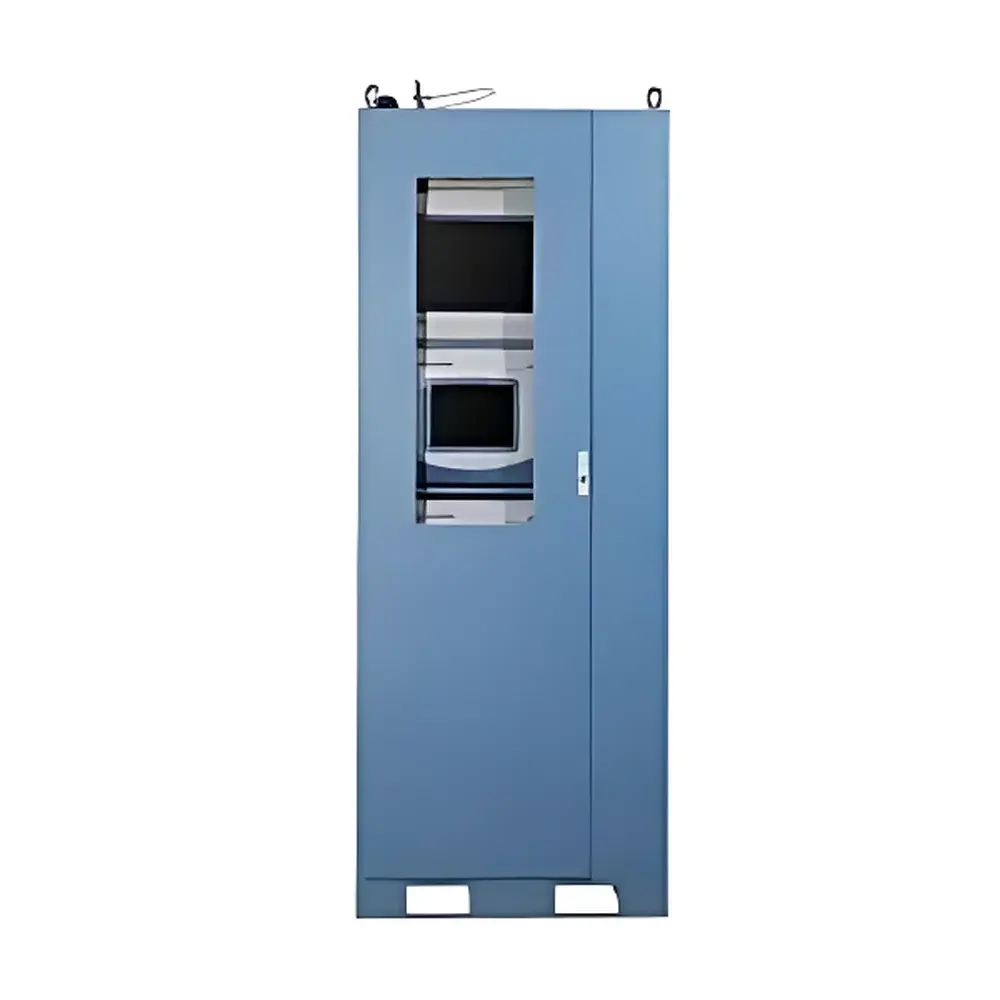
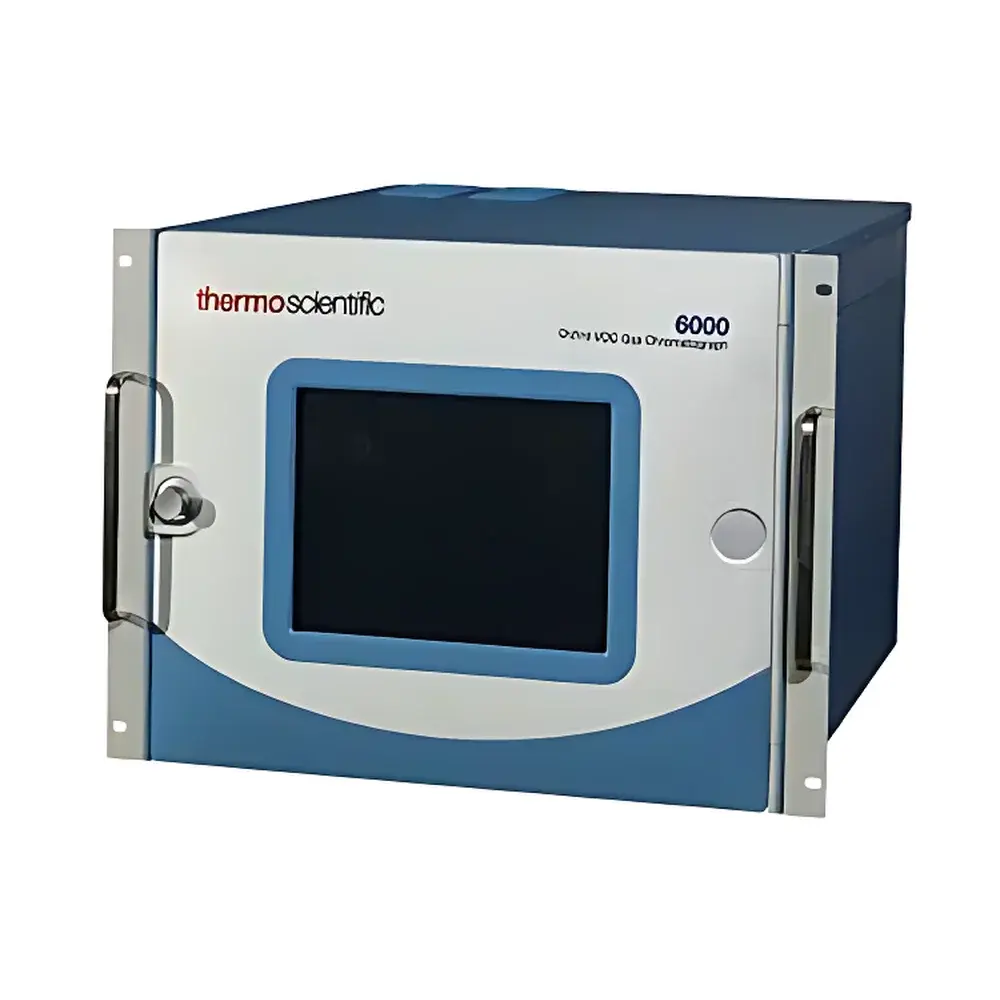
Thermo Scientific 6000 Fixed Source VOC Continuous Emission Monitoring System (CEMS)
| Brand | Thermo Scientific |
|---|---|
| Origin | Shanghai, China |
| Manufacturer Type | Original Equipment Manufacturer (OEM) |
| Regional Classification | Domestic (China) |
| Model | 6000 VOC |
| Detection Principle | Flame Ionization Detection (FID) |
| Instrument Type | Online Gas Analyzer |
| Typical Configuration | Multi-Component VOC CEMS |
| Measurement Range | 0–5000 ppm (as methane or NMHC) |
| Accuracy | ±1% Full Scale or ±0.1 ppm |
| Response Time | ≤60 s (for NMHC, T90) |
Overview
The Thermo Scientific 6000 Fixed Source VOC Continuous Emission Monitoring System (CEMS) is a fully integrated, regulatory-compliant online analyzer engineered for real-time, high-reliability quantification of volatile organic compounds (VOCs) from stationary industrial emission sources. Built upon decades of Thermo Fisher Scientific’s expertise in gas chromatography and flame ionization detection (FID), the system implements a robust hot-wet extractive sampling architecture—eliminating condensation-induced analyte loss and preserving sample integrity throughout the measurement chain. Its core detection module utilizes a proprietary, modular FID with optimized burner geometry and gas flow dynamics to suppress oxygen interference—a known source of baseline drift and nonlinearity in complex flue gas matrices. Designed to meet and exceed the performance requirements of China’s HJ 1013–2018 standard for VOC CEMS, the system delivers trace-level sensitivity, long-term baseline stability (<0.1 pA RMS noise), and repeatable quantification across demanding thermal and particulate environments.
Key Features
- Modular, field-serviceable FID detector with integrated thermal management—enabling rapid maintenance without recalibration.
- Dual-stage sampling pump architecture: maintains stable mass flow under variable stack backpressure while minimizing pulsation-induced signal artifacts.
- Heated sampling probe (up to 200 °C) with stainless-steel housing and IP65-rated thermal shielding—compliant with HJ 1013 probe temperature specifications and capable of operation in dust-laden streams (≤10 g/m³).
- Constant-power heated sample transfer line (120–180 °C), constructed entirely from de-greased, electropolished 316L stainless steel—eliminates fluoropolymer outgassing and ensures inert transport of reactive and polar VOCs.
- Four-stage sintered stainless-steel filtration (0.5 µm final stage) upstream of the analyzer—retains particulates and tars without introducing pressure drop or adsorption artifacts.
- Full-path heating design: no cold spots from probe tip to detector chamber—prevents condensation, wall adsorption, and catalytic degradation of labile compounds (e.g., formaldehyde, acetaldehyde).
- Redundant power supply and safety-critical components—including certified hydrogen shutoff valve (UL/CSA listed)—support unattended 7×24 operation under industrial conditions.
- Programmable DAS based on industrial PLC + ruggedized IPC platform, compliant with HJ 75–2017 data acquisition and reporting protocols, including audit-trail logging and electronic signature support.
Sample Compatibility & Compliance
The 6000 CEMS is validated for direct measurement of total hydrocarbons (THC), non-methane hydrocarbons (NMHC), methane (CH₄), benzene, toluene, xylene (BTX), and other C₂–C₁₂ aliphatic/aromatic VOCs in hot, humid, and particulate-laden exhaust streams. It supports optional integration of parametric sensors for flue gas temperature, velocity, static/dynamic pressure, relative humidity, and O₂ concentration—enabling stoichiometric correction and mass emission rate calculation per GB 16297 or EU IED Annex VII. All wetted materials (probe, line, filters, valves) are 316L stainless steel, passivated and solvent-cleaned to minimize surface reactivity. The system conforms to electromagnetic compatibility (EMC) Class A (GB/T 17626 series), explosion-proof requirements for Zone 2 (GB 3836.1), and functional safety principles aligned with IEC 61508 SIL 2 for critical safety interlocks.
Software & Data Management
The embedded Data Acquisition System (DAS) runs on a Windows IoT–based industrial PC with deterministic real-time scheduling. It provides automated calibration verification (CV), zero/span drift tracking, and fault diagnostics per HJ 75–2017 Annex D. Raw FID current signals (pA range), digital sensor inputs, and event logs are timestamped with NTP-synchronized UTC and stored locally for ≥18 months. Export formats include CSV, XML (HJ 212–2017 protocol), and OPC UA for enterprise SCADA/MES integration. Audit trails capture user actions, configuration changes, and calibration events—fully compliant with GLP/GMP documentation requirements and supporting FDA 21 CFR Part 11 readiness when deployed with electronic signature modules.
Applications
The Thermo Scientific 6000 CEMS is deployed across regulated industrial sectors requiring continuous compliance monitoring and process optimization, including:
- Petrochemical and refinery flare/vent stream monitoring
- Semiconductor fabrication cleanroom abatement systems
- PCB manufacturing etching and stripping exhaust
- Pharmaceutical API synthesis off-gas control
- Automotive paint booth and curing oven emissions
- Coating, ink, and adhesive production lines
- Plastic extrusion and rubber vulcanization stacks
- Furniture and wood finishing surface treatment facilities
- Steel sintering and coke oven battery emissions
It is not intended for medical device applications and carries no CE marking for in vitro diagnostic use.
FAQ
What VOC species can the 6000 CEMS quantify directly?
The system measures total NMHC and CH₄ by default; with optional GC-FID configuration or pre-calibrated multi-point response factors, it supports quantitative analysis of individual aromatics (benzene, toluene, xylenes), alkanes, and selected oxygenates.
Is the system compatible with existing EPA or EU regulatory reporting frameworks?
Yes—it meets technical equivalency to US EPA PS-8 and EN 15267-3 for FID-based CEMS and supports HJ 212–2017, Modbus TCP, and OPC UA for seamless integration into national environmental monitoring platforms.
How is hydrogen safety managed during continuous operation?
The system integrates a UL-listed solenoid shutoff valve with dual redundant pressure sensors and automatic leak-test sequencing—triggering immediate H₂ isolation upon detected overpressure, flame-out, or communication failure.
Can the 6000 CEMS operate in high-humidity flue gas without condensation errors?
Yes—the entire sample path is actively heated to ≥120 °C, and no refrigerated drying is employed, preserving water-soluble VOCs (e.g., acetone, MEK) and preventing phase separation artifacts.
What maintenance intervals are recommended for routine operation?
FID jet cleaning every 3 months, filter replacement every 6 months, and full system performance audit annually—documented via built-in maintenance scheduler and electronic logbook.







