
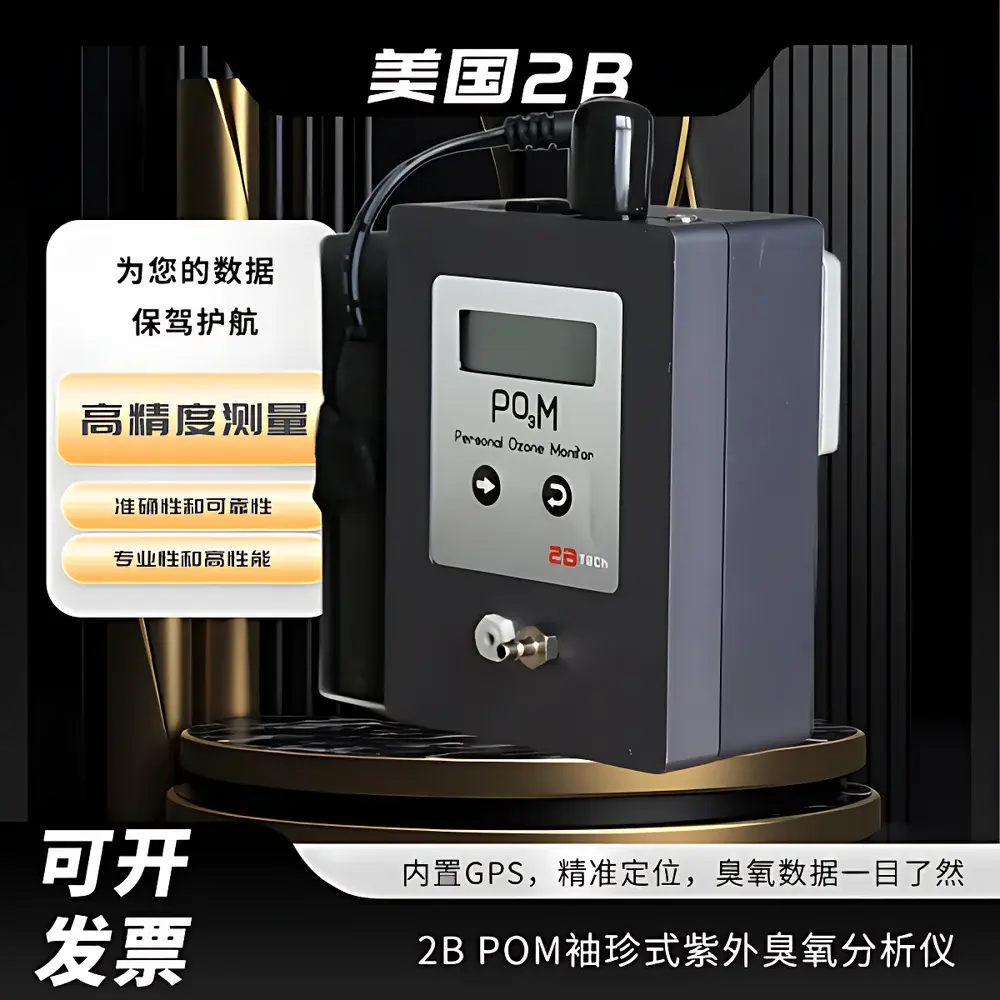
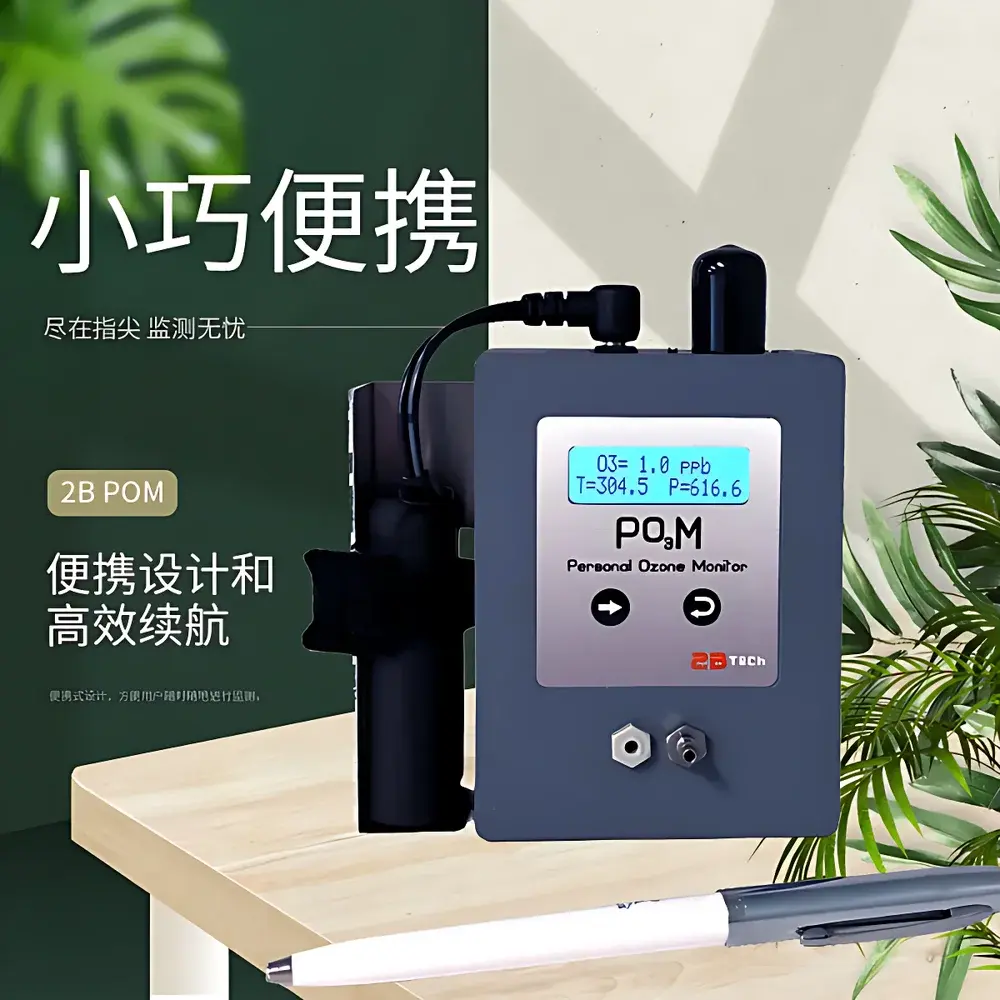
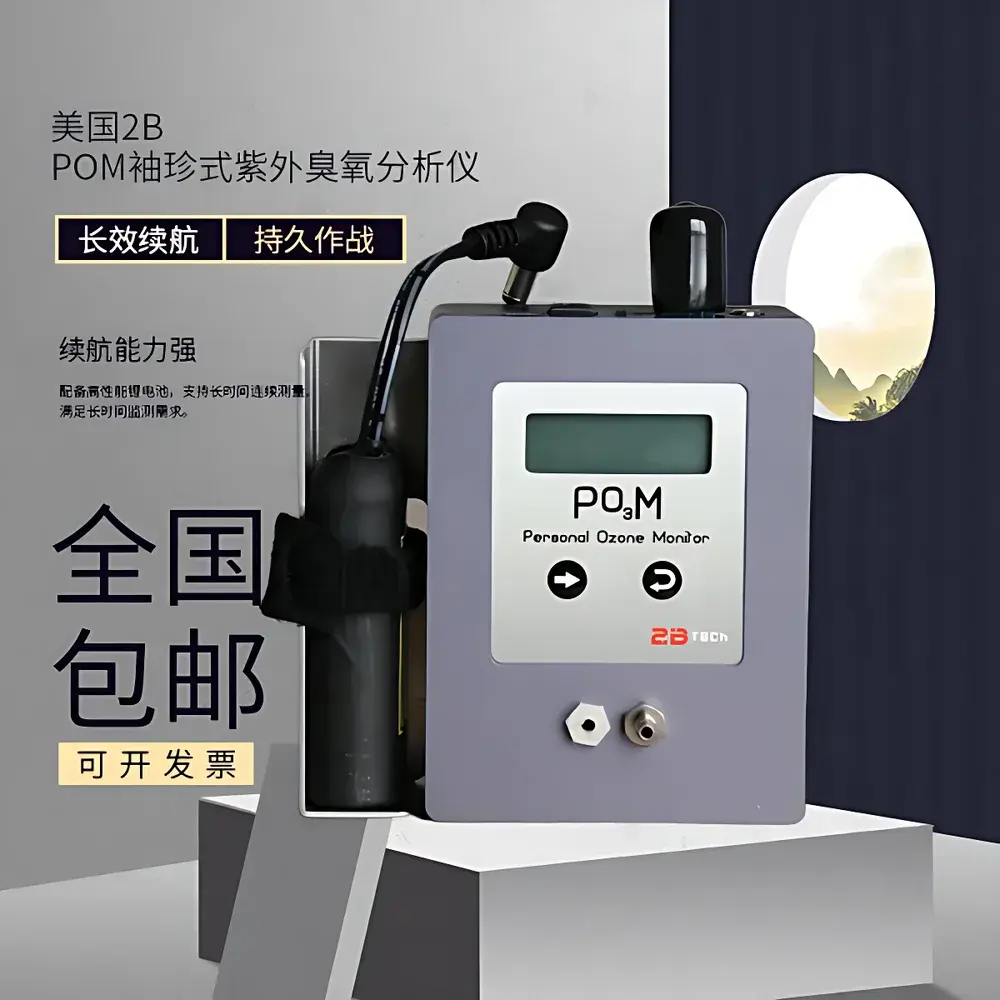
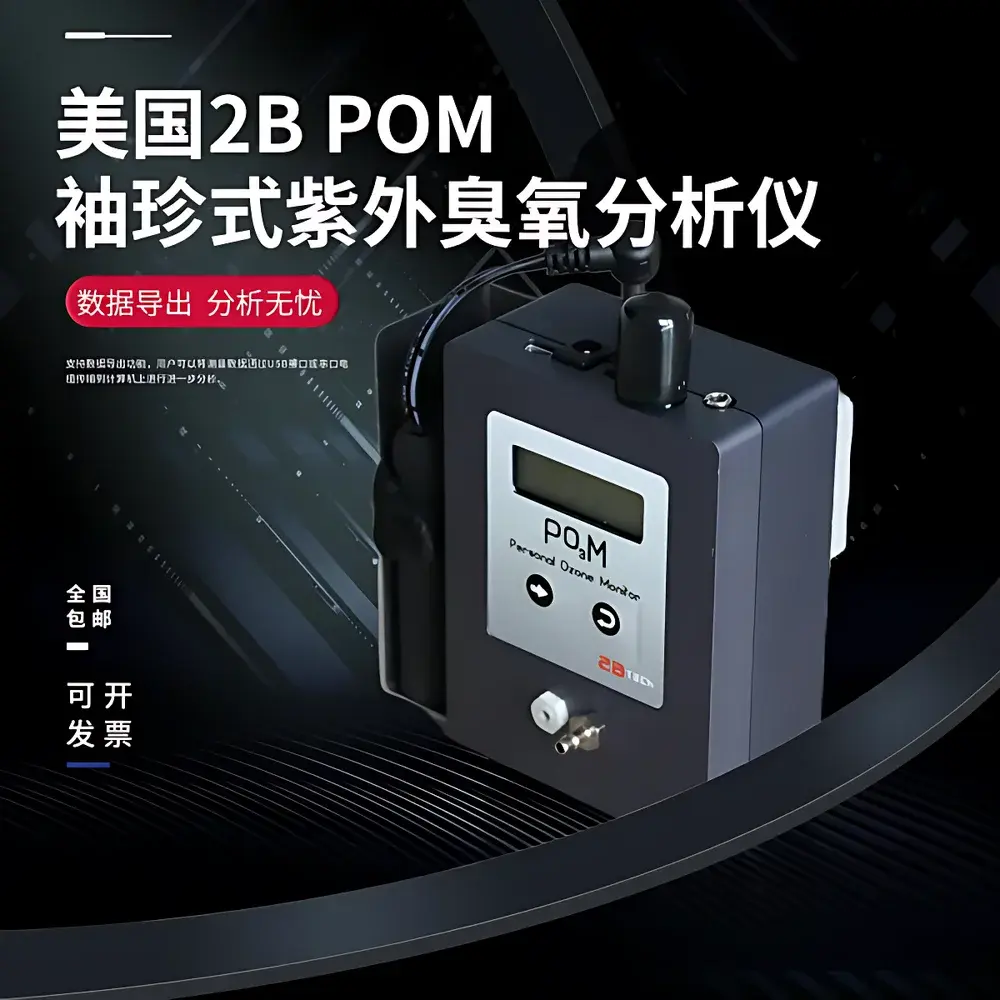
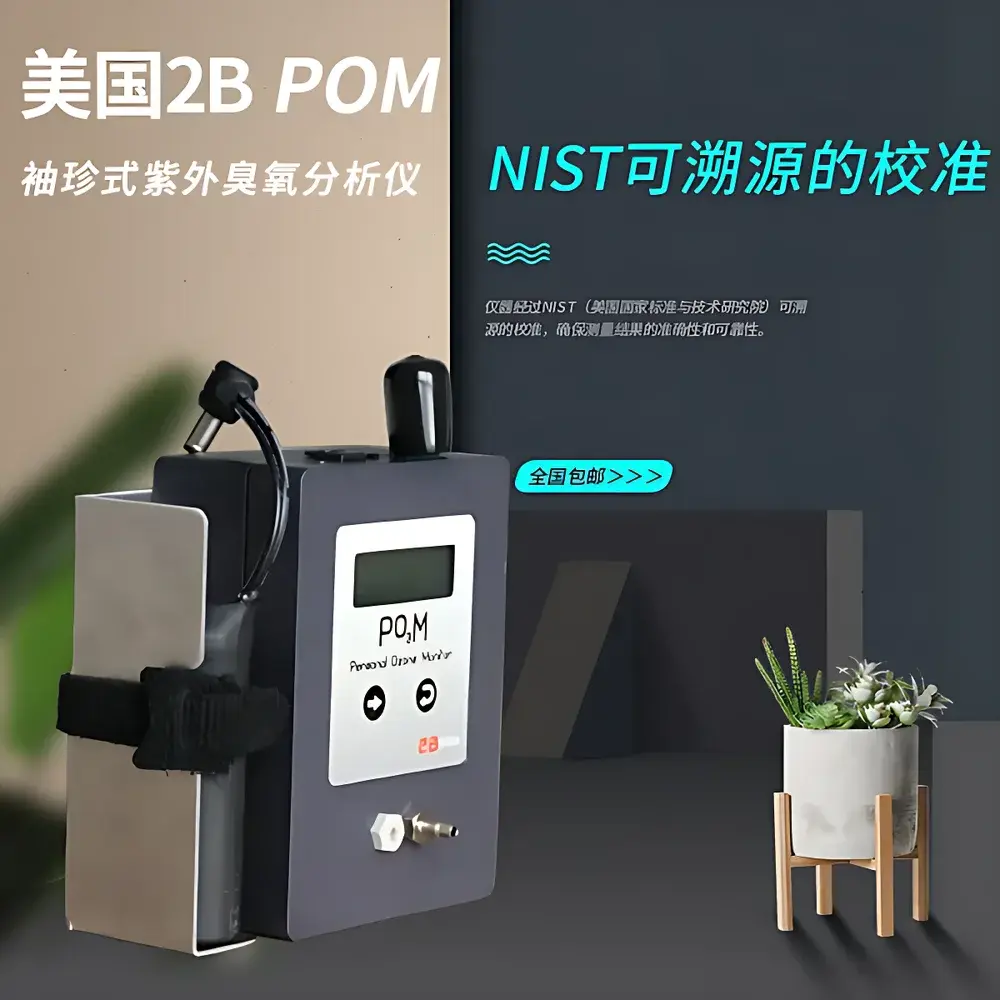
2B Tech POM Portable UV Absorption Ozone Analyzer with Integrated GPS
| Brand | 2B Tech |
|---|---|
| Origin | USA |
| Model | POM |
| Instrument Type | Portable |
| Measurement Range | 0–10 ppm |
| Limit of Detection | 4 ppb |
| Response Time | 10 s |
| Zero Drift | 1.5 ppb |
| Resolution | 1 ppb |
| Detection Principle | UV Absorption at 254 nm |
| EPA Federal Equivalent Method (FEM) | EQOA-0815-227 |
| NIST-Traceable Calibration | Yes |
| Operating Temperature | 0–50 °C |
| Pressure Range | 150–1013 mbar (≈0–13.5 km altitude) |
| Power | 7.4 V Li-ion battery (5–8 h), or 100–240 VAC adapter |
| Dimensions (with GPS) | 12.7 × 7.6 × 3.8 cm |
| Weight (with battery) | 450 g |
Overview
The 2B Tech POM (Portable Ozone Monitor) is a compact, field-deployable UV absorption ozone analyzer engineered for high-fidelity atmospheric ozone quantification in resource-constrained and mobile applications. It employs the well-established principle of ultraviolet photometry at 254 nm — the standard reference method for ozone measurement per U.S. EPA and ISO 13964 — leveraging Beer-Lambert law-based absorption spectroscopy in a folded “U-shaped” optical path. This design achieves an effective optical path length comparable to benchtop instruments (e.g., 2B Models 202 and 205), delivering laboratory-grade accuracy (~2 ppb uncertainty) in a package measuring just 12.7 × 7.6 × 3.8 cm and weighing 450 g with integrated GPS and battery. Certified as an EPA Federal Equivalent Method (FEM) device (EQOA-0815-227), the POM meets regulatory requirements for ambient air monitoring networks and research-grade exposure assessment.
Key Features
- UV absorption detection at 254 nm with NIST-traceable calibration and documented uncertainty budget
- Integrated high-sensitivity GPS module enabling synchronized geotagging of every ozone reading (latitude, longitude, altitude, UTC timestamp)
- Compact, ruggedized enclosure rated for outdoor operation from 0 to 50 °C and pressures down to 150 mbar (suitable for balloon-, drone-, or aircraft-based vertical profiling up to ~13.5 km)
- Low-power architecture supporting 5–8 hours of continuous operation on a rechargeable 7.4 V Li-ion battery; also compatible with AC/DC adapters and vehicle cigarette-lighter power sources
- Real-time data output via RS-232 serial interface (19200 baud) and USB; supports both fast-mode (2 s intervals) and standard averaging modes (10 s, 1 min, 5 min, 1 h)
- DewLine™ active humidity compensation system minimizes water vapor interference without consumables or purge gas
- Onboard memory stores up to 8,192 data points — sufficient for >30 days of 5-minute averaged measurements or >4 hours of 2-second rapid logging
Sample Compatibility & Compliance
The POM is designed for direct analysis of ambient air, stack effluents (when diluted and filtered), and indoor environments. It accepts sample flow rates of 0.5–1.2 L/min and includes a particulate filter and zero-air scrubber to prevent contamination and baseline drift. Its measurement traceability aligns with ISO/IEC 17025–accredited calibration practices. As an EPA FEM-certified instrument, it satisfies data quality objectives for regulatory monitoring under 40 CFR Part 58 and supports compliance reporting for state implementation plans (SIPs). The device incorporates temperature and pressure correction algorithms compliant with ASTM D5012 and US EPA guidance for high-altitude or variable-pressure deployments. All factory calibrations are documented with NIST-traceable certificates, including linearity verification across the full 0–10 ppm range and limit-of-detection validation per EPA Method IO-3.1.
Software & Data Management
Data acquisition and visualization are supported by 2B Tech’s free, cross-platform software suite — compatible with Windows, macOS, and Linux — which enables real-time plotting, time-series export (CSV, TXT), GPS track mapping, and batch processing of stored logs. The software implements audit-trail functionality for raw data files, preserving metadata such as firmware version, calibration date, GPS fix status, and sensor diagnostics. For integration into automated networks, the POM supports ASCII-based command protocols for remote configuration and scheduled data retrieval. While not natively 21 CFR Part 11 compliant, its data structure and timestamping integrity support GLP/GMP-aligned workflows when deployed with external electronic lab notebook (ELN) systems or validated LIMS interfaces.
Applications
- Personal exposure monitoring in epidemiological studies assessing ozone-related respiratory health outcomes
- Vertical ozone profiling using unmanned aerial systems (UAS/drones), tethered balloons, kites, and light aircraft
- Mobile ground-based monitoring campaigns (vehicle-mounted or backpack-operated)
- Remote or off-grid ambient monitoring stations powered by solar-charged batteries
- Urban air quality sensor networks requiring low SWaP-C (Size, Weight, Power, and Cost) nodes with spatial context
- Industrial hygiene assessments in facilities where ozone is generated (e.g., water treatment, semiconductor fabrication, laser labs)
- Educational fieldwork and undergraduate atmospheric science laboratories
FAQ
Is the POM suitable for regulatory compliance monitoring?
Yes — it is certified as an EPA Federal Equivalent Method (FEM) device (EQOA-0815-227), making it eligible for inclusion in state and local ambient air monitoring networks under 40 CFR Part 58.
Can the POM operate at high altitudes or low pressures?
Yes — its pressure-compensated algorithm functions reliably from 150 to 1013 mbar, corresponding to operational altitudes up to approximately 13.5 km; optional firmware configurations extend performance beyond this range.
Does the POM require zero/span gas cylinders or external calibration hardware?
No — it uses a stable mercury-vapor lamp and internal zero-air scrubber; factory calibration is NIST-traceable and remains valid for 12 months under normal use, with field verification possible using portable ozone generators or transfer standards.
How is GPS data synchronized with ozone measurements?
Each recorded ozone value is tagged with concurrent GPS coordinates, altitude, UTC time, and positional accuracy metrics — all embedded in the same data packet and preserved in exported files.
What is the typical maintenance interval for the POM?
Under standard ambient conditions, routine maintenance includes quarterly replacement of the particulate filter and annual inspection of the optical window; no lamp or detector replacement is required during the first five years of operation.







