
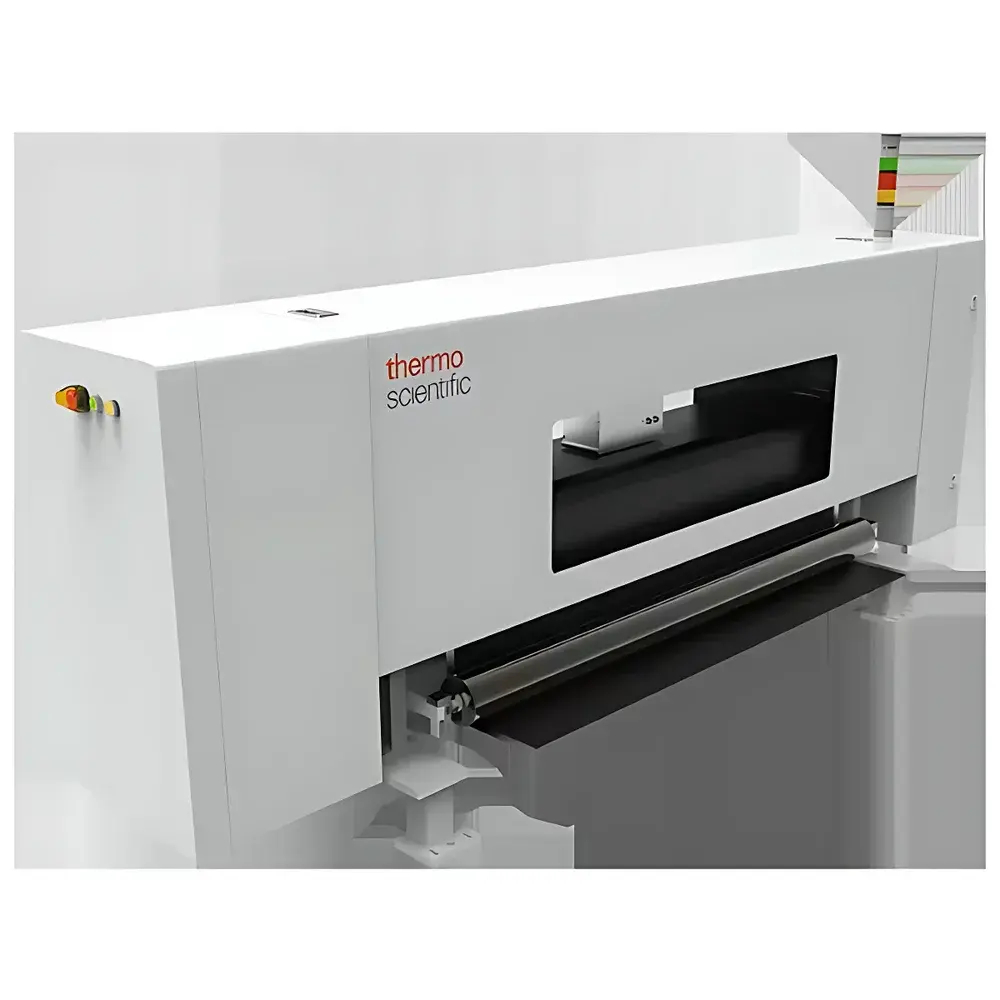
Thermo Scientific 21Plus-C Online X-ray Thickness Gauge
| Brand | Thermo Fisher |
|---|---|
| Origin | Shanghai, China |
| Manufacturer Type | Authorized Distributor |
| Product Origin | Domestic (China) |
| Model | 21Plus-C Online X-ray Thickness Gauge |
| Pricing | Available Upon Request |
Overview
The Thermo Scientific 21Plus-C Online X-ray Thickness Gauge is an industrial-grade, non-contact measurement system engineered for real-time, high-stability areal density and thickness monitoring of continuous web materials. It operates on the fundamental principle of monochromatic X-ray attenuation: when a collimated, single-energy X-ray beam traverses a material, its intensity decays exponentially in proportion to the material’s areal density (mass per unit area, g/m²). By precisely measuring the incident and transmitted X-ray intensities using a high-resolution solid-state detector, the system computes thickness or coating weight with traceable accuracy—without physical contact, mechanical wear, or process interruption. Designed specifically for roll-to-roll manufacturing environments—including polymer film extrusion, lithium-ion battery electrode calendering, metal foil rolling, and flexible packaging lamination—the 21Plus-C delivers sub-millisecond response time and long-term drift stability suitable for closed-loop process control and SPC-driven quality assurance.
Key Features
- Monochromatic X-ray source with digital power regulation for stable beam output and precise energy tuning—ensuring consistent measurement sensitivity across varying substrate compositions.
- High-resolution silicon drift detector (SDD) with low-noise electronics and temperature-compensated signal processing for improved signal-to-noise ratio and repeatability (RSD < 0.3% under controlled conditions).
- Modular scanning frame architecture supporting single- or multi-point measurement configurations; up to four independent scanning units can be synchronized and controlled from one central console.
- Industrial-grade human-machine interface (HMI) with intuitive touchscreen operation, real-time trend visualization, alarm thresholds, and configurable data logging intervals (10 ms to 5 s).
- Native support for PLC integration via EtherNet/IP and Modbus TCP protocols; preconfigured I/O mapping enables seamless linkage with Siemens, Rockwell, and Beckhoff controllers.
- Open architecture with OPC UA server and RESTful API endpoints—designed for direct MES/SCADA integration and compliant with ISA-95 Level 2–3 data exchange requirements.
Sample Compatibility & Compliance
The 21Plus-C accommodates a broad range of thin, homogeneous, or layered web materials including polyethylene (PE), polypropylene (PP), PET, aluminum foil, copper foil, graphite- or NMC-coated electrodes, and laminated composites. Measurement range spans 0.1–500 g/m² for areal density, corresponding to typical thickness ranges of 0.5 µm (Al foil) to 250 µm (cast polymer films), depending on material atomic number and density. The system conforms to IEC 61000-6-2/6-4 (EMC immunity/emission), meets GB/T 18801–2015 (Chinese radiation safety standard for industrial gauges), and is designed to comply with ALARA principles. Full radiation shielding (lead-lined housing, interlocked access doors, and dose rate ≤ 1 µSv/h at 5 cm) satisfies national regulatory requirements for Class II radiation devices in China. Optional third-party certification (e.g., TÜV SÜD functional safety assessment per IEC 61508 SIL2) is available upon request.
Software & Data Management
The embedded Thermo GaugeControl™ software provides comprehensive calibration management—including reference standard-based gain/offset correction, multi-point linearity verification, and drift compensation algorithms using internal reference channels. All measurement data—including raw counts, corrected thickness values, timestamps, and diagnostic flags—are stored in standardized SQLite databases with automatic daily archiving and configurable retention policies. Audit trail functionality records all user actions (login/logout, parameter changes, calibration events) with immutable timestamps—supporting GLP/GMP documentation requirements. Export options include CSV, XML, and PDF reports with embedded statistical summaries (X̄, R, Cpk). For enterprise deployment, optional Thermo DataHub™ module enables centralized configuration management, remote firmware updates, and role-based access control aligned with ISO/IEC 27001 information security practices.
Applications
- Lithium-ion battery manufacturing: Real-time monitoring of cathode/anode coating weight uniformity during slot-die coating and calendering—enabling immediate feedback to coater gap control and reducing scrap rates by up to 18% (based on customer validation studies).
- Plastic film production: Closed-loop thickness control in cast or blown film lines, compensating for die lip adjustments and melt temperature fluctuations.
- Flexible electronics: Quantitative verification of transparent conductive oxide (TCO) layer deposition consistency on PET substrates.
- Metal foil rolling: Detection of micro-thickness variations (< ±0.2 µm) across wide-width aluminum or copper strips at speeds up to 800 m/min.
- Pharmaceutical blister packaging: Verification of aluminum foil laminate integrity and PVC/PVDC layer thickness compliance per USP and ISO 15378 standards.
FAQ
Is the 21Plus-C certified for use in cleanroom environments?
Yes—optional ISO Class 5-compatible enclosures with HEPA-filtered purge air and static-dissipative housings are available for semiconductor and pharmaceutical applications.
Can it measure multi-layer structures?
It measures total areal density of the stack; layer-specific resolution requires dual-energy or spectral XRF configurations not supported by the base 21Plus-C model.
What radiation safety documentation is provided?
Each unit ships with a full Radiation Safety Report, shielding verification test records, and operator training materials compliant with GBZ 126–2011.
Does it support ASTM E1003 or ISO 3543 calibration protocols?
Yes—calibration procedures follow ASTM E1003 Annex A1 (for transmission gauges) and ISO 3543:2020 Clause 8.2, with traceability to NIM (National Institute of Metrology, China) certified reference foils.
How is firmware updated in a validated production environment?
Firmware updates are delivered as signed, version-controlled packages with SHA-256 checksums and require dual-operator authentication; update logs are appended to the system audit trail.



