
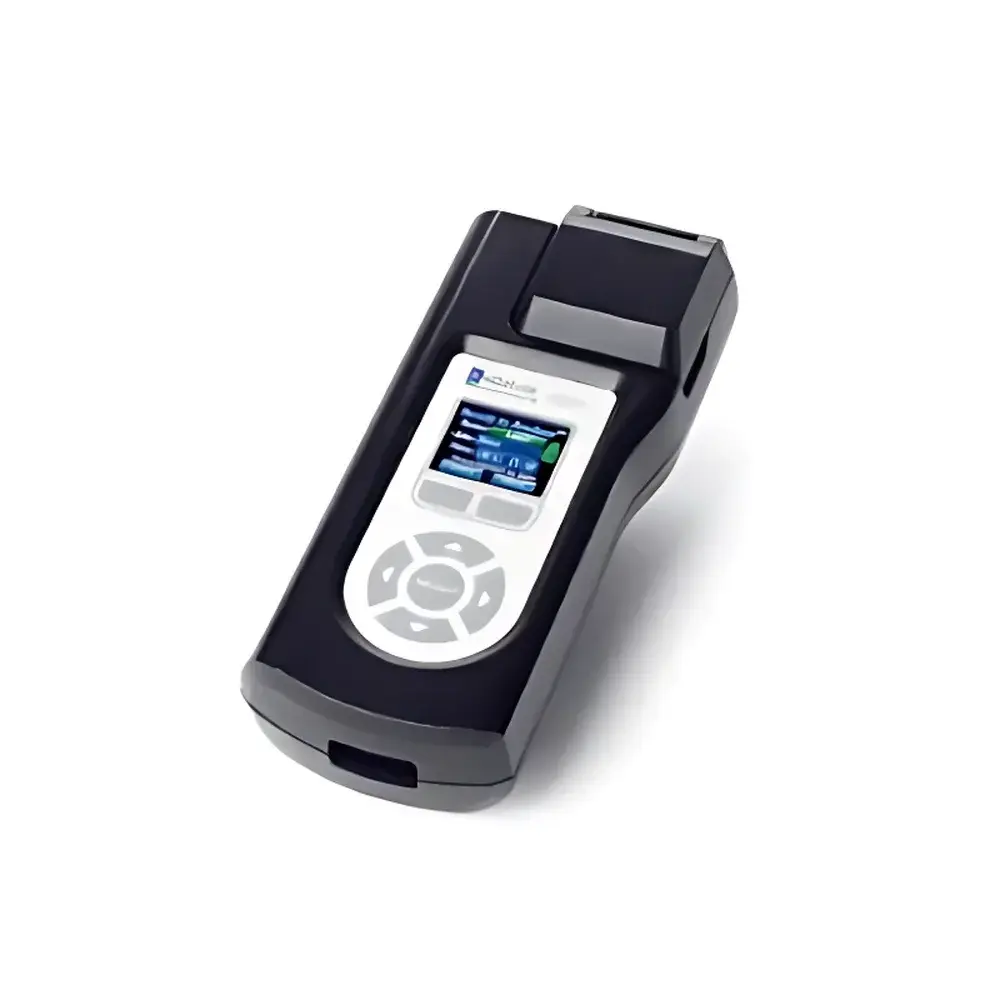
ANDalyze AND1100 Portable Heavy Metal Analyzer
| Brand | ANDalyze |
|---|---|
| Origin | USA |
| Model | AND1100 |
| Detection Principle | DNAzyme-based Fluorescence Assay |
| Measurement Time | ≤60 s per sample |
| Detection Units | ppb or ppm |
| IP Rating | IP54 |
| Certifications | CE |
| Data Interface | USB |
| Software Updates | Over-the-air via USB |
| Operating Languages | English, Chinese, and others |
| Power | Rechargeable battery (USB charging) |
| Sample Volume | 1 mL |
| Sensor Format | Discrete, color-coded single-use cartridges |
Overview
The ANDalyze AND1100 Portable Heavy Metal Analyzer is an EPA-recognized field-deployable instrument engineered for rapid, on-site quantification of soluble heavy metal ions in water matrices—including drinking water, surface water, groundwater, and industrial wastewater. It employs a proprietary DNAzyme (deoxyribozyme) biosensing platform: target metal ions (e.g., Pb²⁺, Cu²⁺, Hg²⁺) selectively activate sequence-specific DNAzymes immobilized on disposable sensor cartridges. This activation triggers a catalytic cleavage reaction that releases a fluorophore, generating fluorescence intensity directly proportional to analyte concentration. The integrated benchtop-grade fluorometer measures emitted signal at defined excitation/emission wavelengths and converts it into quantitative results—reported in ppb or ppm—with no reagent preparation, acid digestion, or laboratory infrastructure required. Designed for regulatory alignment, the method satisfies U.S. EPA Method 1631E (for mercury) and supports compliance with EPA’s Unregulated Contaminant Monitoring Rule (UCMR) and Safe Drinking Water Act (SDWA) screening protocols.
Key Features
- Field-ready operation: Fully functional without external power sources; rechargeable lithium-ion battery supports >50 tests per charge.
- Operator-agnostic interface: Intuitive touchscreen with one-touch assay initiation, real-time progress feedback, and contextual iconography—no chemistry training required.
- Multi-analyte modularity: Single instrument platform accommodates interchangeable, color-coded sensor cartridges (green for Pb²⁺, blue for Cu⁺/Cu²⁺, orange for UO₂²⁺, silver-gray for Hg²⁺, white for Zn²⁺, yellow for Cd²⁺), enabling targeted deployment across monitoring programs.
- Quantitative & semi-quantitative modes: Delivers calibrated concentration values (e.g., 2–100 ppb Pb²⁺) or binary pass/fail outputs (e.g., Hg²⁺ detection threshold: ≥2 ppb).
- Ruggedized design: IP54-rated enclosure resists dust ingress and water splashing; impact-resistant housing validated per MIL-STD-810G for field transport and outdoor use.
- Integrated metadata capture: Timestamps, GPS-derived location tags (via optional Bluetooth-enabled smartphone pairing), and operator ID are embedded in every result file.
Sample Compatibility & Compliance
The AND1100 accepts raw, unfiltered water samples up to 1 mL volume. Turbid or high-iron (>30 ppb Fe³⁺) samples require pre-treatment using the optional AND902 Iron Interference Shield Kit. pH adjustment (via AND903 kit) ensures optimal enzymatic activity across variable source waters (pH 5.0–8.5). All sensor cartridges are manufactured under ISO 13485-certified processes and qualified per ASTM D511-20 (Standard Test Methods for Total Solids in Water) and EPA SW-846 Method 6010D (ICP-AES) cross-validation protocols. Instrument firmware and data handling workflows support audit-ready documentation aligned with GLP and 21 CFR Part 11 requirements—including electronic signature capability, immutable result logs, and full revision history tracking.
Software & Data Management
Embedded firmware enables direct USB export of CSV-formatted reports containing concentration values, calibration status, sensor lot numbers, environmental conditions (ambient temperature, humidity), and QC flags. The free ANDalyze Connect desktop application (Windows/macOS) provides batch analysis, trend visualization, map-based spatial overlays, and automated report generation compliant with EPA Form 3320-1. Firmware updates are delivered via signed USB packages with SHA-256 integrity verification. On-device video tutorials (accessible without internet connectivity) guide users through sensor loading, calibration verification, outlier troubleshooting, and routine maintenance—eliminating dependency on printed manuals.
Applications
- Drinking water utilities: Rapid verification of lead service line replacement effectiveness and post-flushing compliance.
- Environmental consulting firms: Real-time screening at Superfund sites, brownfields, and mining-impacted watersheds.
- Industrial pretreatment monitoring: Instant verification of effluent discharge limits for electroplating, semiconductor fabrication, and battery manufacturing facilities.
- Emergency response: First-responder triage during chemical spills or natural disasters affecting municipal supply intakes.
- Academic research: Field validation of passive sampling devices and low-cost sensor networks.
- Regulatory enforcement: EPA Region-level mobile labs conducting unannounced inspections under the Clean Water Act Section 308.
FAQ
What regulatory methods does the AND1100 validate against?
The Pb²⁺, Hg²⁺, and UO₂²⁺ assays are independently verified per EPA Method 1631E, 200.8, and ASTM D5673-17. Full validation reports are available under NDA upon request.
Can the AND1100 measure total metals or only dissolved fractions?
It quantifies bioavailable, filterable (0.45 µm) metal species only. For total recoverable metals, EPA-compliant acid digestion (e.g., Method 200.2) must precede analysis.
How often does the instrument require recalibration?
Factory calibration remains stable for 12 months; field verification using certified reference standards (e.g., NIST SRM 1643e) is recommended before each sampling campaign.
Is GPS geotagging mandatory for data export?
No—location metadata is optional. When disabled, timestamps and operator IDs remain embedded in all exported files.
Are sensor cartridges reusable?
No. Each cartridge is a single-use, sterile, pre-validated consumable designed to eliminate carryover risk and ensure inter-lot reproducibility (CV <8% across 25 replicates).







