
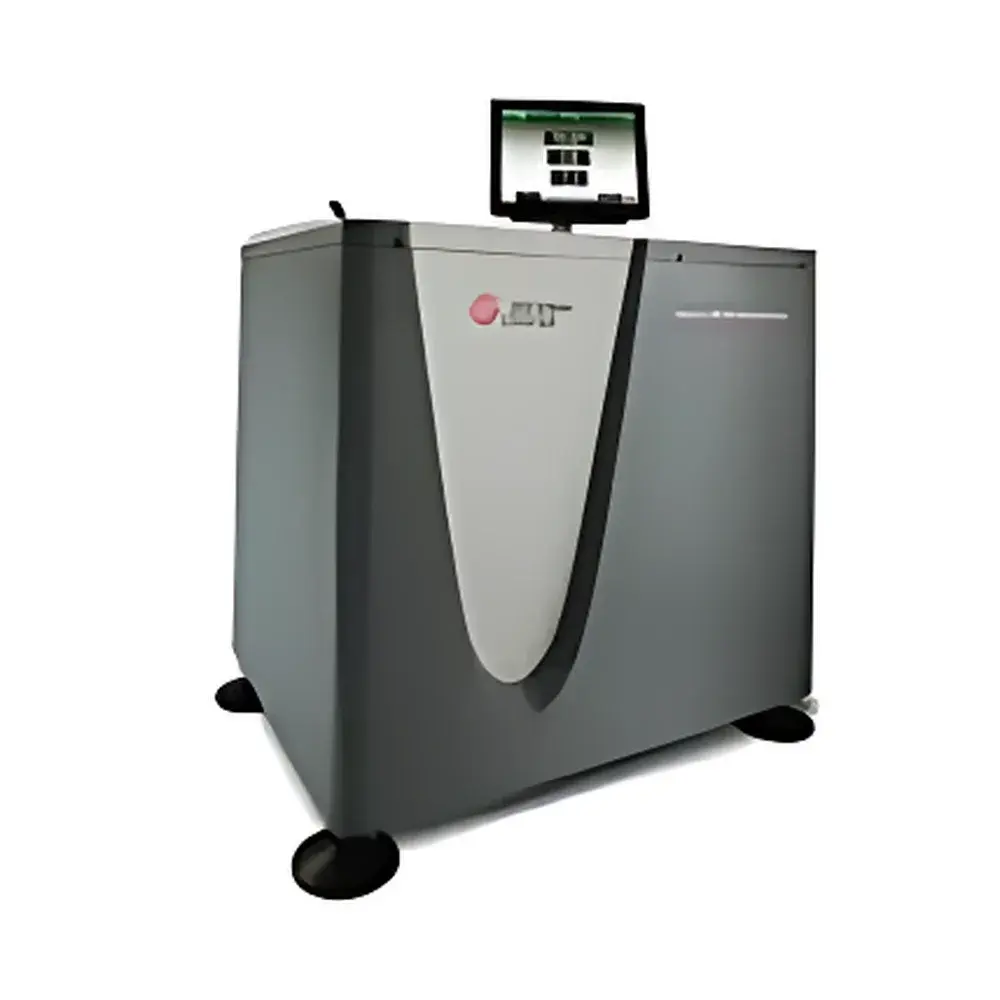
Beckman Coulter Optima XE Ultracentrifuge
| Brand | Beckman Coulter |
|---|---|
| Origin | USA |
| Instrument Type | Floor-standing Ultracentrifuge |
| Speed Range | Up to 100,000 rpm |
| Max RCF | 802,000 × g |
| Max Capacity | 6 × 85 mL |
| Drive System | Refrigerated Brushless Induction Motor |
| Temperature Control | 0–40 °C (±0.5 °C) |
| Power Supply | 180–264 VAC, 50/60 Hz |
| Dimensions (W×D×H) | 94 × 68.1 × 125.7 cm |
| Acoustic Noise Level | <51 dBA |
| Standby Power Consumption | <60 W |
| Compliance | ISO 13485, IEC 61010-1, FDA 21 CFR Part 11 (software-enabled audit trail), GLP/GMP-ready configuration options |
Overview
The Beckman Coulter Optima XE Ultracentrifuge is an engineered platform for high-resolution macromolecular and subcellular separation, designed for laboratories requiring reproducible, high-g centrifugation under precise thermal and rotational control. Operating on the principle of sedimentation velocity and equilibrium ultracentrifugation, the Optima XE delivers exceptional rotor stability and dynamic load compensation at speeds up to 100,000 rpm—enabling isolation of ribosomes, viral particles, lipoprotein fractions, exosomes, and organelles such as mitochondria and lysosomes. Its refrigerated brushless induction motor ensures minimal thermal drift and mechanical vibration, while the integrated vacuum system reduces air resistance and enables rapid acceleration/deceleration profiles with high kinetic fidelity. Unlike conventional high-speed centrifuges, the Optima XE meets the rigorous mechanical and safety standards required for continuous operation in regulated environments—including clinical research labs, biopharmaceutical QC facilities, and structural biology core facilities.
Key Features
- Intuitive 15-inch capacitive touchscreen interface with graphical workflow navigation—supporting both zone and continuous-flow operation modes via flowchart-based protocol visualization.
- Regenerative braking system recaptures kinetic energy during deceleration, reducing net power consumption by up to 33% versus legacy ultracentrifuges; standby draw remains below 60 W.
- Integrated voltage auto-sensing circuitry (180–264 VAC) eliminates manual input selection and prevents operational failure due to line fluctuations—critical for multi-site or mobile lab deployments.
- Acoustically optimized drive assembly and finned heat sink architecture suppress resonance frequencies, achieving <51 dBA noise emission at 1 m distance—compatible with open-plan laboratory layouts.
- Multi-tier biosafety architecture includes rotor imbalance detection, lid interlock verification, real-time temperature monitoring, and automatic vacuum integrity validation prior to run initiation.
- Comprehensive rotor management system tracks cumulative run hours, maximum speed history, and thermal cycling exposure per rotor—enabling predictive maintenance and compliance with ISO 13485 traceability requirements.
Sample Compatibility & Compliance
The Optima XE supports a full suite of Beckman Coulter-certified rotors—including Type 70 Ti, Type 90 Ti, and SW 60 Ti swinging-bucket rotors—as well as fixed-angle rotors (e.g., Type 70.1 Ti, Type 50.2 Ti) compatible with standard ultracentrifuge tubes (2–85 mL). It accommodates both polycarbonate and polyallomer tube materials, with validated performance across density gradient media including sucrose, glycerol, iodixanol, and cesium chloride. All rotor-tube combinations undergo ASTM F2119-compliant mechanical stress testing and are certified for use in GLP and GMP environments. The instrument’s firmware and optional software modules comply with FDA 21 CFR Part 11 for electronic records and signatures, supporting full audit trails, user-level access control, and data integrity assurance.
Software & Data Management
Instrument control and method development are managed through Beckman Coulter’s Avanti™ Software Suite (v4.2+), which provides secure, role-based access, encrypted data storage, and export capabilities compliant with LIMS and ELN integration standards (CSV, XML, PDF/A-2). Method templates include pre-validated protocols for exosome isolation (based on MISEV2018 guidelines), lipoprotein subfractionation (following ATP III criteria), and nucleic acid purification workflows. Raw run logs—comprising real-time RCF, temperature, vacuum pressure, and rotor status—are timestamped and digitally signed. Optional cloud synchronization enables remote monitoring and cross-site protocol harmonization without compromising local data sovereignty.
Applications
- Isolation and characterization of extracellular vesicles (EVs) and exosomes from plasma, serum, and cell culture supernatants.
- Preparative separation of lipoprotein classes (HDL, LDL, VLDL) for cardiovascular biomarker studies.
- Sedimentation velocity analysis of protein complexes and virus-like particles using interference optics-compatible cells.
- Subcellular fractionation of mammalian and bacterial lysates—including nuclei, mitochondria, microsomes, and inclusion bodies.
- Continuous-flow purification of therapeutic proteins and mRNA-LNP formulations under cGMP-aligned process parameters.
- Quality control of AAV vectors and lentiviral preparations in gene therapy manufacturing environments.
FAQ
What rotor types are certified for use with the Optima XE?
Beckman Coulter certifies all titanium and carbon-fiber rotors listed in the Optima XE rotor catalog—including fixed-angle, swinging-bucket, and vertical rotors—provided they are operated within published speed, capacity, and temperature limits.
Does the Optima XE support continuous-flow centrifugation?
Yes—when equipped with the appropriate continuous-flow rotor (e.g., CF-34 Ti) and flow control module, the Optima XE enables scalable, steady-state separation of large-volume samples (up to 2 L/hour) with minimal shear-induced aggregation.
How is data integrity ensured during long-duration runs?
All run metadata—including rotor ID, speed profile, temperature setpoint, vacuum status, and error logs—are written to non-volatile memory at 1-second intervals and cryptographically signed upon completion, satisfying ALCOA+ principles for regulatory submissions.
Can the Optima XE be integrated into automated laboratory workflows?
Yes—the instrument features Ethernet/IP and RS-232 interfaces with SCPI command support, enabling bidirectional communication with robotic liquid handlers, sample tracking systems, and central LIMS platforms.
What maintenance intervals are recommended for routine operation?
Daily visual inspection of rotor seating and vacuum seals; quarterly calibration of temperature and speed sensors by authorized service engineers; annual full mechanical audit including bearing assessment and vacuum pump oil replacement.



