
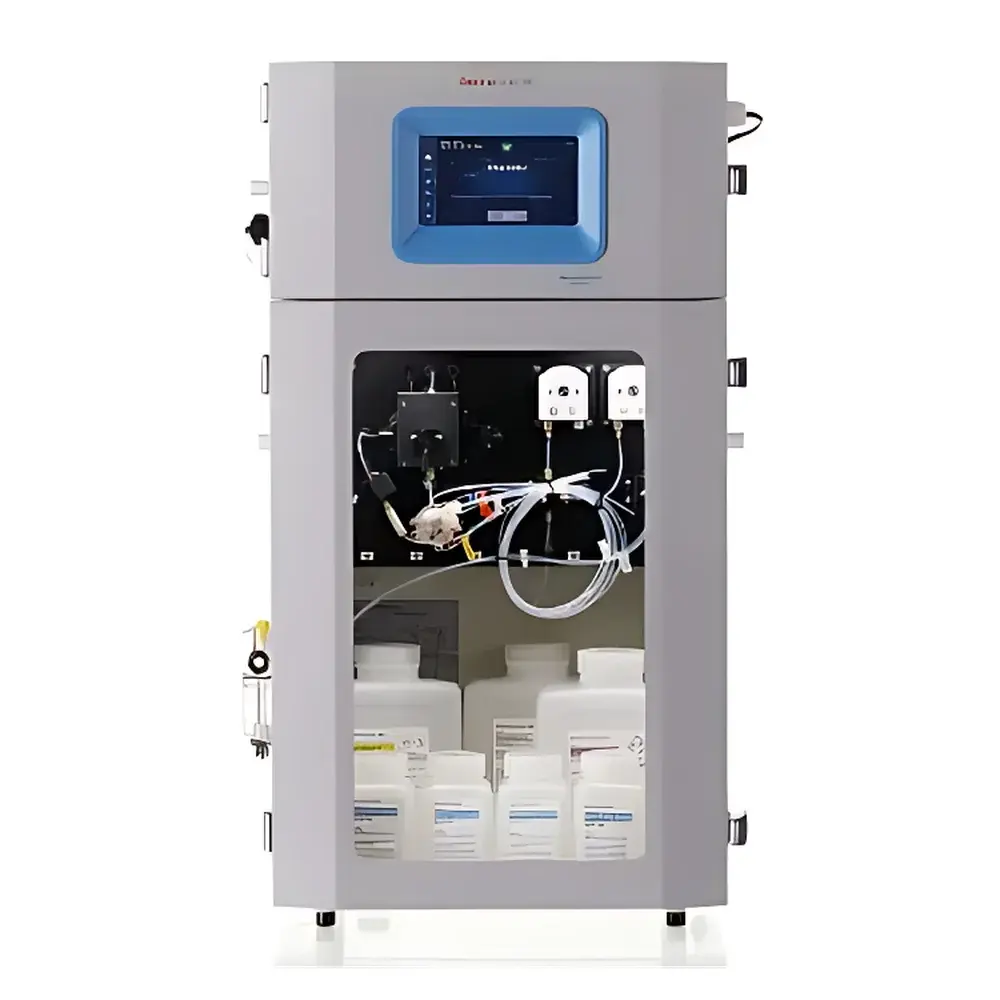
Thermo Scientific Orion 8030cX Online Silica Analyzer
| Brand | Thermo Scientific |
|---|---|
| Origin | USA |
| Manufacturer Type | Manufacturer |
| Origin Category | Imported |
| Model | Orion 8030cX |
| Price | Upon Request |
Overview
The Thermo Scientific™ Orion™ 8030cX Online Silica Analyzer is a fully automated, benchtop-integrated process analyzer engineered for continuous, real-time quantification of reactive (dissolved) silica in ultrapure and industrial water streams. It operates on the principle of molybdenum blue colorimetry — a well-established, ASTM-standardized method (ASTM D859, D4195) for silica determination — where soluble silicate reacts with molybdic acid under controlled acidic conditions to form a heteropoly blue complex, whose absorbance at 650–820 nm is directly proportional to silica concentration. Unlike offline lab-based methods requiring manual sample preparation and lengthy digestion steps, the 8030cX integrates sample conditioning, reagent metering, reaction timing, photometric detection, and waste segregation into a single compact platform. Its design targets critical water quality control points in high-reliability environments where silica deposition poses irreversible risk to thermal efficiency and mechanical integrity — particularly in steam generation cycles, semiconductor rinse loops, and pharmaceutical water-for-injection (WFI) distribution systems.
Key Features
- Patented liquid handling architecture minimizes phosphate interference — a known spectral confounder in conventional silica assays — enabling accurate measurement even in phosphate-dosed boiler feedwater.
- Detection limit of 0.5 ppb (µg/L) with analytical accuracy ≤1 ppb or ±1% (whichever is greater) across the 0–500 ppb dynamic range, validated per ISO/IEC 17025-compliant calibration protocols.
- Extended unattended operation: up to 100 days on a single 2 L reagent cartridge at 15-minute measurement intervals, reducing maintenance frequency and operator dependency.
- Low reagent consumption: only 200 µL per analysis, lowering consumables cost and minimizing hazardous chemical inventory.
- Segregated chemical waste collection system — separates acidic reaction waste from neutral rinse effluent — simplifying regulatory compliance and reducing disposal fees.
- IP65-rated enclosure ensures operational reliability in humid, chemically aggressive plant environments including turbine halls and utility corridors.
- Integrated self-diagnostic suite with predictive alarm logic, onboard troubleshooting guidance, and configurable notification thresholds via relay outputs or Modbus TCP.
Sample Compatibility & Compliance
The Orion 8030cX accepts filtered, particle-free aqueous samples within pH 4.5–9.5 and temperature range 5–45 °C. It is compatible with common pretreatment configurations including side-stream filtration (≤5 µm), deaeration modules, and temperature stabilization loops. The analyzer meets IEC 61326-1 (EMC for industrial environments), UL 61010-1, and carries CE marking. Its measurement methodology aligns with key industry standards: ASTM D859 (silica in water), ASTM D4195 (online silica monitoring), USP (silica in purified water), and EP 2.2.37. Data integrity features support 21 CFR Part 11 compliance when deployed with validated Thermo Scientific SampleManager LIMS integration or third-party SCADA systems featuring audit trail and electronic signature capabilities.
Software & Data Management
The analyzer features an embedded 7-inch capacitive color touchscreen running Thermo Scientific’s proprietary firmware v4.x, supporting intuitive navigation, multi-level user access (operator, supervisor, engineer), and context-sensitive help. All calibration events, validation checks, and diagnostic logs are time-stamped and stored locally with 12-month retention. Data export options include analog 4–20 mA output, RS-485/Modbus RTU, Ethernet/IP, and OPC UA. Optional cloud connectivity enables remote monitoring via Thermo Fisher Connect platform, with encrypted TLS 1.2 transmission and role-based dashboard access. Full audit trail functionality records all parameter changes, manual interventions, and alarm acknowledgments — essential for GLP/GMP-regulated facilities undergoing FDA or EMA inspection.
Applications
- Power generation: Continuous monitoring of boiler feedwater, condensate polishers, and steam cycle makeup to prevent silica scaling on turbine blades and heat exchanger tubes.
- Semiconductor manufacturing: Real-time verification of silica levels in UPW distribution networks (Type I, ASTM D5127) to avoid wafer surface defects during wet etching and cleaning.
- Pharmaceutical production: Compliance with pharmacopoeial limits for silica in purified water (PW) and water-for-injection (WFI) per USP/EP monographs.
- Chemical & petrochemical plants: Early detection of ion exchange resin exhaustion or reverse osmosis membrane degradation through trending of breakthrough silica concentrations.
- Pulp and paper mills: Optimization of caustic recovery boiler feedwater quality to mitigate refractory silica fouling in recovery furnaces.
FAQ
What silica species does the Orion 8030cX measure?
It quantifies reactive (monomeric, dissolved) silica — Si(OH)₄ — which is the primary contributor to deposition in high-temperature systems. It does not detect colloidal or polymeric silica without prior acid hydrolysis.
Can the analyzer be integrated into existing DCS or PLC systems?
Yes — it supports native Modbus TCP, Modbus RTU, and HART 7 communication protocols, with preconfigured function blocks available for Siemens PCS7, Emerson DeltaV, and Honeywell Experion DCS platforms.
Is routine calibration required, and how often?
A two-point calibration (zero and span) is recommended every 7 days; however, the system performs automatic calibration verification using traceable standard solutions before each measurement cycle, with deviation alerts triggered if drift exceeds ±5% of full scale.
Does the analyzer require daily operator intervention?
No — once commissioned and loaded with reagents, it operates autonomously for up to 100 days. Scheduled maintenance includes quarterly optical path cleaning and annual photometer verification.
How is reagent stability ensured over extended deployment?
Reagents are supplied in nitrogen-purged, light-blocking cartridges with integrated humidity indicators; shelf life is 12 months unopened and 90 days after first use under ambient storage conditions (15–30 °C).





