
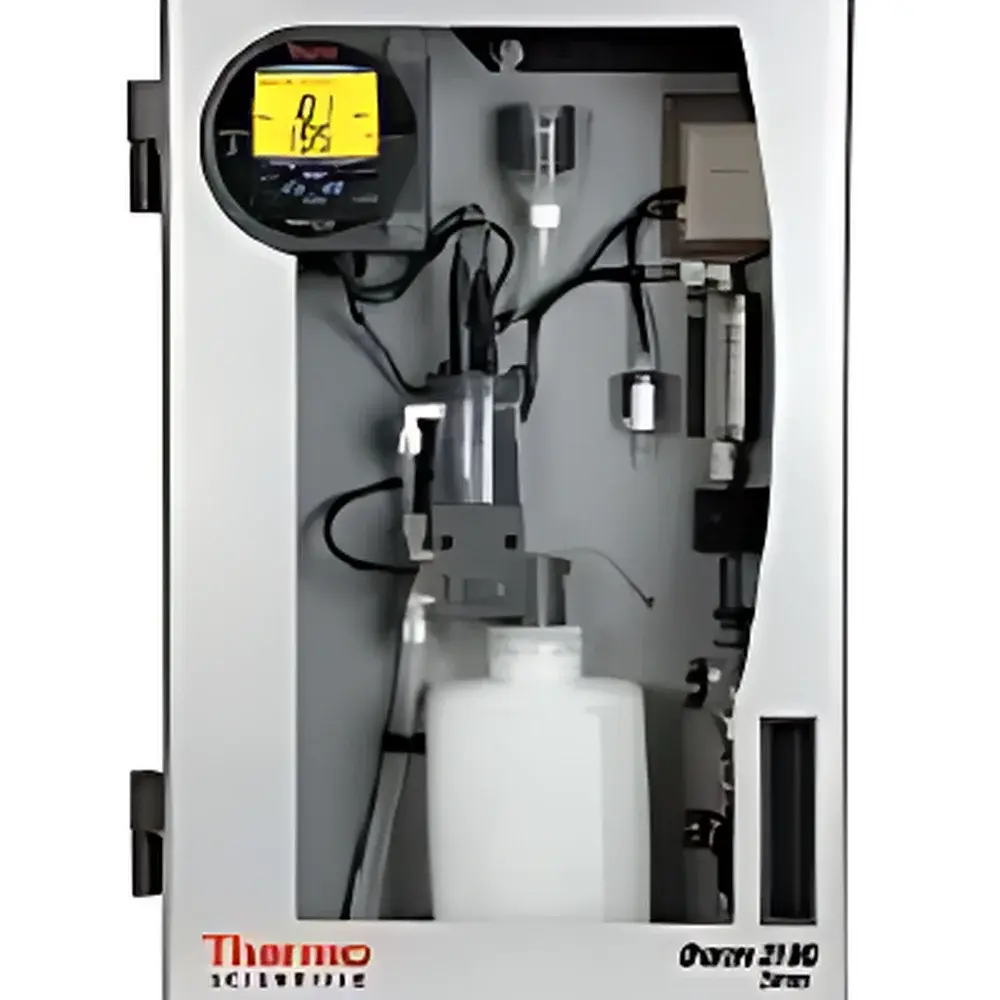
Thermo Scientific 2117XP Chlorine Analyzer
| Brand | Thermo Fisher |
|---|---|
| Origin | USA |
| Model | Thermo Scientific 2117XP |
| Detection Limit | 0.1 ppm Cl⁻ |
| Measurement Principle | Potentiometric with Chloride-Selective Electrode (CSE) |
| Display | Backlit LCD |
| Calibration Method | DKA (Two-Point Known Addition) |
| Optional Channels | pH or Conductivity |
| Communication | Digital Module Support (RS-485/Modbus RTU) |
| Compliance | Designed for continuous online water quality monitoring in industrial process and utility applications |
Overview
The Thermo Scientific 2117XP Chlorine Analyzer is a robust, potentiometric online analyzer engineered for continuous, low-range chloride ion (Cl⁻) monitoring in critical water streams. It employs a high-selectivity chloride ion-selective electrode (ISE) operating on the Nernst principle, delivering stable, drift-resistant measurements across a dynamic range from 0.1 ppm to 1000 ppm Cl⁻. Unlike amperometric or colorimetric chlorine analyzers—designed for free/total residual chlorine—the 2117XP is specifically optimized for dissolved chloride quantification, making it essential for corrosion control, boiler feedwater purity assurance, and ultrapure water (UPW) system integrity monitoring. Its solid-state sensor architecture eliminates reagent consumption, moving parts, and optical path dependencies, resulting in exceptional long-term stability and minimal intervention requirements in demanding industrial environments.
Key Features
- Potentiometric detection with a factory-calibrated, low-drift chloride-selective electrode ensuring reproducible sub-ppm resolution
- 0.1 ppm detection limit—validated per ASTM D511 and ISO 9297 methodologies for trace chloride in high-purity water
- Integrated pH adjustment capability via optional acid dosing module to maintain sample pH between 5.0–8.5, minimizing interference from hydroxide, bromide, and sulfate ions
- DKA (Dual Known Addition) calibration protocol compliant with USP and EP 2.2.38 guidelines—enabling rapid, two-point field calibration without primary standards
- Backlit monochrome LCD interface with intuitive navigation menus supporting real-time diagnostics, calibration history, and sensor health status
- Modular expansion architecture: supports optional second measurement channel for concurrent pH or conductivity monitoring (model-dependent configuration)
- Digital communication-ready: RS-485 interface with Modbus RTU protocol for seamless integration into SCADA, DCS, or PLC-based plant automation systems
- No pumps, no reagents, no waste lines—reducing total cost of ownership and eliminating consumable-driven downtime
Sample Compatibility & Compliance
The 2117XP is validated for use with low-conductivity, low-TDS aqueous samples typical of boiler feedwater, condensate return loops, semiconductor rinse water, and power plant demineralized water. It meets mechanical and environmental specifications per IEC 61000-6-2 (EMC immunity) and IP65-rated enclosure protection. While not a regulatory compliance device per se, its measurement methodology aligns with ASTM D4192 (Standard Test Method for Chloride Ion in Water by Ion-Selective Electrode), ISO 10304-1 (Water Quality — Determination of Dissolved Anions by Liquid Chromatography), and supports GLP/GMP data integrity requirements when paired with Thermo Scientific Orion Star™ Connect software for audit-trail-enabled data logging.
Software & Data Management
The analyzer operates autonomously but integrates with Thermo Fisher’s Orion Star Connect platform for remote configuration, trend visualization, and alarm management. All calibration events, sensor diagnostics, and measurement logs are timestamped and stored onboard with non-volatile memory retention (>30 days at 1-min intervals). When connected to a networked host system, the 2117XP supports FDA 21 CFR Part 11-compliant electronic records—including user authentication, operation logging, and digital signature capability—when deployed within regulated pharmaceutical or biotech water systems.
Applications
- Boiler feedwater chloride monitoring to prevent stress corrosion cracking (SCC) in high-pressure steam cycles (ASME B31.1 / RP-19)
- Condensate polishing loop surveillance in fossil and nuclear power generation facilities
- Ultrapure water (UPW) distribution monitoring for semiconductor fab tool supply lines (SEMI F63)
- Process water quality control in pulp & paper mill white water circuits
- Makeup water chloride screening in closed-loop cooling systems across petrochemical and refinery operations
FAQ
What is the recommended sample flow rate and pressure for optimal performance?
Optimal operation requires a laminar, bubble-free flow of 50–150 mL/min at ≤30 psi inlet pressure; a flow restrictor and air eliminator are recommended upstream.
Can the 2117XP measure chloride in seawater or brackish water?
No—its design and electrode calibration are optimized for low-concentration (<100 ppm) applications; high ionic strength matrices cause significant junction potential errors and require alternative methods (e.g., IC or titration).
Is temperature compensation automatic?
Yes—the integrated Pt1000 RTD sensor enables real-time, NIST-traceable temperature compensation per the extended Debye-Hückel equation.
How often does the chloride electrode require replacement?
Under typical industrial conditions, electrode service life exceeds 12 months; performance degradation is tracked via built-in impedance diagnostics and slope validation during calibration.
Does the analyzer support analog output for hardwired PLC integration?
Yes—standard 4–20 mA isolated output with HART 7.5 protocol is available as an optional hardware module.







