
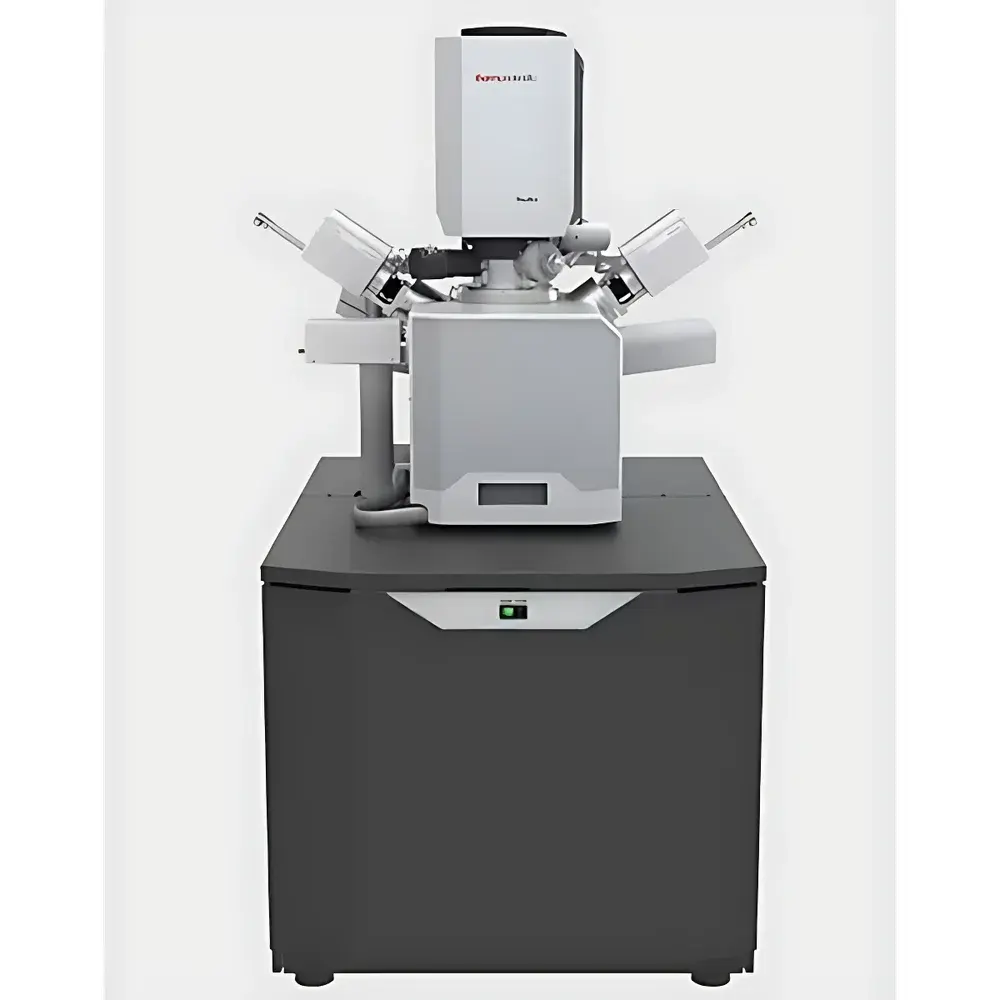
Thermo Scientific Quattro ESEM Environmental Field Emission Scanning Electron Microscope
| Brand | Thermo Fisher Scientific |
|---|---|
| Origin | Shanghai, China |
| Model | Quattro ESEM |
| Vacuum Modes | High Vacuum / Low Vacuum / Environmental SEM (ESEM) |
| Resolution | 0.8 nm @ 30 kV (STEM), 1.0 nm @ 30 kV (SE), 3.0 nm @ 1 kV (SE), 1.3 nm @ 30 kV (ESEM/low vacuum) |
| Stage | 5-axis motorized eucentric stage, 105° tilt, 110 × 110 mm² travel |
| Chamber | 340 mm internal width, 12 ports, supports up to three EDS detectors (180° symmetric), co-planar EBSD interface, WDS port |
| Optional In-situ Accessories | -165°C to 1400°C heating/cooling stages, GIS for EBID (Pt, W, C), Peltier stage (-20°C to +60°C), liquid nitrogen cryo-stage, nanomanipulator, multi-probe station |
| Detectors | ETD, LVD, GSED, IR-CCD, Nav-Cam+, DBS, STEM 3+, WetSTEM, RGB-CLD, EDS, EBSD, WDS, Raman, EBIC |
| Software | AutoScript 4 (Python API), Maps, TopoMaps, ChemiSEM (real-time EDS quantification, point/line/map analysis) |
Overview
The Thermo Scientific Quattro ESEM is an environmental field emission scanning electron microscope engineered for high-resolution imaging and quantitative microanalysis of specimens in their native, uncoated, and often hydrated or insulating states. Unlike conventional high-vacuum SEMs, the Quattro leverages the principles of Environmental SEM (ESEM)—where a controlled gaseous environment (e.g., water vapor, nitrogen, or CO₂) is maintained in the specimen chamber—to enable charge dissipation from non-conductive or beam-sensitive samples without metal coating. This capability is grounded in the physics of gaseous secondary electron detection: ionization of the gas by the primary electron beam generates signal-amplifying ions and electrons, which are collected via a gaseous secondary electron detector (GSED). Combined with a cold-field emission gun (CFEG), the Quattro delivers sub-nanometer resolution in high vacuum mode (0.8 nm at 30 kV in STEM configuration) while retaining analytical fidelity across all operational regimes—including low vacuum (up to 2600 Pa H₂O) and full ESEM conditions.
Key Features
- Triple-mode vacuum architecture: Seamlessly switch between high vacuum (for ultimate resolution and EBSD/WDS compatibility), low vacuum (for rapid, charge-free imaging of polymers and biological tissues), and ESEM (for dynamic observation of wet, volatile, or reactive specimens under controlled partial pressure).
- High-performance field emission source: Cold-FEG provides exceptional brightness and long-term stability, enabling high-current imaging at low kV (<1 kV) with 3.0 nm resolution—critical for surface-sensitive characterization of delicate coatings and thin films.
- Optimized analytical chamber design: 340 mm internal chamber width accommodates up to three EDS detectors arranged in a symmetric 180° geometry, ensuring high solid-angle collection and minimized shadowing. The EBSD detector port is co-planar with EDS, enabling simultaneous crystallographic and compositional mapping without realignment.
- Advanced in-situ capabilities: Motorized 5-axis eucentric stage (105° tilt, 110 × 110 mm² travel) supports precise angular navigation and tomographic acquisition. Integrated gas injection systems (GIS) enable electron-beam-induced deposition (EBID) of Pt, W, or C for nanofabrication or fiducial marking.
- Innovative detection modalities: RGB cathodoluminescence detector (RGB-CLD) delivers spectrally resolved, color-coded luminescence maps—revealing defect distributions, dopant heterogeneity, and bandgap variations in semiconductors and phosphors inaccessible to SE/BSE or EDS alone.
Sample Compatibility & Compliance
The Quattro ESEM eliminates traditional sample preparation bottlenecks for materials that degrade under high vacuum or charging artifacts—such as hydrated gels, pharmaceutical powders, plant cuticles, mineral hydrates, fuel cell membranes, and polymer blends. Its ability to image insulators (e.g., ceramics, glasses, composites) without sputter-coating ensures preservation of true surface topography and stoichiometry. For regulated environments, the system supports audit-ready operation: AutoScript 4 enables automated, repeatable workflows compliant with GLP and GMP documentation requirements; Maps software includes timestamped metadata logging and user-access controls aligned with FDA 21 CFR Part 11 electronic record integrity standards. All EDS quantification routines adhere to ISO 16700 (quantitative microanalysis) and ASTM E1508 (standard practice for EDS analysis), while EBSD indexing conforms to ASTM E1181 (crystallographic orientation measurement).
Software & Data Management
Thermo Scientific AutoScript 4 provides a Python-based application programming interface (API) for full instrument control—including beam parameters, stage motion, detector synchronization, and multi-modal data acquisition. Users develop reproducible scripts for time-lapse in-situ experiments (e.g., thermal cycling, hydration/dehydration, catalytic reaction monitoring), with built-in error handling and remote execution via secure SSH. Maps software enables large-area automated stitching (up to 1 m²) with sub-pixel registration accuracy, supporting correlative workflows with optical microscopy or X-ray tomography datasets. TopoMaps performs quantitative 3D surface reconstruction from stereo-SE pairs or focus-series, generating ISO 25178-compliant roughness parameters (Sa, Sq, Sz). ChemiSEM integrates real-time EDS spectral processing—enabling live elemental mapping, stoichiometric quantification, and phase identification directly during acquisition—without post-hoc spectral library matching delays.
Applications
- Materials science: In-situ observation of grain growth, phase transformation, crack propagation, and interfacial reactions in alloys, ceramics, and battery electrodes under controlled thermal or gaseous atmospheres.
- Geosciences & petrology: Hydration/dehydration dynamics in clay minerals, pore-network evolution in shale cores, and fluid–rock interaction studies at elevated pressures and temperatures.
- Life sciences & biomedicine: Imaging of freeze-fractured or vitrified soft tissues, drug delivery particles in mucosal simulants, and biofilm architecture in humidified chambers—preserving native morphology and spatial chemistry.
- Industrial R&D: Failure analysis of coated automotive components, adhesion testing of multilayer packaging films, catalyst deactivation tracking in reforming reactors, and quality control of additive-manufactured metal parts.
- Nanotechnology: Real-time EBID nanowire growth, plasmonic nanoparticle assembly under reactive gases, and strain mapping in 2D heterostructures via CL hyperspectral imaging.
FAQ
Can the Quattro ESEM perform quantitative EDS analysis on uncoated insulators?
Yes—under low vacuum or ESEM conditions, the Quattro suppresses charging through gas ionization, enabling stable beam current and accurate ZAF correction for EDS quantification without conductive coating. Detection limits remain comparable to high-vacuum EDS for elements ≥ Na.
What is the maximum working distance for EBSD pattern acquisition?
The co-planar EBSD port allows optimal pattern quality at working distances of 15–20 mm, compatible with both room-temperature and in-situ heating stages up to 1100°C.
Is AutoScript 4 compatible with third-party hardware integration?
Yes—the Python API exposes low-level instrument control functions and supports external trigger inputs (TTL, Ethernet/IP), enabling synchronization with laser sources, mechanical testers, or environmental chambers.
How does the RGB-CLD differ from monochromatic CL detectors?
The RGB-CLD uses a prism-based spectral splitter and three synchronized CMOS sensors to acquire red, green, and blue channels simultaneously—enabling true-color luminescence imaging and ratiometric analysis (e.g., R/G intensity for defect density mapping) without sequential filter wheel movement.
Does the Quattro support automated particle analysis per ISO 13322-2?
Yes—Maps software includes ISO-compliant particle detection algorithms (size, shape, agglomeration index) with customizable thresholds and export to statistical process control (SPC) formats for QA/QC reporting.




