
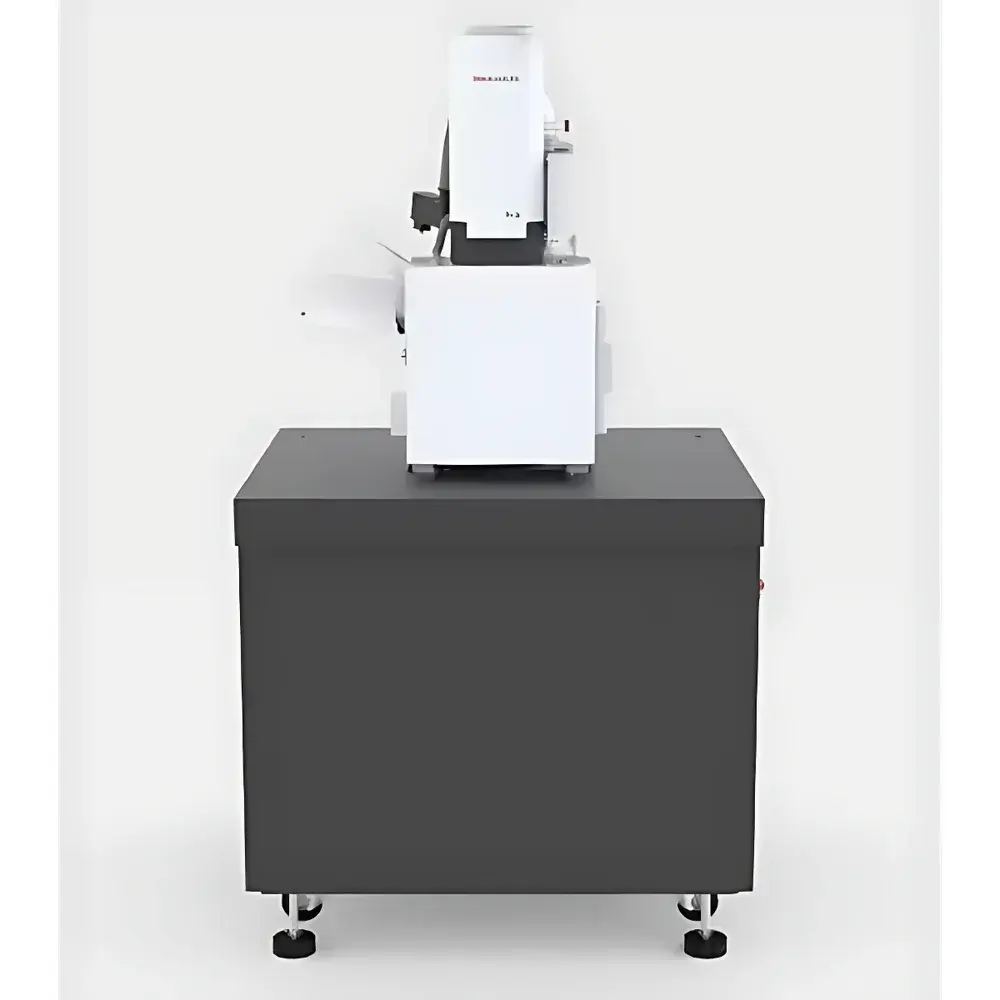
Thermo Fisher Axia ChemiSEM Advanced Real-Time EDS-Integrated Scanning Electron Microscope
| Brand | Thermo Fisher |
|---|---|
| Origin | Shanghai, China |
| Manufacturer Type | Authorized Distributor |
| Regional Classification | Domestic (China) |
| Model | Axia ChemiSEM |
| Pricing | Upon Request |
Overview
The Thermo Fisher Axia ChemiSEM is an advanced, EDS-integrated scanning electron microscope engineered for concurrent morphological imaging and quantitative elemental analysis. Unlike conventional SEMs that require sequential acquisition of secondary electron (SE), backscattered electron (BSE), and energy-dispersive X-ray spectroscopy (EDS) data, the Axia ChemiSEM employs a patented real-time signal fusion architecture. It continuously acquires and processes BSE and EDS signals in parallel during standard imaging—enabling simultaneous visualization of topography, atomic number contrast, and spatially resolved elemental composition in full color. This capability is grounded in the instrument’s integrated TrueSight EDS detector, high-stability thermionic LaB6 source, and low-vacuum-compatible column design. The system operates across vacuum regimes—from high vacuum (HV) to variable pressure (VP)—without compromising resolution or requiring conductive coating for insulating or beam-sensitive samples. Its design reflects a paradigm shift toward workflow-centric electron microscopy, where analytical throughput, reproducibility, and operational safety are prioritized without sacrificing scientific rigor.
Key Features
- Real-time EDS integration: TrueSight silicon drift detector (SDD) mounted directly within the chamber enables continuous, background-subtracted X-ray collection synchronized with BSE/SE imaging—no manual switching or post-acquisition correlation required.
- Low-vacuum imaging without coating: Stable VP operation down to 130 Pa allows direct examination of non-conductive, hydrated, or outgassing samples at 30 kV with ≤3.0 nm SE resolution—matching HV performance.
- Nav-Cam optical navigation system: Integrated full-color CCD camera provides real-time, wide-field optical overview of the specimen chamber (280 mm internal width), enabling rapid sample positioning and safe stage movement.
- Automated alignment & optimization: One-click autofocus, stigmation correction, brightness/contrast adjustment, and beam alignment are executed across magnifications using adaptive algorithms—eliminating routine manual tuning.
- Motorized retractable BSE detector: Fully automated deployment/retraction minimizes risk of mechanical interference with the pole piece or sample; pre-aligned filament ensures consistent emission stability.
- Modular expandability: Standard multi-port interface supports seamless integration of EBSD (e.g., Quasor-II), cathodoluminescence (CL), heating stages (CleanHeater, up to 1100 °C), and beam deceleration modules.
Sample Compatibility & Compliance
The Axia ChemiSEM accommodates diverse sample geometries: maximum stage travel (X/Y) is 120 × 120 mm, tilt range −15° to +90°, rotation n × 360°, and unobstructed Z-height up to 128 mm with 10 kg load capacity. Its low-vacuum capability ensures compatibility with polymers, ceramics, biological tissues, geological specimens, and battery electrode materials—all without sputter-coating. From a regulatory standpoint, the system supports GLP/GMP-compliant workflows through audit-trail-enabled software logging (via AutoScript 4 and Maps), electronic signature readiness, and full traceability of acquisition parameters, detector calibrations, and spectral processing steps per ISO/IEC 17025 and ASTM E1508 guidelines.
Software & Data Management
ChemiSEM operation is unified under Thermo Scientific’s SmartSEM platform, which integrates real-time EDS mapping, spectral deconvolution, and drift-corrected time-resolved analysis. Maps™ software enables unattended large-area stitching (up to 100,000×100,000 pixels) with auto-focus and stage calibration. AutoScript 4 delivers Python-based automation via open API—supporting custom scripting for batch analysis, conditional acquisition triggers, and third-party data export (e.g., HDF5, TIFF, .emsa). Offline processing is enhanced by ChemiView for advanced peak stripping, matrix correction (ZAF/φρZ), and quantification validation. All software modules comply with FDA 21 CFR Part 11 requirements for electronic records and signatures when deployed in regulated environments.
Applications
- Materials science: Phase identification in multiphase alloys, inclusion analysis in steels, cross-sectional characterization of thin-film stacks.
- Geosciences: Mineralogical mapping of silicates and carbonates, porosity quantification in shale cores, fluid inclusion morphology.
- Life sciences: Uncoated tissue sections, freeze-dried cells, bio-mineral interfaces—imaged in low vacuum with preserved ultrastructure.
- Electronics & semiconductors: Failure analysis of solder joints, contamination screening on wafers, interconnect cross-sectioning.
- Battery R&D: In-situ and ex-situ analysis of cathode cracking, SEI layer thickness estimation, transition metal dissolution mapping.
FAQ
Does the Axia ChemiSEM require conductive coating for non-metallic samples?
No. Its low-vacuum mode (down to 130 Pa) and charge compensation via gas ionization eliminate the need for sputter-coating—preserving native surface morphology and avoiding artifacts.
Can EDS spectra be acquired simultaneously with high-magnification imaging?
Yes. The TrueSight EDS detector operates in parallel with SE/BSE detection at all magnifications and working distances, with live spectrum updating and elemental overlay rendering.
Is the system compatible with EBSD for crystallographic analysis?
Yes. The chamber includes dedicated ports and geometry-optimized mounting for Quasor-II EBSD detectors, with synchronized acquisition enabled via SmartSEM synchronization protocols.
What level of automation is supported for repetitive imaging tasks?
AutoScript 4 enables fully programmable workflows—including stage sequencing, multi-region acquisition, automatic focus recovery, and conditional logic based on signal thresholds or stage position.
How is data integrity ensured for regulatory submissions?
All raw images, spectra, acquisition metadata, and processing history are stored in timestamped, immutable project files. Audit trails, user access logs, and electronic signature support meet 21 CFR Part 11 and ISO 17025 documentation requirements.





