
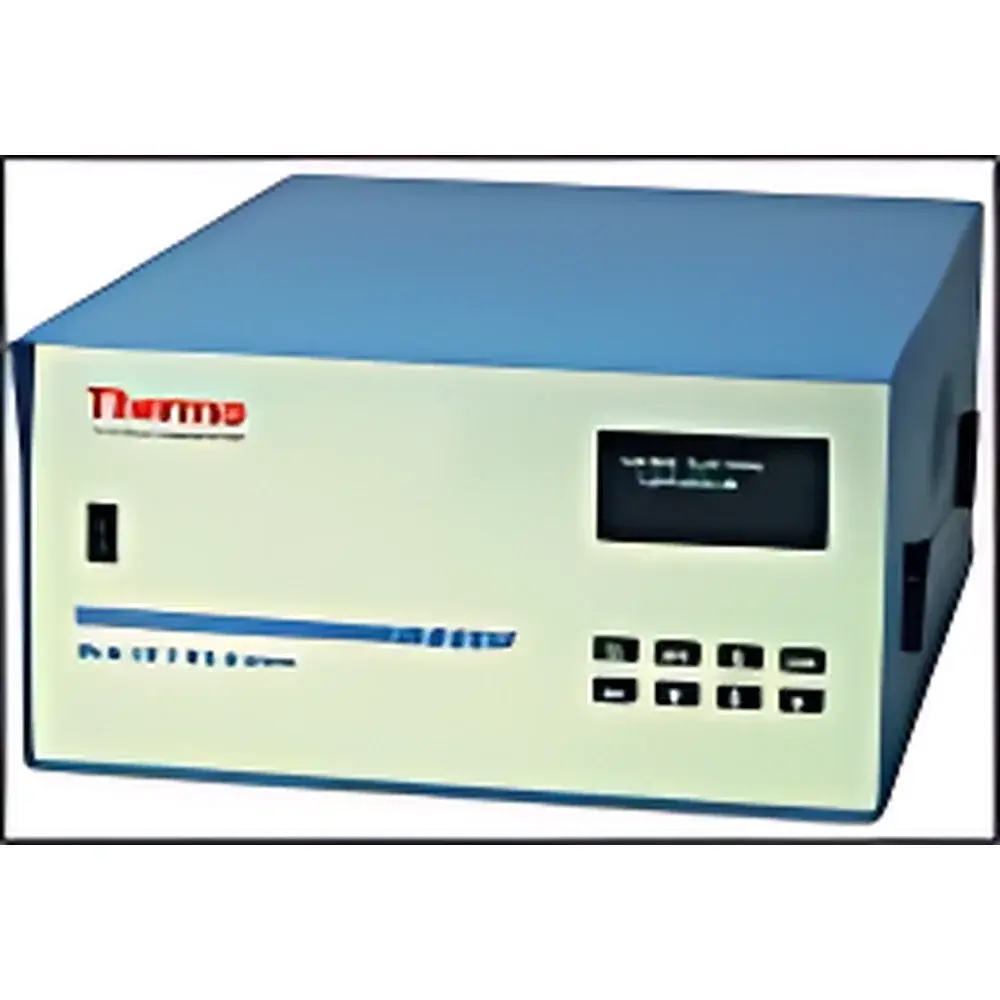
Thermo Scientific Water Quality Analyzer
| Origin | Imported |
|---|---|
| Manufacturer Type | Distributor |
| Model | Thermo Scientific Water Quality Analyzer |
| Instrument Type | Laboratory Water Quality Analyzer |
| Price Range | USD 70,000 – 98,000 (based on configuration and regional import duties) |
| Key Compliance | ASTM D1293, ISO 7888, ISO 5667-3, USP <643>, EPA Methods 4500-OC, 4500-BOD, 4500-P, 4500-Cl⁻ |
Overview
The Thermo Scientific Water Quality Analyzer is a modular, laboratory-grade analytical platform engineered for comprehensive physicochemical and electrochemical characterization of natural, potable, wastewater, and industrial process water samples. It operates on a multi-sensor fusion architecture—integrating potentiometric (pH, ion-selective electrodes), amperometric (dissolved oxygen), conductometric (conductivity, salinity), and spectrophotometric (UV-Vis absorbance for COD, BOD₅, total phosphorus, chlorine species, turbidity) measurement principles within a single, interoperable hardware framework. Designed to meet the operational rigor of environmental testing laboratories accredited to ISO/IEC 17025, the system supports method-defined workflows aligned with U.S. EPA, ASTM International, and ISO standard protocols—including EPA Method 4500-OC for chemical oxygen demand, ASTM D1293 for pH, and ISO 5667-3 for sampling preservation. Its core function is not standalone parameter reporting but traceable, auditable, and repeatable quantification of water quality indicators under GLP-compliant data governance.
Key Features
- Modular sensor bays accommodating interchangeable probe assemblies: pH/ORP, conductivity/salinity, dissolved oxygen (Clark-type or optical), and UV-Vis cuvette-based photometers (200–800 nm wavelength range)
- Integrated temperature compensation across all electrochemical sensors (±0.1 °C resolution) with automatic thermal equilibration algorithms
- Onboard calibration verification using NIST-traceable reference standards; dual-point pH calibration with slope and offset diagnostics
- Rugged benchtop chassis with IP54-rated enclosure, ESD-protected analog front-end, and isolated digital I/O for PLC interfacing in hybrid lab-to-field deployments
- Preloaded method libraries for over 40 regulatory water test procedures—including COD digestion-free rapid assays, BOD₅ incubation tracking, and EPA-compliant free/total chlorine DPD colorimetry
- Automatic electrode diagnostics: impedance monitoring, response time validation, and drift detection per ASTM D1129 guidelines
Sample Compatibility & Compliance
The analyzer accepts liquid samples ranging from 10 mL to 500 mL volume, compatible with standard 10–50 mm pathlength cuvettes and flow-through cells. It supports raw surface water, filtered drinking water, digested wastewater effluents, and high-ionic-strength industrial brines (up to 120 mS/cm conductivity). All measurement modules comply with metrological requirements defined in ISO/IEC 17025:2017 Clause 7.7 (uncertainty estimation), and software operation conforms to FDA 21 CFR Part 11 for electronic records and signatures—featuring role-based access control, full audit trail (user actions, calibration events, result modifications), and immutable data archiving. Instrument qualification documentation (IQ/OQ/PQ) templates are provided for GMP-aligned environmental monitoring programs.
Software & Data Management
The Thermo Scientific Water Analysis Suite (v4.2+) provides a validated Windows-based application with dual operating modes: guided walk-through for routine compliance testing and advanced scripting for custom method development. Data export supports ASTM E1384-compliant .csv and .xml formats, as well as direct integration with LIMS via HL7 v2.5 or ODBC drivers. All spectral acquisitions include metadata tagging (wavelength, slit width, integration time, lamp intensity decay), and photometric results undergo second-derivative baseline correction to mitigate matrix interference. The software maintains full traceability from raw signal to final reported value—including intermediate calculation steps, correction factors applied (e.g., temperature-corrected conductivity to 25 °C), and uncertainty propagation per GUM (JCGM 100:2018).
Applications
- Regulatory compliance testing for municipal drinking water systems (EPA Safe Drinking Water Act, EU Directive 98/83/EC)
- BOD₅ and COD trending in wastewater treatment plant influent/effluent monitoring per ISO 5815-1 and ISO 6060
- Phosphorus speciation (orthophosphate, total phosphorus) in eutrophication studies using ascorbic acid/molybdate chemistry
- Chlorine residual profiling (free vs. combined) in distribution networks using DPD colorimetry (ISO 7393-2)
- Multi-parameter QA/QC of ultrapure water in pharmaceutical manufacturing (USP , EP 2.2.43)
- Method validation support for ISO 11733 (BOD in high-strength wastewater) and ASTM D5257 (low-level nitrate by UV absorbance)
FAQ
Does this system support field-deployable operation?
No—it is engineered exclusively as a laboratory instrument with fixed power supply (100–240 VAC, 50/60 Hz) and non-ruggedized optics; portable variants require separate Thermo Scientific Orion AQUAfast or Pocket Pro+ platforms.
Can it perform simultaneous multi-parameter analysis without manual reconfiguration?
Yes—via pre-configured “Water Profile” methods that auto-switch sensors, adjust gain settings, and sequence measurements (e.g., pH → conductivity → DO → turbidity → UV-Vis absorbance) with <60-second cycle time.
Is third-party software integration supported for enterprise data aggregation?
Yes—through certified OPC UA server interface and RESTful API endpoints for real-time telemetry ingestion into cloud-based environmental data lakes (e.g., AWS IoT SiteWise, Azure IoT Central).
What is the recommended calibration frequency for routine regulatory use?
Per ISO/IEC 17025:2017 Annex A.3, daily calibration verification with check standards is required; full multi-point calibration every 24 hours or after 10 sample runs—whichever occurs first.
Are consumables and certified reference materials supplied by Thermo Fisher?
Yes—NIST-traceable pH buffers (4.01, 7.00, 10.01), conductivity standards (84 µS/cm to 1413 mS/cm), DO zero solution (sodium sulfite), and EPA-certified COD vials (0–1500 mg/L range) are available under catalog numbers 01-1000 through 01-8921.
Related Products







