
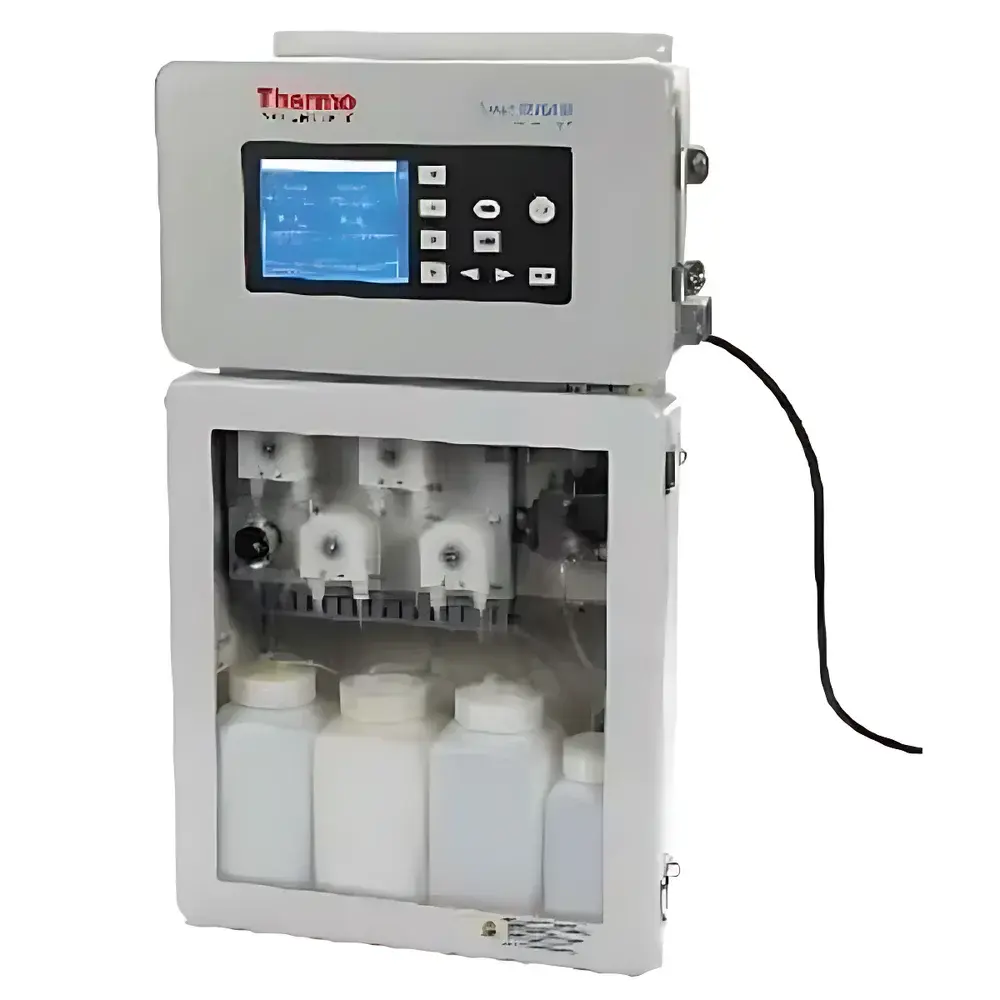
Thermo Scientific Orion 2210AM Online Ammonia Nitrogen Analyzer
| Brand | Thermo Fisher Scientific |
|---|---|
| Origin | USA |
| Model | Thermo Scientific Orion 2210AM |
| Instrument Type | Online Analyzer |
| Measurement Principle | Colorimetric Method (Indophenol Blue) |
| Measurement Ranges | 0.01–2 mg/L, 0.05–10 mg/L, 0.5–50 mg/L, 5–500 mg/L (as N) |
| Accuracy | ±5% or ±0.01 mg/L (whichever is greater) within 0.01–50 mg/L |
| Detection Limit | 0.01 mg/L (as N) |
| Analysis Time | ≤30 minutes per cycle |
| Temperature Control | Integrated thermostatically controlled cuvette with magnetic stirring |
Overview
The Thermo Scientific Orion 2210AM Online Ammonia Nitrogen Analyzer is an industrial-grade, fully automated water quality monitoring system engineered for continuous, unattended measurement of total ammonia nitrogen (NH3-N and NH4+-N) in aqueous matrices. It employs the standardized indophenol blue colorimetric method—compliant with ISO 7150-1, ASTM D1426, and APHA Standard Methods 4500-NH3F—where ammonia reacts with hypochlorite and phenol under alkaline conditions to form a stable blue chromophore, quantified photometrically at 630 nm. Designed for deployment in municipal drinking water treatment plants, wastewater influent/effluent streams, surface water monitoring stations, and industrial process water loops, the 2210AM delivers high reproducibility and long-term stability without manual intervention. Its robust architecture supports operation in ambient environments ranging from 5 °C to 40 °C, with IP54-rated enclosure suitability for indoor or sheltered outdoor installations.
Key Features
- Four programmable measurement ranges (0.01–2, 0.05–10, 0.5–50, and 5–500 mg/L as N), enabling seamless adaptation across raw water, treated effluent, and high-strength industrial discharges without hardware modification
- Software-selectable range switching—no reagent kit replacement, no calibration recalibration, and no mechanical valve reconfiguration required
- Integrated thermostatically controlled reaction cuvette (maintained at 37 ± 0.5 °C) with precision magnetic stirring ensures kinetic consistency and minimizes temperature-induced drift
- Micro-dosing fluidic system reduces reagent consumption by >60% versus conventional analyzers, lowering operational cost and hazardous waste generation (typical reagent usage: <1.2 mL per analysis)
- Self-diagnostic routines monitor optical path integrity, pump performance, reagent depletion, and temperature stability—generating actionable status flags via Modbus TCP or analog 4–20 mA outputs
- Modular design supports field-replaceable components (e.g., LED light source, photodiode detector, peristaltic pump heads), minimizing downtime during maintenance
Sample Compatibility & Compliance
The 2210AM accepts untreated or filtered liquid samples with suspended solids <50 mg/L and turbidity <100 NTU. It is validated for use with drinking water, surface water, groundwater, secondary-treated wastewater, and anaerobic digester supernatant. All wetted materials—including sample tubing, reaction chamber, and reagent delivery lines—are chemically resistant (EPDM, PTFE, borosilicate glass) to prevent adsorption or leaching. The analyzer meets CE marking requirements (2014/30/EU EMC Directive, 2014/35/EU LVD), complies with UL 61010-1 safety standards, and supports audit-ready data logging aligned with GLP and GMP principles. Optional 21 CFR Part 11-compliant software configuration enables electronic signatures, user access control, and immutable audit trails for regulated utilities.
Software & Data Management
Control and configuration are managed via the embedded Orion Connect™ web interface (HTTPS-enabled), accessible through standard browsers on any network-connected device. Real-time concentration values, diagnostic logs, calibration history, and alarm events are timestamped and stored locally (8 GB internal flash memory, retaining ≥12 months of 5-minute interval data). Data export is supported in CSV and XML formats. Integration with SCADA, DCS, or cloud-based platforms (e.g., Siemens Desigo, Honeywell Experion, AWS IoT Core) is achieved via native Modbus TCP, OPC UA, or optional Profibus DP-V1 modules. Remote firmware updates and secure over-the-air configuration changes are supported with TLS 1.2 encryption.
Applications
- Drinking water treatment: Monitoring ammonia breakthrough post-chlorination, optimizing chloramine formation, and verifying compliance with WHO and EPA guidelines (max. 0.5 mg/L as N)
- Wastewater process control: Feedback control of nitrification/denitrification basins, aeration optimization, and effluent compliance reporting against NPDES permits
- Surface water surveillance: Early detection of agricultural runoff or sewage infiltration in rivers, lakes, and reservoirs
- Industrial process monitoring: Ammonia concentration tracking in cooling towers, semiconductor rinse water, and pharmaceutical manufacturing water-for-injection (WFI) loops
- Research & regulatory compliance: Long-term trend analysis supporting ISO 5667-3 sampling programs and EPA Method 350.1 validation studies
FAQ
What sample pretreatment is required before analysis?
No filtration or digestion is needed for most applications; however, samples with >50 mg/L suspended solids should be pre-filtered using a 10 µm mesh to avoid clogging the 1.6 mm ID sample line.
Can the 2210AM operate unattended for extended periods?
Yes—designed for 30-day reagent autonomy (with standard 2-L reagent bottles) and 6-month calibration interval under typical operating conditions (25 °C, pH 6.5–8.5, low organic interference).
Is the instrument compatible with existing plant communication infrastructure?
It provides dual Ethernet ports (10/100 Mbps), Modbus TCP server/client, and configurable 4–20 mA analog outputs with HART 7 support—ensuring interoperability with legacy and modern control systems.
How does the system handle interferences such as chloride or heavy metals?
The indophenol method exhibits minimal interference from Cl− (<500 mg/L), Ca2+, Mg2+, and Fe2+; elevated Cu2+ (>0.5 mg/L) or sulfide (>0.1 mg/L) may require matrix-specific spike recovery verification.
What service and support options are available globally?
Thermo Fisher offers factory-certified field service engineers, remote diagnostics via TeamViewer-assisted support, and annual preventive maintenance contracts including sensor validation, fluidic integrity testing, and traceable calibration certificate issuance.







