
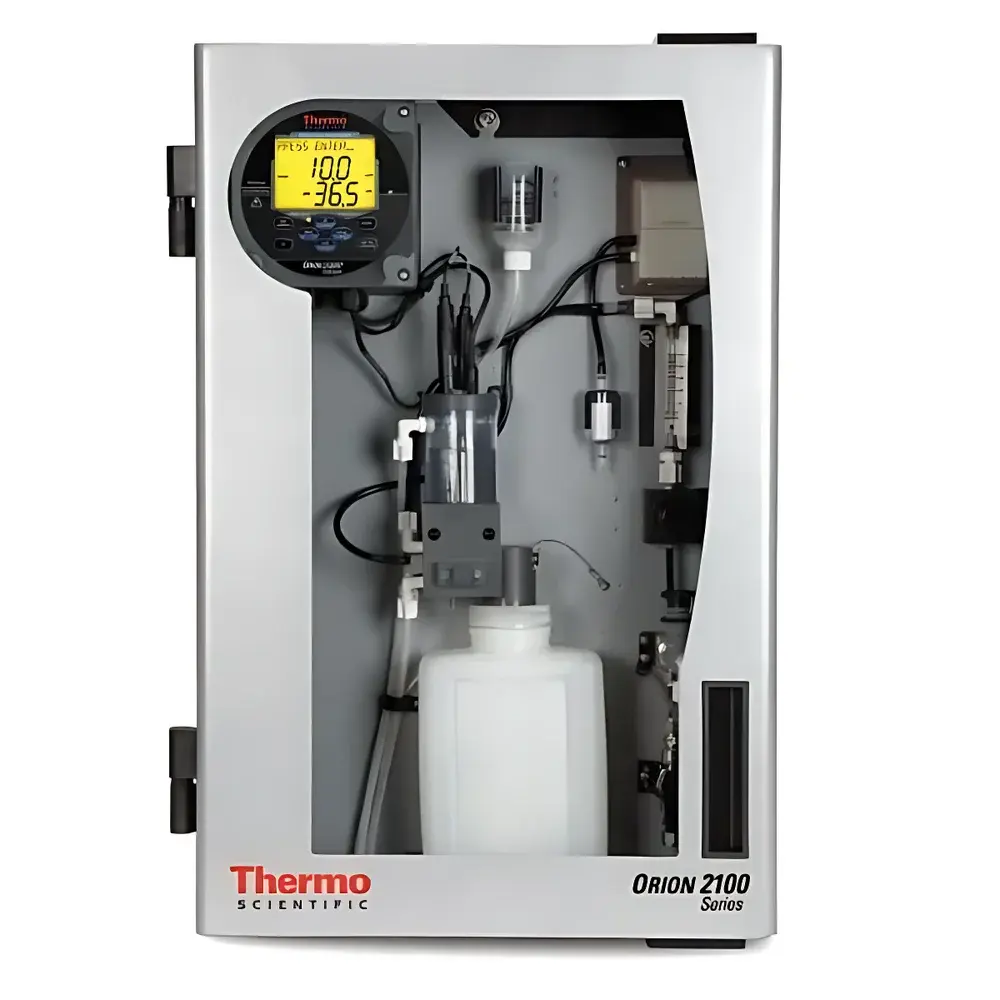
Thermo Scientific 2120XP Calcium Analyzer
| Brand | Thermo Fisher Scientific |
|---|---|
| Origin | USA |
| Model | Thermo Scientific 2120XP |
| Detection Limit | 25 ppb Ca²⁺ |
| Measurement Principle | Calcium-Selective Electrode (CSE) with pH-Buffered Sample Conditioning |
| Display | Backlit LCD |
| Calibration Method | Dual-Standard Known Addition (DKA) |
| Optional Channels | pH or Conductivity (second channel) |
| Communication | Digital I/O and Modbus RTU/ASCII support |
| Maintenance Design | No moving parts, no reagent pumps, no consumable dosing systems |
| Compliance | Designed for continuous operation in industrial water treatment environments per ASTM D1066 and ISO 5667-3 guidelines |
Overview
The Thermo Scientific 2120XP Calcium Analyzer is a dedicated online process analyzer engineered for continuous, real-time measurement of calcium ion concentration (Ca²⁺) in low-conductivity, low-hardness water streams—particularly in post-softening effluent from ion exchange systems. It employs a solid-state calcium-selective electrode (CSE) operating on the principle of potentiometric ion activity measurement, coupled with an integrated, flow-through pH conditioning module that ensures sample alkalinity remains within the optimal range (pH 10–11) for selective Ca²⁺ detection. Unlike colorimetric or titrimetric analyzers requiring reagents, pumps, or frequent recalibration, the 2120XP delivers stable, drift-resistant readings through a maintenance-minimized architecture. Its design targets critical applications in power plant boiler feedwater pretreatment, pulp & paper mill process water loops, petrochemical desalination brine polishing, and municipal tertiary softening verification—where early detection of calcium breakthrough (<25 ppb) directly correlates with resin exhaustion and risk of downstream scale formation.
Key Features
- Sub-ppb detection capability: Verified lower limit of quantitation (LLOQ) at 25 ppb Ca²⁺, enabling proactive identification of incipient softener breakthrough before system integrity is compromised.
- Integrated pH conditioning: On-line, reagent-free pH adjustment using a compact, chemically resistant buffer cartridge—eliminates manual pH meter calibration and ensures consistent ionic strength and complexation control across variable influent conditions.
- True zero-maintenance sensor architecture: No peristaltic pumps, no liquid reagent delivery, no membrane replacement schedules—only periodic electrode cleaning and annual reference junction inspection recommended.
- Intuitive operator interface: Backlit graphical LCD with multilevel menu navigation; supports full diagnostic logging, calibration history review, and real-time signal stability indicators.
- DKA (Dual-Standard Known Addition) calibration protocol: Two-point standard addition performed automatically within the flow cell—minimizes operator intervention and eliminates reliance on external lab standards or matrix-matched calibrants.
- Expandable platform: Optional second-channel input supports simultaneous monitoring of pH or conductivity, facilitating cross-parameter correlation for softener performance trending and fault isolation.
Sample Compatibility & Compliance
The 2120XP is validated for use with deionized, reverse osmosis (RO), and mixed-bed polished waters having total dissolved solids (TDS) < 50 µS/cm and temperature between 5–45 °C. It complies with sampling requirements outlined in ASTM D1066 (Standard Practice for Sampling Water) and ISO 5667-3 (Water quality — Sampling — Part 3: Guidance on preservation and handling of water samples), ensuring representative analysis under GLP-aligned operational protocols. While not FDA 21 CFR Part 11-certified as a standalone unit, its data output structure supports integration into validated SCADA or DCS platforms meeting GMP audit requirements for pharmaceutical or biotech utility water systems.
Software & Data Management
The analyzer provides analog 4–20 mA outputs for primary Ca²⁺ concentration and secondary parameters (e.g., temperature, status flags), plus optional RS-485 serial interface supporting Modbus RTU/ASCII protocols. All calibration events, sensor diagnostics (e.g., slope, offset, response time), and raw mV signals are timestamped and stored internally for ≥30 days. Exportable logs conform to CSV format for traceability in QA/QC documentation. No proprietary software is required for configuration—setup is performed locally via front-panel keypad or remotely via Modbus register mapping compatible with industry-standard HMI systems.
Applications
- Power generation: Monitoring calcium leakage from cation/anion exchange trains prior to high-pressure boiler feedwater injection.
- Pulp & paper: Ensuring calcium levels remain below scaling thresholds in paper machine white water recirculation loops.
- Refining & petrochemicals: Verifying calcium removal efficiency in amine regenerator overhead condensate polishing units.
- Municipal water: Validating softener performance in lime-soda ash or nanofiltration-based hardness removal plants serving drinking water distribution networks.
- Electronics manufacturing: Supporting ultrapure water (UPW) sub-loop monitoring where Ca²⁺ contamination risks wafer etch uniformity.
FAQ
What is the typical response time to reach stable reading after sample introduction?
Stabilization occurs within 90–120 seconds under nominal flow (100–200 mL/min) and temperature (25 °C), with <±2% drift over 24-hour continuous operation when installed per manufacturer’s hydraulic specifications.
Does the analyzer require daily calibration?
No. DKA calibration is recommended weekly under steady-state conditions or after any maintenance event; monthly calibration suffices in highly stable softener effluents with documented historical reproducibility.
Can the 2120XP be installed in hazardous locations?
The base unit is rated NEMA 4X/IP66 for outdoor panel mounting; intrinsic safety certification (e.g., ATEX, IECEx) requires third-party enclosure integration and is not provided by default.
Is remote firmware update supported?
Firmware updates must be performed locally via USB-to-serial adapter and Thermo-provided configuration utility; over-the-air (OTA) updates are not implemented.
How is electrode lifetime defined and monitored?
Electrode service life is typically 12–18 months in clean, low-chloride softener effluent; the analyzer continuously tracks electrode slope and offset deviation, triggering configurable warning alerts when performance thresholds are exceeded.
Related Products







