
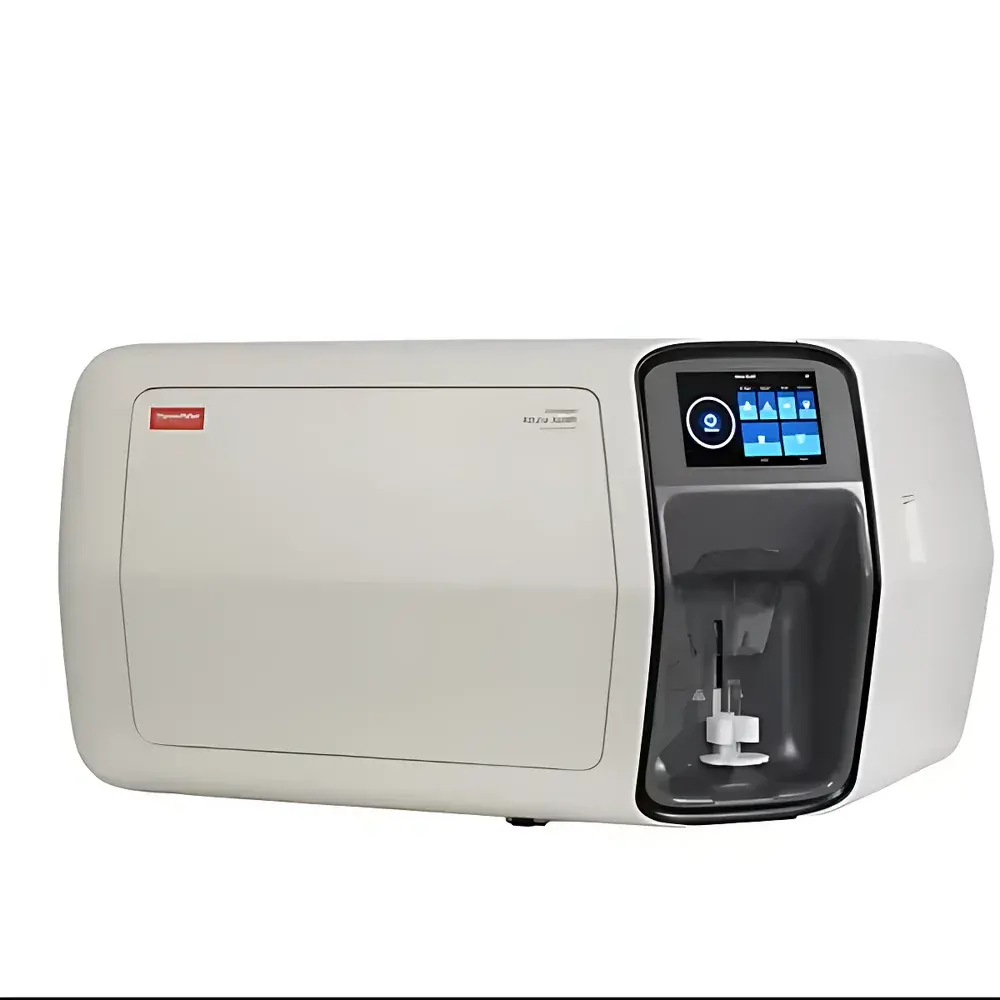
Thermo Fisher Attune Xenith Flow Cytometer A59358
| Brand | Thermo Fisher |
|---|---|
| Origin | USA |
| Manufacturer Type | Authorized Distributor |
| Origin Category | Imported |
| Model | A59358 |
| Pricing | Available Upon Request |
Overview
The Thermo Fisher Attune Xenith Flow Cytometer A59358 is a high-parameter, spectral-capable flow cytometry platform engineered for precision, reproducibility, and operational robustness in demanding life science research environments. It employs acoustic-assisted hydrodynamic focusing—a proprietary technology combining ultrasonic cell alignment with laminar fluid dynamics—to achieve stable, high-velocity sample interrogation without compromising resolution or signal fidelity. Unlike conventional sheath-based focusing systems, this method enables precise spatial control of cells within the interrogation zone, minimizing coefficient of variation (CV) in fluorescence and scatter signals while supporting variable sample concentrations—from rare-cell suspensions to viscous tissue digests—without manual dilution or flow-rate recalibration. The instrument is designed for GLP-compliant laboratories and integrates seamlessly into workflows requiring multi-laser excitation, high-dimensional immunophenotyping, and longitudinal assay validation.
Key Features
- Acoustic-assisted hydrodynamic focusing: Delivers uniform cell alignment at flow rates up to 1,000 µL/min, enabling five-fold faster acquisition than conventional cytometers without sacrificing data quality.
- Six spatially separated, flat-top lasers (349 nm UV, 405 nm violet, 488 nm blue, 561 nm yellow-green, 637 nm red, 781 nm NIR) with independent beam path optimization for minimal cross-talk and maximal photon collection efficiency.
- Fifty-one user-configurable fluorescent detectors with interchangeable filter sets, supporting both traditional compensation-based analysis and full-spectrum unmixing via real-time linear unmixing algorithms.
- Six scatter detection channels: dual-angle forward scatter (FSC) and side scatter (SSC) at 488 nm (standard), 405 nm (optimized for submicron particles), and polarized 488 nm FSC/SSC for enhanced granularity and refractive index discrimination.
- Positive displacement fluidics architecture: Mitigates clogging risk from heterogeneous or sticky biological samples—including enzymatically digested tumor tissues—through controlled pressure application that clears obstructions without interrupting acquisition.
- Integrated diagnostics suite: Onboard service cameras monitor flow cell cleanliness and laser alignment; telemetry logs system performance metrics (e.g., laser power stability, PMT gain drift, fluidic pressure profiles) for predictive maintenance and audit-ready service reporting.
Sample Compatibility & Compliance
The Attune Xenith accommodates a broad spectrum of primary and cultured samples, including whole blood, PBMCs, dissociated solid tumors, organoids, and microvesicle-enriched supernatants. Its low-shear fluidics design preserves cell viability and surface epitope integrity during extended runs. The system meets essential regulatory expectations for research-use-only (RUO) instrumentation under ISO 13485-aligned manufacturing controls and supports documentation practices aligned with FDA 21 CFR Part 11 requirements for electronic records and signatures when deployed with validated software configurations. While not CE-IVD or FDA-cleared for clinical diagnostics, its optical architecture and calibration traceability support method development compliant with ASTM E2810 and ISO/IEC 17025 standards for analytical instrument qualification.
Software & Data Management
Instrument operation and data analysis are managed through Attune Cytometric Software v3.x (or later), a Windows-based application supporting both local and network-deployed configurations. The software includes built-in spectral reference library management, batch processing for standardized gating strategies, and export compatibility with FCS 3.1 and HDF5 formats. Audit trails record all user actions—including gate adjustments, compensation matrix edits, and instrument parameter changes—with timestamps and operator IDs. Raw spectral data files retain full detector-level intensity values, enabling retrospective reanalysis using updated unmixing models or third-party tools such as FlowJo Spectral or Cytobank. Data backup protocols integrate with enterprise-grade NAS or cloud storage via configurable SFTP endpoints.
Applications
- High-parameter immunophenotyping (≥30-color panels) in human and murine immune profiling studies.
- Cell cycle and proliferation analysis using DNA dyes (e.g., DAPI, Hoechst) combined with phospho-protein detection.
- Exosome and extracellular vesicle characterization via high-sensitivity scatter detection and antibody-capture bead assays.
- Functional assays including calcium flux, mitochondrial membrane potential, and reactive oxygen species quantification across heterogeneous populations.
- Longitudinal monitoring of CAR-T or NK-cell expansion kinetics in bioreactor harvests and cryopreserved products.
- Development of spectral panel designs for translational biomarker discovery where fluorochrome spillover limits conventional compensation accuracy.
FAQ
What sample types are compatible with the Attune Xenith’s acoustic focusing system?
Primary tissues, enzymatically digested tumors, whole blood, and aggregated suspension cultures—all processed without pre-filtration or dilution in most cases.
Does the system support FDA 21 CFR Part 11 compliance for regulated environments?
Yes, when configured with validated software settings, electronic signature modules, and audit-trail-enabled operation—subject to site-specific IQ/OQ/PQ protocols.
Can I switch between spectral unmixing and traditional compensation during an experiment?
Yes—detector configuration and analysis mode can be changed between acquisitions without hardware reconfiguration.
What maintenance intervals are recommended for routine operation?
Daily fluidic flushes, weekly flow cell inspection via onboard camera, and quarterly PM services including laser power calibration and PMT voltage verification.
Is remote diagnostics capability available out-of-the-box?
Yes—the system includes embedded telemetry and secure remote access support for Thermo Fisher Field Service Engineers under customer-approved network policies.




