
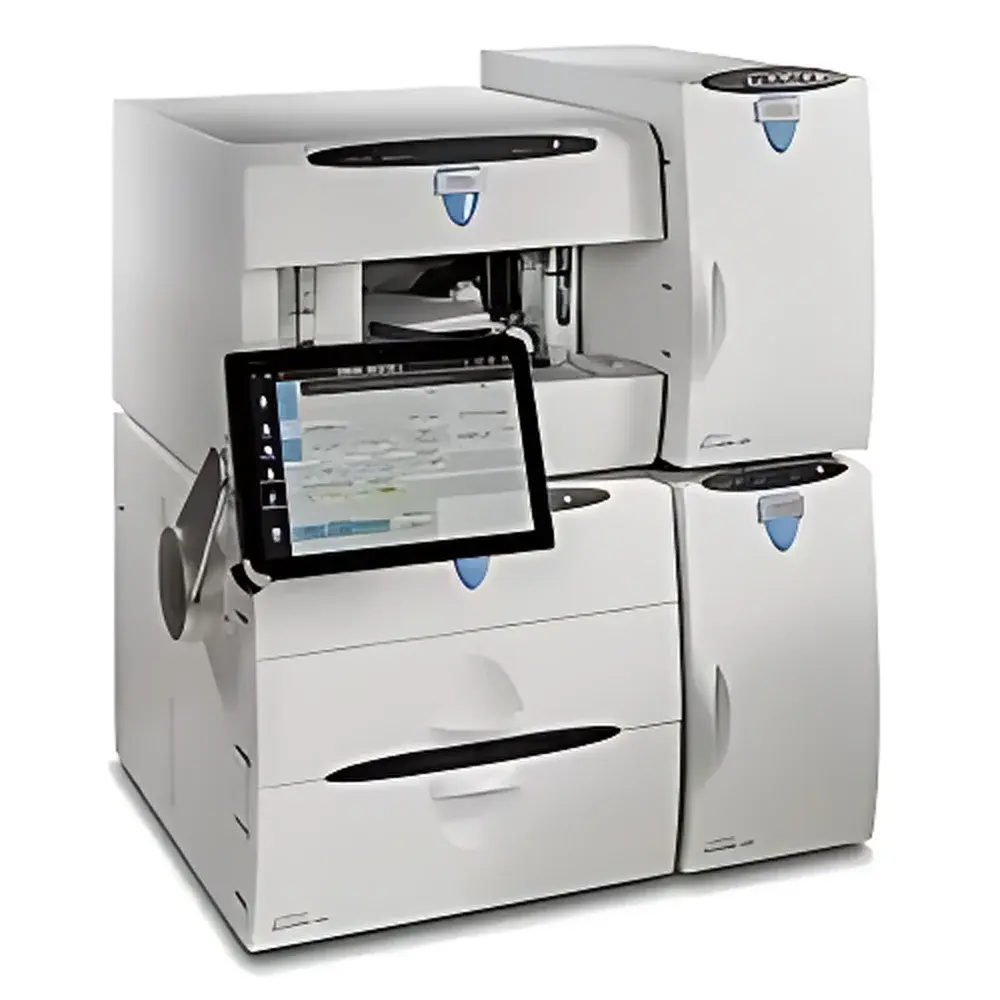
Thermo Scientific Dionex ICS-6000 HPIC High-Pressure Ion Chromatography System
| Brand | Thermo Scientific |
|---|---|
| Origin | USA |
| Manufacturer Type | Original Equipment Manufacturer (OEM) |
| Product Origin | Imported |
| Model | ICS-6000 HPIC |
| Instrument Type | Laboratory |
| Application Scope | Universal |
| Configuration Flexibility | Modular |
| RFIC™ Capability | Yes |
| Maximum Operating Pressure | 5000 psi |
| Column Particle Size Support | 4 µm |
| Column Dimensions Supported | 150 mm and 250 mm |
| Column Inner Diameter Compatibility | 1–7 mm (capillary to standard bore) |
| Detector Options | CD, ED, VWD, PDA, ICP-MS interface |
| Software Platform | Thermo Scientific Dionex Chromeleon 7.3 CDS |
| Regulatory Compliance | FDA 21 CFR Part 11, GLP/GMP-ready audit trail |
Overview
The Thermo Scientific Dionex ICS-6000 HPIC is a high-pressure, modular ion chromatography (IC) system engineered for maximum resolution, reproducibility, and method scalability in modern analytical laboratories. As the world’s first IC platform capable of sustained operation at up to 5000 psi, it enables advanced separations unattainable with conventional low-pressure IC instrumentation. Its core architecture leverages high-efficiency 4 µm particle-packed columns—offering either accelerated analysis (e.g., 150 mm columns at elevated flow rates) or ultra-high resolution (e.g., 250 mm columns at standard flow rates)—without compromising peak capacity or quantitation integrity. The system supports both isocratic and electrolytically generated gradient elution via integrated Reagent-Free™ IC (RFIC™) technology, eliminating manual eluent preparation and enhancing long-term baseline stability through precise temperature-controlled conductivity detection and electrochemical cell management.
Key Features
- Modular design allowing configuration from capillary-scale (1–3 mm i.d.) to standard-bore (3–7 mm i.d.) IC workflows
- RFIC™-enabled eluent generation with real-time concentration control, reducing chemical waste and operator variability
- Dual-pump (DP) and single-pump (SP) options for method-specific pressure and flow optimization
- DC detector with dual-zone column compartment temperature control (±0.1 °C stability), critical for retention time reproducibility
- Integrated degassing modules and precision flow metering ensure <±0.1% flow accuracy across extended runs
- Expandable detection suite: Conductivity (CD), Pulsed Amperometric (ED), Variable Wavelength (VWD), Photodiode Array (PDA), and ICP-MS coupling for elemental speciation
- Chromeleon 7.3 Chromatography Data System (CDS) with full 21 CFR Part 11 compliance—including electronic signatures, audit trail logging, and role-based access control
Sample Compatibility & Compliance
The ICS-6000 HPIC accommodates diverse sample matrices including environmental water extracts, pharmaceutical excipients, food additives, biological fluids (e.g., plasma, urine), and industrial process streams. Its compatibility with Thermo Scientific Dionex microbore and capillary columns ensures robust performance for trace-level anion/cation analysis (e.g., nitrate, sulfate, fluoride, sodium, ammonium) as well as specialized applications such as carbohydrate profiling (BioIC configuration) and amino acid quantification (AAA-Direct). All hardware and software components are validated per ISO/IEC 17025 requirements and support GLP/GMP environments through instrument qualification documentation packages (IQ/OQ/PQ), electronic record integrity, and secure data archiving protocols.
Software & Data Management
Chromeleon 7.3 CDS serves as the unified control and reporting engine for the ICS-6000 HPIC. It provides sequence-driven acquisition, real-time chromatogram visualization, automated peak integration using customizable algorithms (e.g., valley-to-valley, tangent skim), and multi-detector correlation tools. The software supports method transfer between instruments, legacy method emulation, and seamless export to LIMS via ASTM E1384-compliant formats. Audit trail functionality records all user actions—including parameter changes, reprocessing events, and report generation—with immutable timestamps and operator identification. Data files are stored in vendor-neutral .cdf format, ensuring long-term accessibility independent of software version upgrades.
Applications
- Environmental monitoring: Quantification of regulated anions (Cl⁻, NO₃⁻, SO₄²⁻) and cations (Na⁺, Ca²⁺, Mg²⁺) in drinking water per EPA Methods 300.0 and 300.1
- Pharmaceutical quality control: Counterion analysis in APIs, residual chloride testing in injectables, and excipient purity assessment per USP and
- Food & beverage safety: Nitrite/nitrate determination in cured meats, phosphate detection in dairy products, and organic acid profiling in juices
- Biopharmaceutical development: Carbohydrate mapping of monoclonal antibodies using BioIC-ED configuration
- Geochemical research: Speciation of arsenic, selenium, and chromium species via ICP-MS hyphenation
- Materials science: Leachate analysis from battery electrolytes and semiconductor cleaning solutions
FAQ
What distinguishes the ICS-6000 HPIC from legacy IC systems?
Its 5000 psi operational ceiling, combined with 4 µm column technology and RFIC™ eluent generation, delivers superior resolution-speed trade-offs and eliminates manual eluent preparation errors.
Can the system be upgraded post-purchase?
Yes—the modular architecture supports field-installable additions including second detectors, autosampler expansion kits, and RFIC™ upgrade modules without requiring full system replacement.
Is Chromeleon 7.3 validated for regulated environments?
Yes—validated installation and operational qualification (IQ/OQ) protocols are available; the software meets FDA 21 CFR Part 11, EU Annex 11, and ISO/IEC 17025 requirements for electronic records and signatures.
Which column formats are natively supported?
Both standard-bore (4 mm i.d.) and microbore (2 mm i.d.) columns, as well as capillary columns (0.4 mm i.d.), with dedicated flow cells and tubing kits included in respective configurations.
How does temperature control impact analytical performance?
Precise column and detector compartment temperature regulation minimizes retention time drift (<0.05 min over 24 h) and improves conductivity signal stability—critical for low-concentration quantitation and gradient method robustness.




