
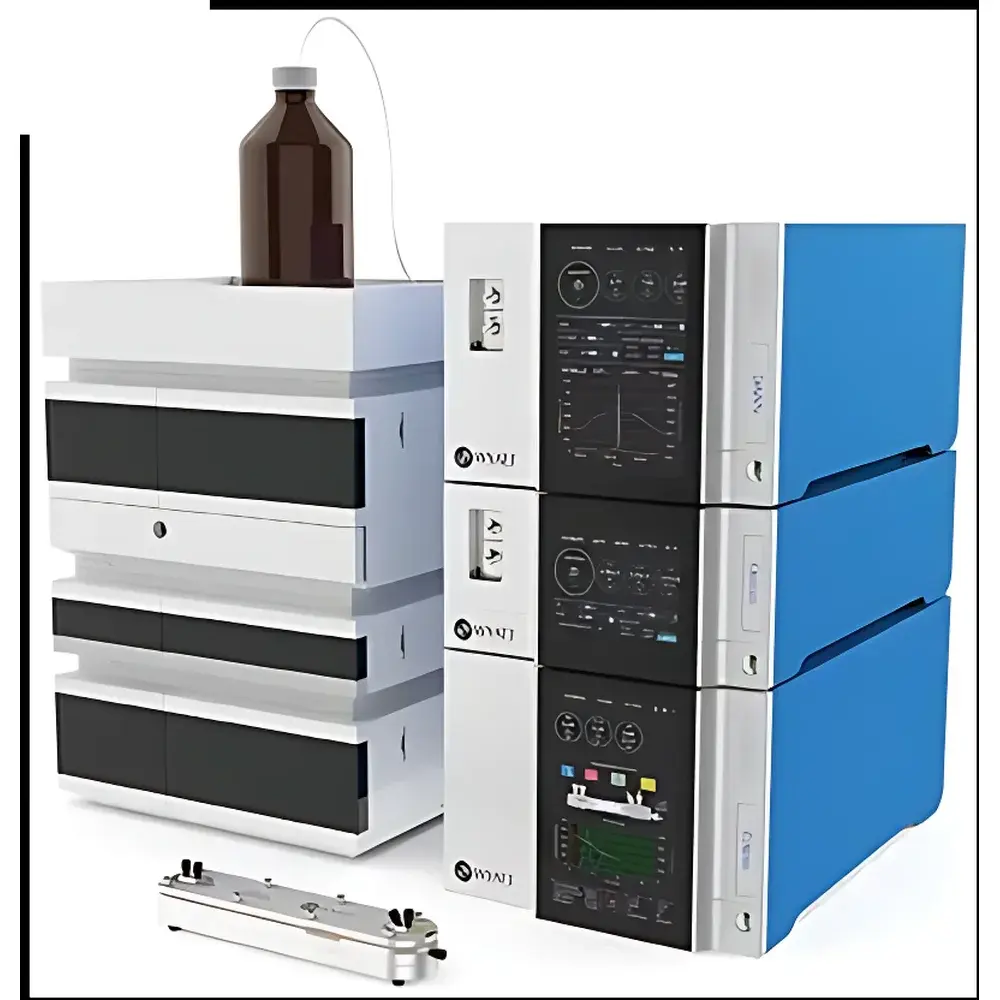
Wyatt AF4-MALS Absolute Molecular Weight Chromatography System
| Brand | Wyatt |
|---|---|
| Origin | USA |
| Manufacturer | Wyatt Technology Corporation |
| Instrument Type | Asymmetric Flow Field-Flow Fractionation (AF4) Coupled with Multi-Angle Light Scattering (MALS) |
| Model | AF4-MALS System |
| Compliance | Fully Compatible with ASTM D7980, ISO 22412, USP <788>, and GLP/GMP Data Integrity Requirements |
| Fluid Compatibility | Aqueous and Organic Solvents (e.g., THF, DMF, Chloroform) |
| Separation Range | 1 nm – 10 µm |
| Typical Run Time | 10–30 min |
| Detection Integration | MALS (18-angle), UV-Vis, dRI, DLS, ICP-MS, MALDI-TOF (via fraction collection) |
| Control Interface | PC-driven Motorized Needle Valve, Dual Pressure Monitoring, Real-time LCD Display, Analog/Digital I/O Ports |
Overview
The Wyatt AF4-MALS Absolute Molecular Weight Chromatography System is a high-precision, modular field-flow fractionation platform engineered for the orthogonal separation and absolute characterization of macromolecules, colloids, nanoparticles, and synthetic polymers without reliance on column-based retention mechanisms. Unlike size-exclusion chromatography (SEC), which depends on porous stationary phases and calibration standards, AF4 separates analytes based on their diffusion coefficients under a perpendicular crossflow field within a thin, ribbon-like channel—enabling true size-based fractionation across an exceptionally broad hydrodynamic diameter range (1 nm to 10 µm). When hyphenated with multi-angle light scattering (MALS), the system delivers absolute molar mass distributions (Mw, Mn, PDI), root-mean-square radius (Rg), and conformational analysis (e.g., sphere vs. rod vs. random coil) in a single, label-free run. This principle—grounded in first-order physical transport phenomena and rigorous angular light scattering theory—ensures traceable, standard-independent quantification compliant with ISO 22412 and ASTM D7980.
Key Features
- Asymmetric flow FFF (AF4) separation channel with interchangeable spacer thicknesses (50–500 µm) and customizable accumulation wall membranes (regenerated cellulose, polyethersulfone, nylon) for optimized resolution across diverse sample classes.
- Integrated MALS detector with 18 fixed-angle photodiode array (wavelength: 658 nm or 660 nm), enabling simultaneous measurement of scattered intensity and angular dependence for robust Rg and Mw determination.
- Motorized, PC-controlled needle valve system for precise, reproducible focusing and injection—critical for minimizing band broadening and ensuring quantitative recovery (>95% for proteins and liposomes).
- Dual independent pressure monitoring circuits: one for crossflow pressure stability (±0.02 psi resolution), another for channel outlet pressure—both with real-time alarm thresholds and automatic pump shutdown protocols.
- Full solvent compatibility: validated operation with aqueous buffers (PBS, Tris-HCl), polar organics (THF, DMF), and halogenated solvents (chloroform), supported by chemically resistant fluidic pathways (PEEK, titanium, and ceramic components).
- Real-time LCD interface with intuitive menu navigation; analog/digital I/O ports for integration into automated lab environments (e.g., robotic samplers, LIMS synchronization via Ethernet/RS-232).
Sample Compatibility & Compliance
The AF4-MALS System accommodates complex, “difficult” samples that degrade, adsorb, or shear in conventional SEC columns—including monoclonal antibodies (mAbs), virus-like particles (VLPs), extracellular vesicles (EVs), PEGylated proteins, dendrimers, micelles, and inorganic nanomaterials (e.g., Au, SiO2, quantum dots). Its membrane-based separation eliminates stationary-phase interactions, preserving native conformation and aggregation state. The system meets regulatory expectations for analytical method validation under ICH Q5E and supports audit-ready data integrity per FDA 21 CFR Part 11 when used with Wyatt’s ASTRA software (v8.x), which provides full electronic signatures, change history logs, and ALCOA+ compliant reporting.
Software & Data Management
ASTRA software serves as the unified control, acquisition, and analysis engine—orchestrating AF4 gradient programming, MALS signal deconvolution, and multi-detector correlation (UV, dRI, light scattering). It implements Zimm, Debye, and Berry fitting models for molar mass and Rg calculation; supports batch processing for QC workflows; and exports structured data (CSV, XML) compatible with enterprise LIMS and statistical process control platforms. All raw detector signals, method parameters, and user annotations are stored in encrypted, timestamped project files with immutable audit trails.
Applications
- Biopharmaceutical characterization: aggregate/fragment profiling of therapeutic proteins, comparability studies for biosimilars, and stability-indicating analysis under thermal/chemical stress.
- Nanomedicine development: size distribution and mass recovery of lipid nanoparticles (LNPs), polymeric micelles, and exosome preparations prior to in vivo dosing.
- Polymer science: absolute molecular weight and branching analysis of hyperbranched polymers, graft copolymers, and stimuli-responsive hydrogels—without column calibration artifacts.
- Environmental nanotoxicology: separation and quantification of engineered nanomaterials in complex matrices (e.g., wastewater, soil extracts) coupled with ICP-MS detection.
- Materials science: colloidal stability assessment, particle-polymer conjugate stoichiometry, and conformational transitions in stimuli-responsive macromolecules.
FAQ
What distinguishes AF4 from size-exclusion chromatography (SEC)?
AF4 separates solely based on diffusion coefficient in an open, membrane-defined channel—eliminating column packing heterogeneity, surface adsorption, and shear-induced degradation common in SEC.
Can the system analyze samples in organic solvents?
Yes—the fluidic architecture supports THF, DMF, chloroform, and other common organic eluents, with chemically inert wetted materials ensuring long-term reliability.
Is method transfer between laboratories feasible?
Absolutely: AF4 methods are defined by physical parameters (crossflow rate, focus time, channel geometry) rather than column lot numbers, enabling robust inter-laboratory reproducibility.
How is data integrity ensured for regulated environments?
ASTRA v8.x provides 21 CFR Part 11 compliance features including role-based access control, electronic signatures, and immutable audit trails for all instrument actions and data transformations.
What maintenance is required for routine operation?
Daily system suitability checks (pressure stability, baseline noise), quarterly channel cleaning with recommended solvents, and annual calibration verification using NIST-traceable polystyrene latex standards.



