
Wyatt DAWN SEC-MALS 18-Angle Laser Light Scattering Detector for Gel Permeation Chromatography
| Brand | Wyatt |
|---|---|
| Origin | USA |
| Manufacturer | Wyatt Technology Corporation |
| Model | DAWN (SEC-MALS) |
| Instrument Type | Ambient-Temperature GPC/SEC System |
| Pump Flow Range | 0.001–10 mL/min |
| Pump Pressure Range | 0–40 MPa |
| Refractive Index Detector Drift | <1.0 × 10⁻⁷ RIU/h |
| RI Detector Cell Volume | 7 µL |
| UV Detector Wavelength Range | 190–600 nm |
| UV Detector Noise | <0.25 × 10⁻⁵ AU |
| Column Oven Temperature Range | (Ambient −10) to 85 °C |
Overview
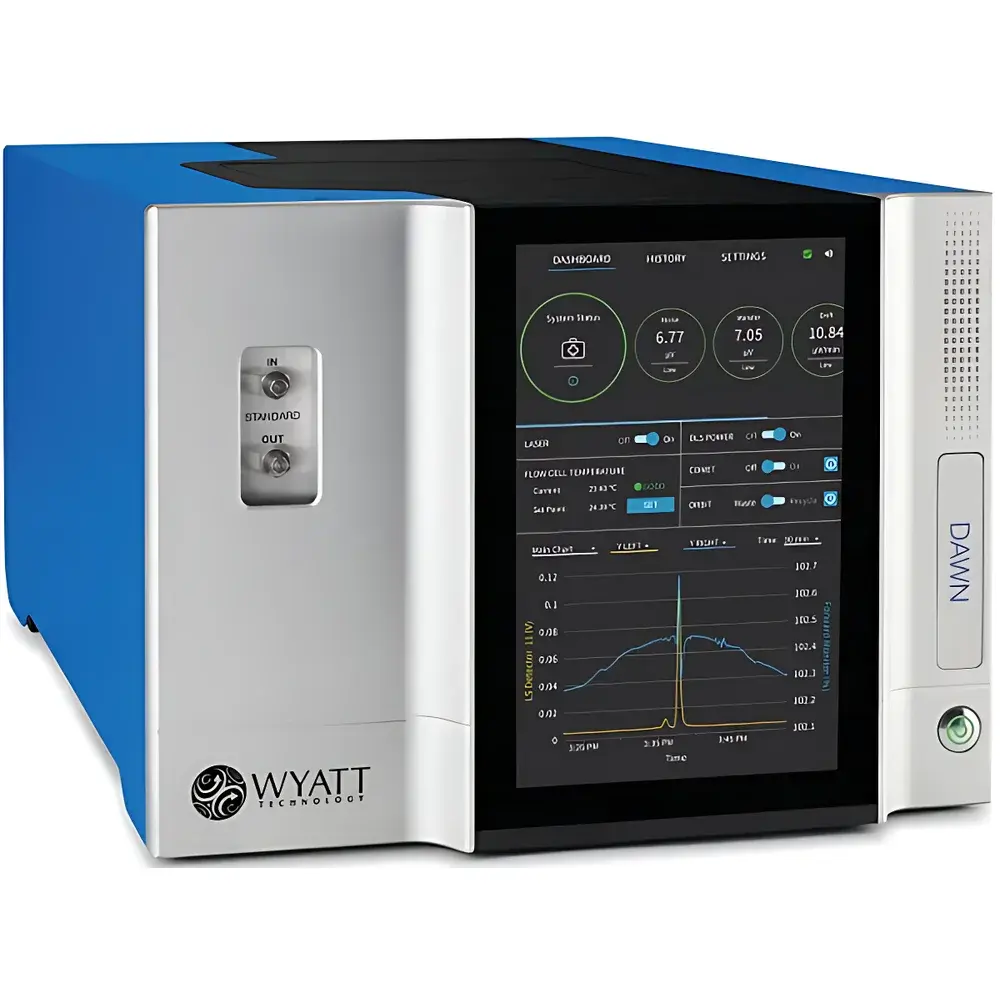
The Wyatt DAWN SEC-MALS is a high-precision, multi-angle static and dynamic light scattering (MALS/DLS) detector engineered for integration with gel permeation chromatography (GPC) or size-exclusion chromatography (SEC) systems. Operating on the fundamental principles of Rayleigh–Gans–Debye light scattering theory, the DAWN measures the angular dependence of scattered laser intensity at 18 discrete detection angles simultaneously—enabling direct, calibration-free determination of absolute molar mass, root-mean-square (Rg) radius, and conformational parameters for macromolecules in solution. Unlike conventional SEC relying on polymer standards, SEC-MALS eliminates column calibration bias by coupling light scattering signals with concentration data from inline detectors (e.g., differential refractometry or UV absorbance), thereby delivering first-principles molecular characterization across a broad mass range—from 200 Da to 109 Da—and Rg values spanning 10–500 nm.
Key Features
- 18-angle MALS detection geometry with real-time angular intensity acquisition, optimized for robust Zimm and Debye analysis
- 658 nm linearly polarized GaAs laser (100 mW output), thermally stabilized and fiber-coupled for beam consistency and long-term alignment stability
- Integrated Ethernet interface enabling deterministic, low-latency data streaming to ASTRA software with sub-millisecond time-stamping
- Full-color LCD display providing immediate visualization of scattering intensity profiles, signal-to-noise metrics, and system status diagnostics
- Rugged optical housing with temperature-compensated photodiode array and sealed detector compartments to minimize thermal drift and contamination
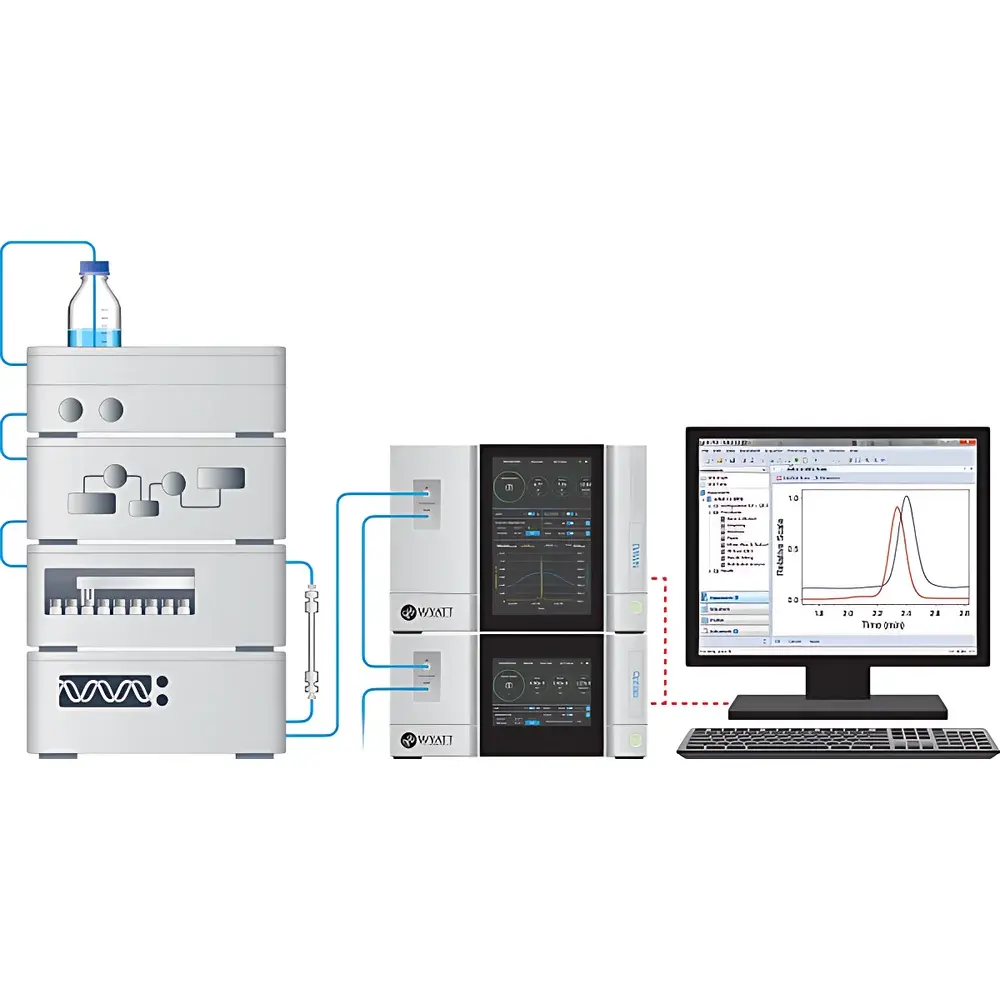
- Modular design supporting both online (in-line with HPLC/SEC pumps) and offline (fraction-collection mode) configurations without hardware reconfiguration
- Simultaneous acquisition of static (Mw, Rg, A2) and dynamic (hydrodynamic radius, polydispersity) scattering parameters within a single chromatographic run
Sample Compatibility & Compliance
The DAWN is compatible with aqueous and organic mobile phases commonly used in SEC/GPC—including PBS, acetate buffers, DMF, THF, and chloroform—provided refractive index matching and low-absorbance conditions are maintained. Its detection architecture meets essential regulatory requirements for analytical traceability: raw scattering and concentration data are timestamped, digitally signed, and stored in vendor-neutral HDF5 format compliant with FDA 21 CFR Part 11 (electronic records and signatures) when deployed with ASTRA’s audit-trail-enabled configuration. The system supports GLP/GMP-aligned workflows through configurable user roles, instrument qualification templates (IQ/OQ/PQ), and full metadata logging—including pump pressure, column temperature, flow rate, and detector baseline stability metrics. It is routinely validated per ASTM D5296 (standard test method for molecular weight averages of polymers by SEC) and ISO 16014-4 (plastics—determination of average molecular weight by SEC).
Software & Data Management
Data acquisition, processing, and reporting are managed via Wyatt’s ASTRA software—a validated, platform-independent application built on a modular, object-oriented architecture. ASTRA implements rigorous error propagation models for MALS-derived parameters, automatically calculates second virial coefficient (A2) and Mark–Houwink parameters (k and α) when paired with a viscometer, and supports batch processing of hundreds of chromatograms with customizable report templates. All raw detector signals (scattering, RI, UV) are stored losslessly with full provenance: acquisition timestamps, instrument configuration snapshots, and user-defined annotation fields. Export options include CSV, PDF, and XML formats compatible with LIMS and enterprise data repositories. Software validation packages—including installation qualification (IQ), operational qualification (OQ), and performance qualification (PQ)—are available upon request for regulated environments.
Applications
- Determination of absolute molar mass distributions for synthetic polymers, dendrimers, and nanoparticle conjugates without reference standards
- Characterization of protein oligomerization states, aggregation propensity, and complex stoichiometry in biopharmaceutical development
- Quantification of glycosylation heterogeneity and PEGylation efficiency by deconvoluting component-specific masses from UV/RI/MALS tri-detector data
- Conformational analysis of polysaccharides and nucleic acids via Rg/Mw scaling relationships and branching ratio calculations
- Stability assessment of therapeutic proteins under thermal, pH, or shear stress using time-resolved SEC-MALS
- Validation of column performance and system dispersion effects through band-broadening correction algorithms embedded in ASTRA
FAQ
Can the DAWN be integrated with existing HPLC or UHPLC systems?
Yes—the DAWN features standard 1/16″ stainless-steel tubing interfaces and pressure-rated flow cells compatible with all major commercial LC platforms, including Agilent, Waters, Shimadzu, and Thermo Fisher systems.
Is column calibration required for molecular weight determination?
No—SEC-MALS provides absolute molar mass directly from first principles; column calibration is neither necessary nor recommended for quantitative results.
What sample volume is required for a typical SEC-MALS run?
Typical injection volumes range from 10–100 µL depending on concentration and detector sensitivity; minimum detectable mass is ~0.1 µg for globular proteins and ~1 µg for linear polymers in common solvents.
Does the DAWN support dynamic light scattering (DLS) measurements?
Yes—integrated DLS capability enables concurrent hydrodynamic radius (Rh) determination during SEC elution, facilitating direct comparison of Rg and Rh for conformational insight.
How is system suitability verified prior to routine use?
ASTRA includes automated system suitability tests (SSTs) that assess baseline noise, angular response uniformity, laser power stability, and inter-detector retention time alignment—generating pass/fail reports aligned with internal SOPs or regulatory guidelines.




