
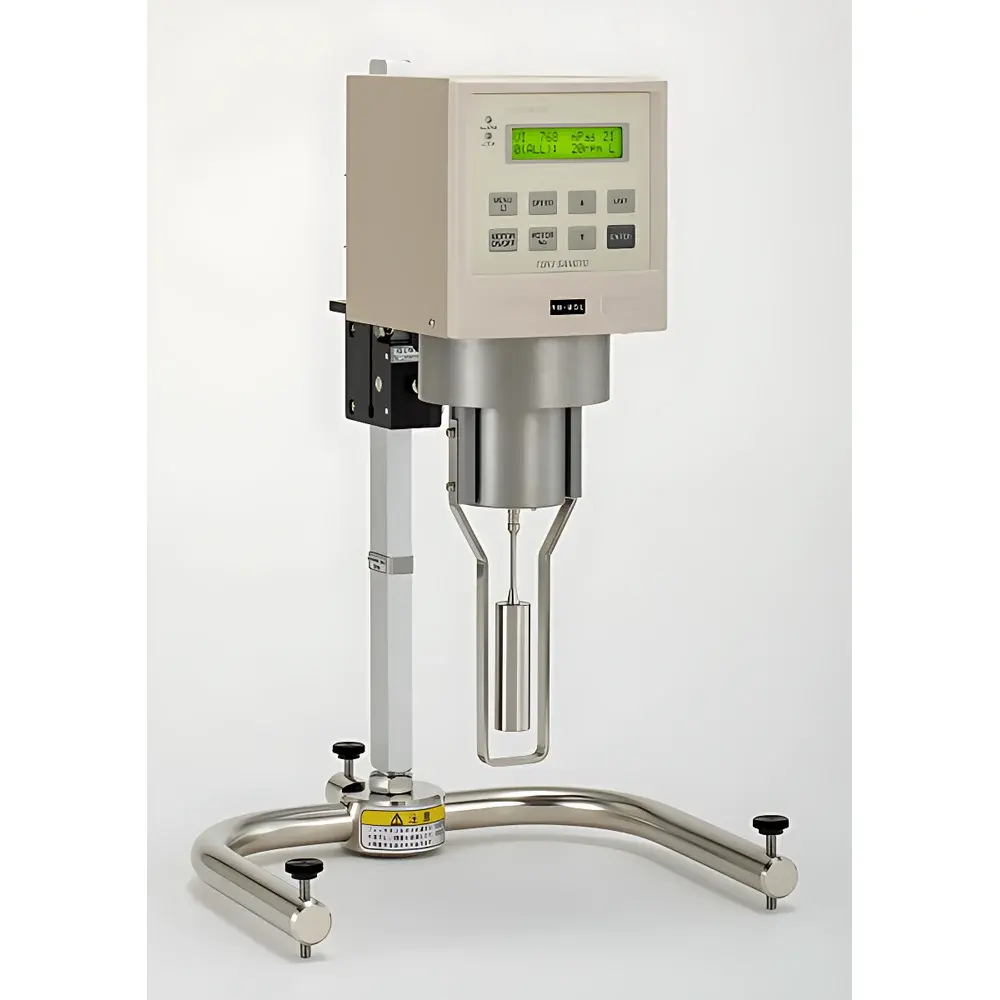
TOKI SANGYO RB-85 Series Cylindrical Rotational Viscometer
| Brand | TOKI SANGYO |
|---|---|
| Origin | Japan |
| Model Variants | RB-85L, RB-85H, RB-85R, RB-85S, RB-85U |
| Viscosity Range | 0.6–64,000,000 mPa·s |
| Accuracy | ±2.0% of full scale |
| Repeatability | ±0.2% of full scale |
| Operating Temperature | 0–40 °C |
| Relative Humidity | <90% RH (non-condensing) |
| Wetted Materials | SUS304 & SUS303 stainless steel |
| Power Supply | AC 100–240 V ±10%, DC 12 V / 2 A output |
| Power Consumption | ≤50 VA |
| Dimensions (Main Unit) | 120 × 145 × 330 mm (E-type) |
| Base Stand | 300 × 300 × 450 mm |
| Weight | 6.0 kg (including base stand) |
| Display Options | SI (mPa·s, Pa·s), CGS (cP), or % torque units |
Overview
The TOKI SANGYO RB-85 Series is a precision-engineered cylindrical rotational viscometer designed for high-stability viscosity measurement across an exceptionally broad dynamic range—from low-viscosity solvents (0.6 mPa·s) to highly structured polymer melts and gels (up to 64 million mPa·s). Based on the Couette principle, the instrument employs a concentric cylinder geometry where the sample resides in the annular gap between a stationary outer cup and a rotating inner spindle (rotor). Torque generated by fluid resistance is measured via a calibrated torsion spring or electromagnetic sensor system, enabling direct determination of dynamic viscosity under controlled shear conditions. Unlike cone-and-plate or spindle-based systems, the cylindrical configuration ensures uniform shear rate distribution throughout the measurement volume, minimizing wall-slip effects and improving reproducibility—particularly critical for non-Newtonian, thixotropic, or yield-stress fluids. The RB-85’s mechanical architecture integrates a motor-driven rotor assembly with automatic shaft-locking functionality activated post-measurement, protecting the precision pivot bearing during rotor removal—a key ergonomic and longevity-enhancing feature for routine QC laboratories and R&D environments.
Key Features
- Auto-locking shaft mechanism prevents bearing wear during rotor disengagement, significantly extending service life and reducing maintenance frequency.
- Five model variants (RB-85L/H/R/S/U) optimized for distinct viscosity sub-ranges and sample volumes, supporting method-specific calibration traceability.
- Dual-unit display capability: real-time switching between SI (mPa·s, Pa·s), CGS (cP), and % torque modes without recalibration.
- Stainless-steel wetted parts (SUS304 and SUS303) ensure chemical compatibility with aqueous, organic, and mildly corrosive media per ISO 8504-2 surface finish standards.
- Integrated environmental monitoring: continuous logging of ambient temperature (0–40 °C) and humidity (<90% RH, non-condensing) to support GLP-compliant test records.
- Low-power DC12V operation with universal AC input (100–240 V), enabling stable performance in variable-grid laboratory environments without voltage regulation hardware.
Sample Compatibility & Compliance
The RB-85 Series accommodates samples from Newtonian liquids (e.g., mineral oils, glycerol solutions) to complex structured fluids including hydrogels, bitumen emulsions, ceramic slips, and food pastes. Its fixed geometry eliminates user-induced alignment errors common in removable-spindle systems. All models comply with JIS Z 8803:2017 (Viscosity Measurement Methods Using Rotational Viscometers) and align with ASTM D2196 and ISO 2555 for apparent viscosity determination. The stainless-steel construction meets FDA-recommended material criteria for non-sterile pharmaceutical excipient testing. While not inherently 21 CFR Part 11 compliant, audit-trail-ready data export (via RS-232/USB) supports integration into validated LIMS or ELN platforms meeting GMP/GLP documentation requirements.
Software & Data Management
The RB-85 operates as a standalone instrument with front-panel control; optional PC connectivity enables ASCII-formatted data streaming for time-resolved viscosity profiling (e.g., gelation kinetics, thermal ramping). Exported files include timestamp, rotor ID, speed, torque, temperature, and calculated viscosity—structured for direct import into Excel, MATLAB, or statistical process control (SPC) software. Firmware supports firmware-upgradable calibration coefficients stored in non-volatile memory, ensuring metrological continuity across instrument lifecycles. No proprietary runtime environment is required—data acquisition is OS-agnostic and compatible with Windows, macOS, and Linux terminals.
Applications
- Quality control of adhesives, coatings, and inks where batch-to-batch consistency in sag resistance and leveling behavior is governed by low-shear viscosity.
- Rheological screening of battery electrode slurries to correlate viscosity with particle dispersion stability and coating defect formation.
- Process validation of edible oil refining steps (e.g., winterization, deodorization) through temperature-dependent viscosity mapping.
- Regulatory submission support for topical pharmaceutical formulations per USP <911> and Ph. Eur. 2.9.35 guidelines.
- Educational use in polymer science labs for introducing fundamental rheological concepts—including shear-thinning index calculation and zero-shear viscosity estimation via extrapolation.
FAQ
Does the RB-85 require annual recalibration?
Yes—TOKI SANGYO recommends traceable recalibration every 12 months using NIST-traceable standard oils (e.g., Cannon-Fenske or Brookfield viscosity standards) to maintain ±2.0% full-scale accuracy.
Can the RB-85 measure yield stress?
Not directly—the instrument reports apparent viscosity at discrete rotational speeds. Yield stress estimation requires complementary analysis (e.g., flow curve fitting using Herschel-Bulkley model) from multi-speed data sets.
Is rotor identification automated?
No—rotor type (L/H/R/S/U) must be manually selected on the front panel prior to measurement to apply correct geometric constants and scaling factors.
What is the minimum sample volume required?
Depends on model: RB-85L accepts ≥15 mL; RB-85H requires ≥40 mL due to larger cup geometry—refer to model-specific operating manual for exact fill-level markings.
Can the unit operate continuously for extended periods?
Yes—designed for unattended operation up to 8 hours at rated speed, provided ambient temperature remains within 0–40 °C and ventilation slots are unobstructed.



