
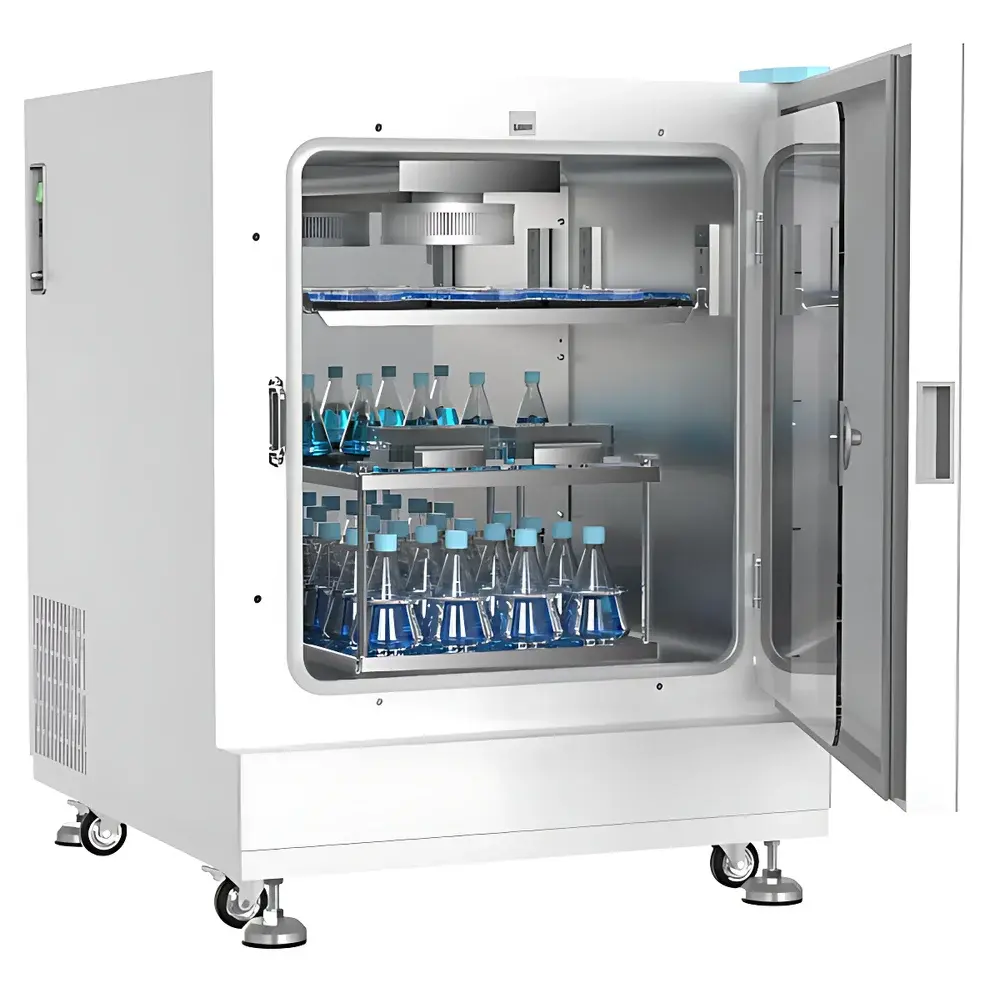
Yiheng BPNZ-100CS/100CD & BPNZ-300CS/CD CO₂ Incubator Shaker
| Brand | Yiheng |
|---|---|
| Origin | Shanghai, China |
| Manufacturer Type | Direct Manufacturer |
| Region Classification | Domestic (China) |
| Models | BPNZ-100CS, BPNZ-100CD, BPNZ-300CS, BPNZ-300CD |
| Pricing | Upon Request |
Overview
The Yiheng BPNZ Series CO₂ Incubator Shaker integrates precision cell culture incubation with controlled orbital shaking in a single compact platform. Engineered for mammalian, stem cell, and suspension culture applications requiring both physiological CO₂ tension and mechanical stimulation, it operates on dual-core principles: infrared-based CO₂ concentration monitoring (0–20% range) coupled with microprocessor-regulated orbital agitation (20–300 rpm). The system maintains temperature uniformity ±0.3°C across the chamber via PID-controlled heating, forced-air convection with adaptive fan speed modulation, and door-heating to eliminate condensation—critical for long-term imaging-compatible experiments. Its design conforms to core biosafety and process integrity requirements for GLP-compliant labs, supporting uninterrupted operation over 72+ hours under full load.
Key Features
- Integrated dual-function architecture: simultaneous CO₂ incubation (0–20%, ±0.1% accuracy) and orbital shaking (20–300 rpm, ±1 rpm repeatability), eliminating need for separate incubators and shakers.
- Infrared CO₂ sensor (imported, non-dispersive) with drift-free calibration; unaffected by ambient humidity or frequent door openings; response time <60 seconds to 95% of setpoint.
- O₂ control option (zirconia-based sensor): adjustable range 0.1–90% O₂, enabling hypoxic, normoxic, and hyperoxic culture protocols within one unit.
- 304 stainless steel interior with electropolished finish and radiused corners; corrosion-resistant, autoclavable surfaces compliant with ISO 14644-1 Class 5 (100-level cleanroom equivalency post-HEPA recovery).
- Dual-stage filtration: 0.3 µm-rated microbial filter (99.99% efficiency) on CO₂ inlet + internal HEPA (H14 grade) recirculation filter; chamber achieves ≤100 particles/ft³ (≥0.5 µm) within 5 minutes after door closure.
- 90°C high-humidity thermal sterilization cycle (18-hour duration), validated for complete inactivation of mycoplasma, bacteria, and fungi—including sensors, fans, and shelf supports.
- Three-eccentric-axis balanced drive mechanism ensures uniform motion distribution across entire shaker platform, even at maximum payload (up to 30 kg for BPNZ-300 models).
- Intelligent safety architecture: independent overtemperature cutoff, CO₂/O₂ deviation alarms, door-open interlock (halts shaking, heating, and fan), and real-time motor current monitoring to prevent liquid splash damage.
Sample Compatibility & Compliance
The BPNZ series accommodates standard tissue culture vessels including T-flasks (up to 175 cm²), roller bottles, multi-well plates (6–96-well), and custom bioreactor bags (with compatible clamps). All contact surfaces meet USP Class VI biocompatibility standards. The system supports regulatory workflows aligned with FDA 21 CFR Part 11 (when equipped with optional分级权限 management and audit-trail-enabled touchscreen), ISO 13485 for medical device R&D, and ASTM E1998 for incubator performance verification. Internal validation documentation includes temperature mapping reports (per ISO 14644-3), CO₂ homogeneity profiles (±0.3% spatial deviation), and vibration spectrum analysis confirming <0.5 mm amplitude consistency across load conditions.
Software & Data Management
The 7-inch capacitive touchscreen interface supports bilingual (English/Chinese) operation with configurable user roles: Administrator (full parameter access, sterilization control, log export), Operator (routine run control only), and Guest (view-only mode). System logs record timestamped events—including parameter changes, door openings, alarm triggers, and sterilization cycles—with SHA-256 hashing for tamper evidence. Optional SMS alert module transmits fault codes (e.g., CO₂ sensor timeout, compressor shutdown) directly to designated mobile numbers. Data export is available via USB 2.0 (CSV format) with optional Ethernet connectivity for integration into LIMS or ELN platforms.
Applications
- Mammalian suspension cell expansion (CHO, HEK293, hybridomas) under controlled gas tension and shear stress.
- Stem cell differentiation studies requiring dynamic mechanical cues alongside hypoxia (e.g., HIF-1α stabilization assays).
- Microcarrier-based 3D culture systems where uniform nutrient/gas exchange depends on consistent orbital motion.
- Vaccine production workflows (e.g., viral vector amplification) demanding strict sterility, traceable environmental records, and uninterrupted agitation.
- Toxicology screening using organ-on-chip models where real-time metabolic activity correlates with precise O₂/CO₂ modulation.
FAQ
What CO₂ concentration accuracy does the infrared sensor provide?
The NDIR sensor delivers ±0.1% absolute accuracy across 0–20% range, with automatic compensation for ambient pressure and humidity fluctuations.
Can the unit operate continuously for 7 days without maintenance?
Yes—validated for unattended 168-hour operation under nominal load (25°C, 5% CO₂, 120 rpm) with low-heat DC motor and sealed bearing design.
Is the HEPA filter replaceable without tools?
Yes—the H14-grade HEPA module mounts via quick-release latches; replacement interval is 12 months under typical lab use or after each thermal sterilization cycle.
Does the 90°C sterilization cycle validate sensor survival?
Yes—temperature and CO₂ sensors are rated for continuous exposure to 90°C saturated steam; calibration remains stable post-cycle per factory validation report.
How is door-opening impact mitigated during CO₂ recovery?
The control algorithm activates rapid CO₂ injection + recirculation boost upon door closure, restoring setpoint within ≤3 minutes (tested at 20°C ambient, 50% RH).



