
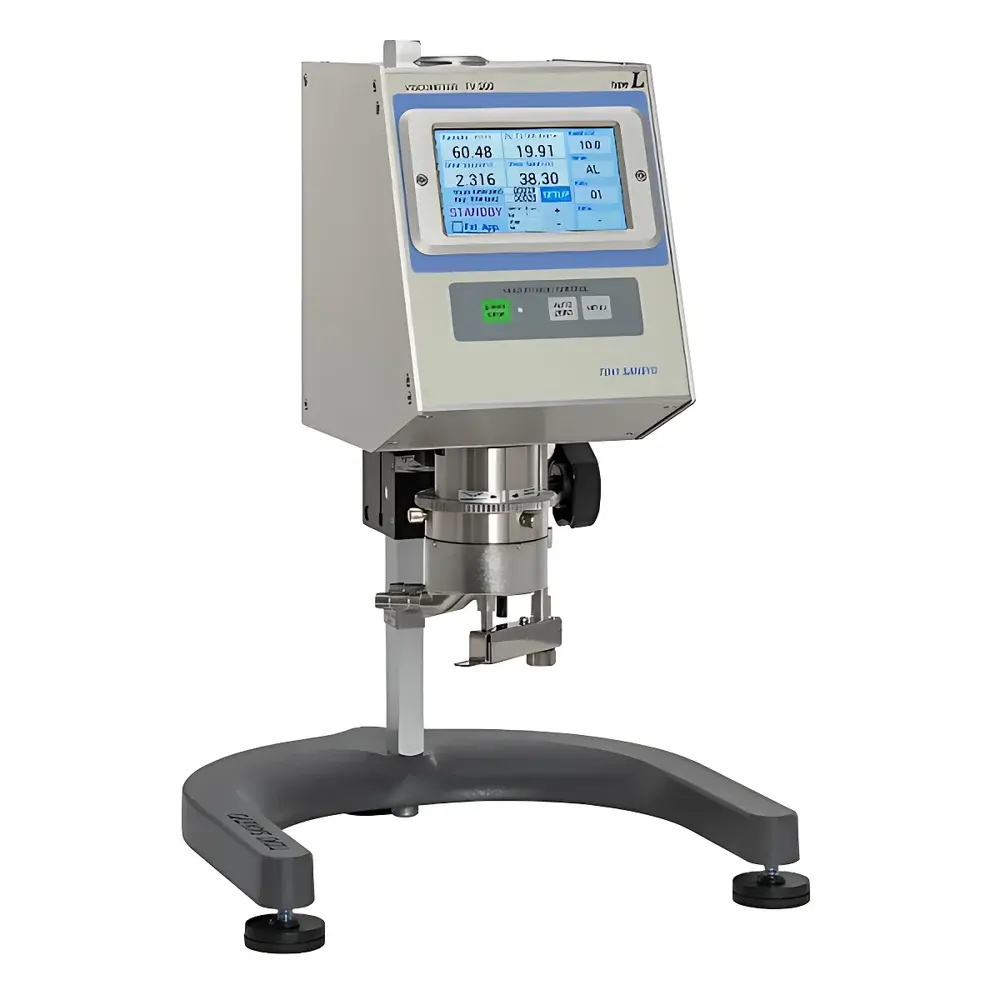
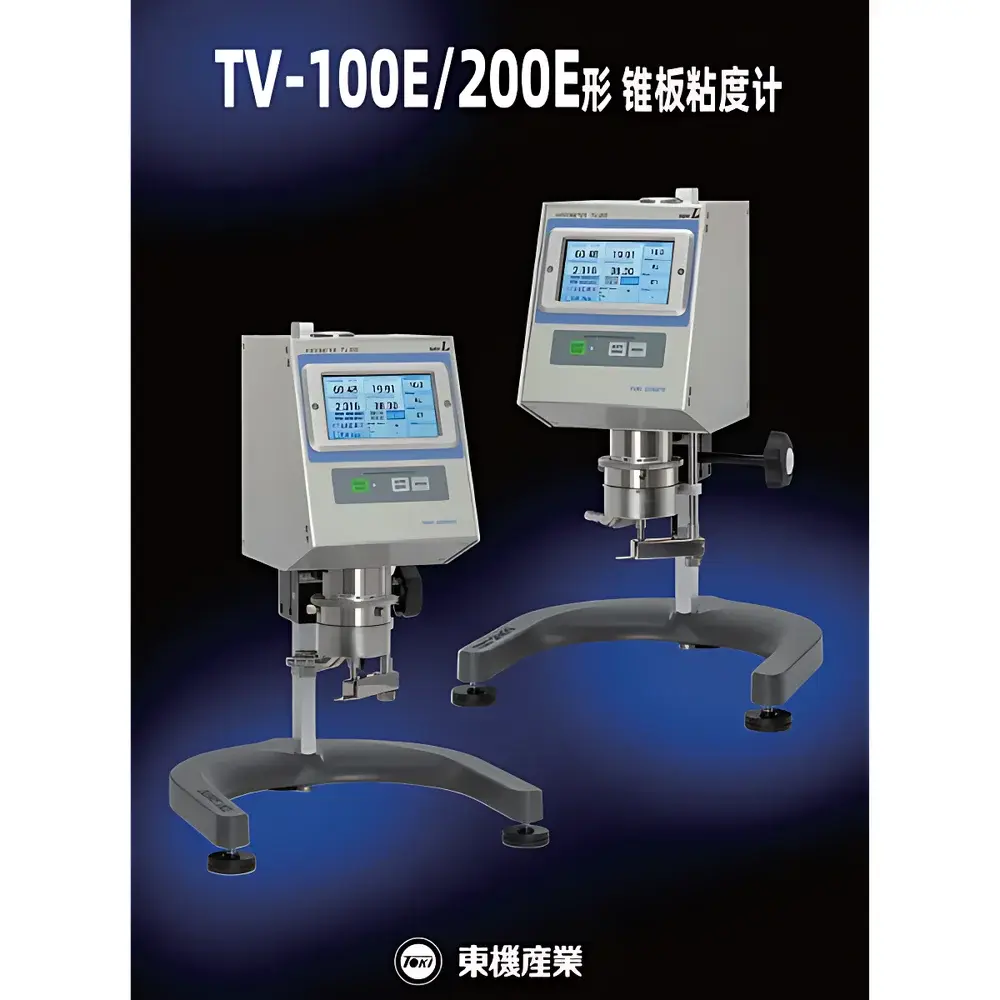
TOKI SANGYO TV-100EH Cone-Plate Viscometer
| Brand | TOKI SANGYO |
|---|---|
| Origin | Japan |
| Manufacturer Type | Authorized Distributor |
| Origin Category | Imported |
| Model | TV-100EH Cone-Plate Viscometer – Multi-Range |
| Instrument Type | Rotational Viscometer |
| Mounting | Benchtop (Fixed) |
| Operating Environment | Ambient Temperature |
| Viscosity Range | 0.608–303,800 mPa·s (standard cone rotor 1°34′×R24) |
| Speed Range | 0.1–100.0 rpm in 0.1-rpm increments |
| Torque Range | 718.7–5749.6 µN·m (H/R/U ranges) |
| Accuracy | ±1% of full scale |
| Repeatability | ±0.2% of full scale |
| Temperature Range | 10–60 °C |
| Temp. Resolution | 0.1 °C |
| Temp. Accuracy | ±0.2 °C |
| Display | 4.3″ color TFT touchscreen |
| Data Interfaces | USB-B (PC), USB-A (printer), analog temperature sensor input |
| Power | AC 100–240 V, 15 VA |
| Dimensions (W×D×H) | 300 × 334 × 436 mm (incl. stand) |
| Weight | ~6.5 kg |
| Sample Contact Material | Stainless Steel |
| Compliance | JIS Z 8803, ISO 2555, ASTM D2196 |
Overview
The TOKI SANGYO TV-100EH Cone-Plate Viscometer is a high-precision, benchtop rotational viscometer engineered for reliable and reproducible viscosity measurement across an exceptionally wide dynamic range. It operates on the principle of controlled shear rate application via a precisely defined cone-and-plate geometry—where a conical rotor rotates above a flat, thermostatically stabilized plate—generating a uniform shear field ideal for Newtonian and non-Newtonian fluid characterization. Unlike traditional spindle-based viscometers, the cone-plate configuration ensures constant shear rate distribution across the entire sample gap, eliminating edge effects and enabling accurate determination of shear stress, shear rate, and apparent viscosity under defined rheological conditions. The TV-100EH implements a torque-balanced servo control system with pivotless hinge architecture—eliminating mechanical wear associated with jewel bearings—and delivers linear, drift-free response across its full operational envelope. Its hallmark feature is the three-tier dynamic torque range (H/R/U), allowing seamless extension of measurable viscosity up to 518,500 mPa·s without manual rotor exchange—a capability critical for laboratories handling diverse formulations—from low-viscosity solvents to highly structured pastes and gels.
Key Features
- Torque-balanced servo mechanism employing null-balance detection: ensures stable zero-point reference and minimizes thermal/mechanical drift during extended measurements.
- Pivotless hinge structure: replaces conventional pivot-and-jewel bearing assemblies with a compliant flexure system, enhancing long-term mechanical stability and eliminating maintenance-related calibration shifts.
- Three auto-switching torque ranges (H/R/U): provides 8× effective dynamic range expansion while maintaining full resolution and accuracy within each range; no physical rotor replacement required during multi-viscosity workflows.
- 4.3-inch full-color capacitive touchscreen interface: displays real-time viscosity (mPa·s or cP), % torque, shear stress (Pa), shear rate (s⁻¹), temperature, speed, range status, and rotor identification—all configurable and navigable without external software.
- Programmable measurement modes: supports 10 user-defined protocols per mode—including manual operation, time-triggered stop, and viscosity-threshold termination—with automatic zero and offset correction executed prior to each run.
- Precise rotational control: 0.1–100.0 rpm in 0.1-rpm increments (1001 discrete steps), enabling fine-grained shear rate sweeps and compliance with standardized test methods requiring specific angular velocity profiles.
- Integrated temperature monitoring: accepts external Pt100 or thermistor probes (optional), with 0.1 °C resolution and ±0.2 °C accuracy over 10–60 °C—essential for temperature-dependent viscosity profiling per ISO 2555 and ASTM D2196.
- Remote I/O capability: TTL-compatible trigger inputs for start/stop commands and open-collector status outputs for external signaling (e.g., PLC integration, alarm lights, audible alerts).
Sample Compatibility & Compliance
The TV-100EH accommodates samples requiring precise thermal and shear history control—including polymer melts, coatings, adhesives, pharmaceutical suspensions, food emulsions, and ceramic slurries. Its stainless-steel wetted parts comply with general laboratory material compatibility requirements, and the cone-plate geometry enables minimal sample volume usage (~0.5 mL) while ensuring representative bulk behavior. The instrument conforms to key international standards governing rotational viscometry: JIS Z 8803 (Japanese Industrial Standard for rotational viscometers), ISO 2555 (plastics—resins in solution—determination of viscosity), and ASTM D2196 (test methods for rheological properties of non-Newtonian materials). While not intrinsically 21 CFR Part 11 compliant, audit-ready data export via USB ensures traceability for GLP/GMP-aligned environments when paired with validated lab information management systems (LIMS).
Software & Data Management
Data acquisition and reporting are handled natively via the embedded OS; no proprietary PC software is required for routine operation. All measurements—including timestamp, temperature, speed, torque, viscosity, and range selection—are logged internally and exportable in CSV format via USB-B connection. The unit supports direct printing to USB-A–compatible serial printers for hard-copy records. For advanced analysis, exported datasets integrate seamlessly with third-party tools such as Excel, OriginLab, or Python-based rheological modeling packages. Memory retains up to 10 protocols per mode, and all calibration parameters—including torque offset, temperature compensation coefficients, and rotor-specific geometry constants—are stored non-volatilely. Firmware updates are delivered via USB flash drive, ensuring long-term supportability without hardware modification.
Applications
The TV-100EH serves quality control laboratories in paints & coatings, where rapid assessment of sag resistance and leveling behavior demands consistent low-shear viscosity data; R&D units developing topical pharmaceutical gels, where viscosity at physiologically relevant shear rates dictates spreadability and drug release kinetics; and materials science groups characterizing thermoset resins prior to curing, where viscosity evolution versus time/temperature informs process window definition. Its robustness and repeatability also make it suitable for incoming raw material verification in chemical manufacturing, compliance testing against contractual specifications, and educational use in university rheology labs seeking a cost-effective entry into cone-plate methodology.
FAQ
Does the TV-100EH require regular recalibration using certified standard oils?
Yes—while the instrument features automatic zero and offset correction, periodic verification using NIST-traceable viscosity standards (e.g., Cannon-Manning silicone oils) is recommended per ISO/IEC 17025 guidelines, especially before critical batch release testing.
Can the TV-100EH be connected to a temperature-controlled circulating bath?
Yes—the unit accepts external temperature sensor input and is compatible with standard recirculating chillers/heaters equipped with Pt100 output; the plate temperature is regulated externally, and the viscometer reads and logs that value synchronously.
Is rotor geometry factor (K-factor) automatically applied during calculation?
Yes—each rotor (including optional cones such as 1°34′×R24, 2°×R24, or 4°×R24) has its unique K-factor pre-programmed; selection from the touchscreen triggers automatic scaling of torque-to-viscosity conversion.
What is the minimum sample volume required for valid cone-plate measurement?
Approximately 0.4–0.6 mL, depending on cone angle and radius; sufficient to fully cover the plate surface and fill the defined gap without overflow or air entrapment.
Does the instrument support continuous real-time data streaming to a host PC?
No—it does not support live serial or Ethernet streaming; however, measurement sequences can be triggered remotely, and full datasets are instantly available post-run via USB export.



