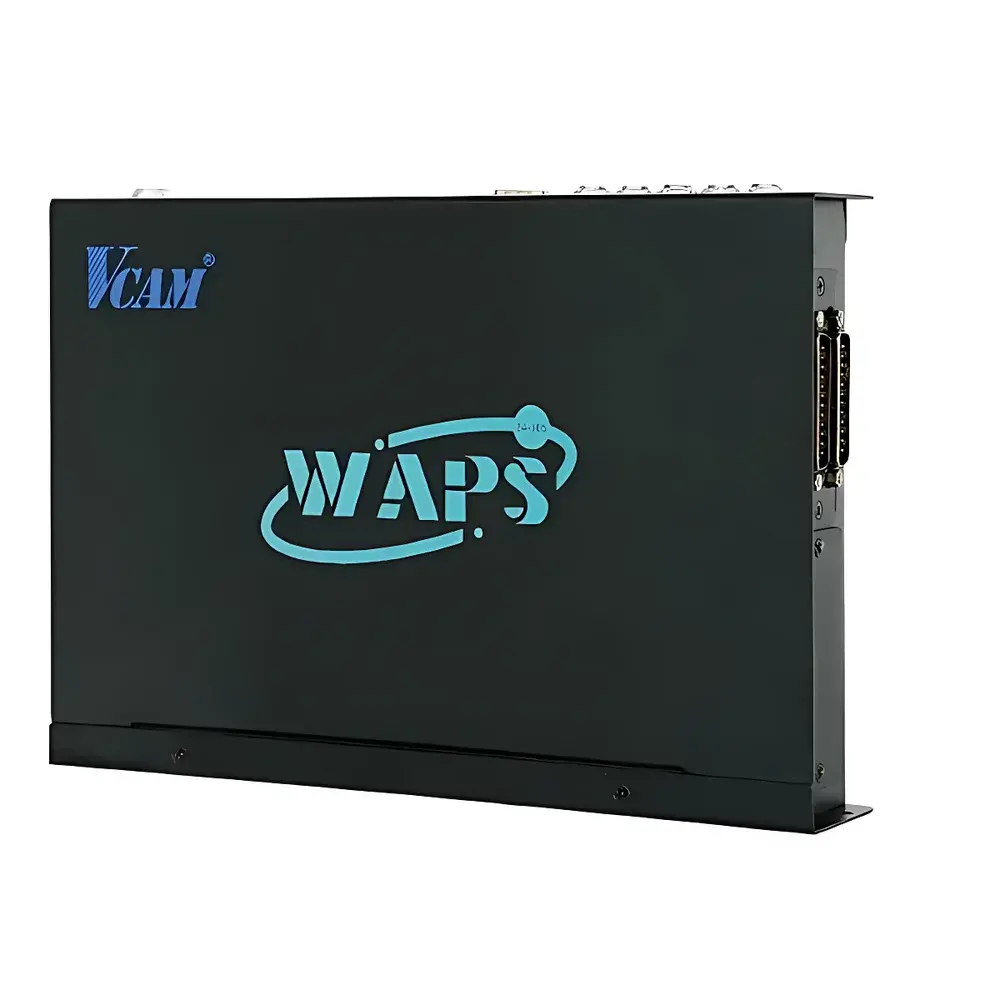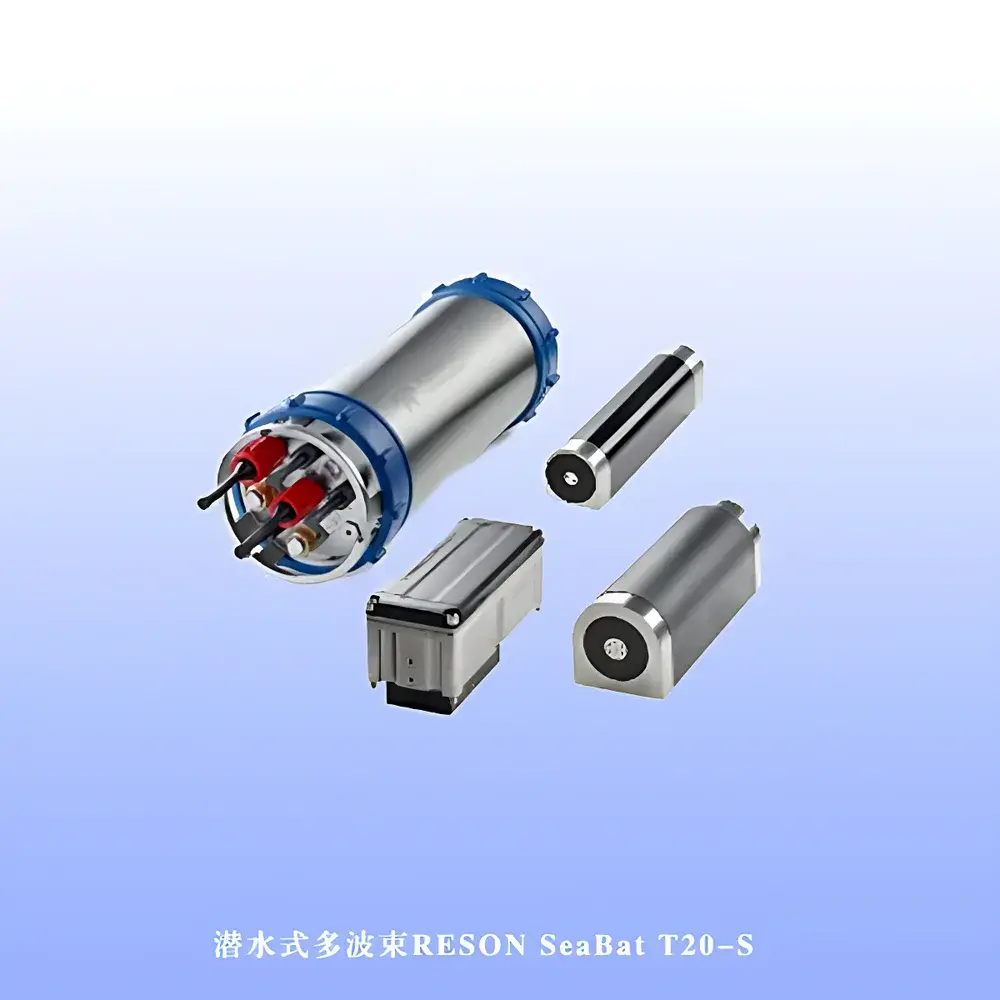
Reson SeaBat T20-S Submersible Multibeam Echo Sounder
| Origin | Denmark |
|---|---|
| Manufacturer Type | Authorized Distributor |
| Origin Category | Imported |
| Model | SeaBat T20-S |
| Price | USD 100 (FOB) |
| Operating Depth | Up to 6000 m |
| Housing Material | Titanium Alloy (6″ pressure housing) |
| Onboard Storage | 1 TB SSD |
| Beam Count | Up to 512 beams |
| Swath Width | Up to 165° |
| Frequency | 200–400 kHz |
| Vertical Beamwidth | 1.1°–2.2° (nominal) |
| Horizontal Beamwidth | 1.1°–2.2° (nominal) |
| Depth Range | 0.5–500 m |
| Ping Rate | Up to 50 Hz |
| Pulse Width | 30–10,000 µs (CW/FM modes) |
| Depth Resolution | 6 mm |
| Transducer Weight (air/water) | 5.0–5.4 kg / 3.4–4.2 kg |
| Portable Processor Dimensions | 131 × 424 × 379 mm |
| Portable Processor Weight | 14 kg |
| IP Rating | IP54 |
| Operating Temp (Processor) | −2°C to +40°C |
| Operating Temp (Transducer) | −2°C to +30°C |
| Power Input | 24 VDC or 100–230 VAC, 50/60 Hz |
| Power Consumption | 200 W (std), 300 W (peak) |
| Cable Length (standard) | 10 m (25 m / 50 m optional) |
Overview
The Reson SeaBat T20-S is a purpose-engineered submersible multibeam echo sounder designed for deep-ocean deployment on remotely operated vehicles (ROVs) and autonomous underwater vehicles (AUVs). Unlike surface-deployed variants such as the SeaBat T20-P, the T20-S integrates a fully encapsulated, pressure-rated titanium alloy housing (6″ diameter) that accommodates both the acoustic transceiver and an embedded real-time sonar processor with 1 TB of onboard solid-state storage. This architecture eliminates external cabling dependencies during submerged operations and enables autonomous data acquisition—critical for missions where latency, bandwidth constraints, or vehicle tether limitations preclude real-time telemetry. The system operates across a dual-frequency band (200 kHz and 400 kHz), delivering high-resolution bathymetric mapping with vertical beamwidths as narrow as 1.1° and up to 512 simultaneous beams per ping. Its physical design conforms to ISO 8508 and IEC 60529 (IP54) standards for environmental protection, while its hydrostatic rating supports continuous operation at depths up to 6000 meters—validated per ISO 12217-3 for subsea pressure integrity.
Key Features
- Integrated titanium pressure housing (6″) rated to 6000 m depth, containing transceiver, processor, and 1 TB internal SSD
- Dual-frequency operation (200 kHz / 400 kHz) with selectable pulse width (30 µs–10 ms) and modulation mode (CW/FM)
- Up to 512 beams per ping; maximum swath width of 165° at 400 kHz, optimized for high-resolution shallow-water surveys
- Depth resolution of 6 mm at full bandwidth, compliant with IHO Special Order accuracy requirements for hydrographic surveying
- Self-contained time synchronization via embedded GPS-disciplined oscillator (GPSDO), ensuring precise sensor timestamping without external PPS input
- Low in-water weight (<4.2 kg for receiver, <3.4 kg for transmitter) minimizes vehicle payload burden and improves maneuverability
- Modular power architecture supporting 24 VDC (vehicle bus) or 100–230 VAC (dockside checkout); peak draw limited to 300 W
Sample Compatibility & Compliance
The SeaBat T20-S is engineered for compatibility with standard ROV/AUV integration frameworks including Kongsberg MCL, Teledyne Gavia, and Saab Seaeye control buses. Its mechanical interface complies with ISO 13628-6 for subsea connector mounting, and its electrical interface adheres to RS-422 and Ethernet/IP protocols for command-and-control interoperability. All firmware and data formats conform to S-100 (IHO Hydrographic Data Model) and S-102 (Bathymetric Surface Product) specifications. The system meets EMC requirements per EN 61000-6-2/6-4 and is certified for marine use under DNV-GL Marine System Certification Scheme (MSCS) Class B. For regulatory compliance, raw data logs include audit-trail metadata (ping timestamp, attitude compensation source, calibration epoch) required under ISO/IEC 17025 for accredited hydrographic service providers.
Software & Data Management
Data acquisition and post-processing are supported by Reson’s SIS (Seafloor Information System) v5.x software suite, which provides real-time QC visualization, motion-sensor fusion (lever-arm corrected using MRU inputs), and automated beamforming calibration. Raw .all files are stored in Reson’s proprietary but openly documented QINSy-compatible binary format, enabling seamless import into CARIS HIPS, QPS Qimera, and EIVA NaviModel. The embedded processor supports scheduled autonomous missions via Lua-based scripting—allowing conditional ping rate adjustment, adaptive swath control, and failure-triggered data dump. All data exports include embedded NMEA 0183 and NMEA 2000 metadata streams for traceable sensor provenance, satisfying FDA 21 CFR Part 11 electronic record requirements when used in offshore geotechnical site investigations governed by API RP 2GEO.
Applications
- High-resolution seafloor mapping for pipeline route surveys and cable corridor clearance (per DNV-RP-F109)
- ROV-based inspection of subsea infrastructure—including manifolds, templates, and wellheads—at depths exceeding 4000 m
- AUV-based benthic habitat classification in support of ISA exploration contract obligations (Regulation 31, Mining Code)
- Pre- and post-dredging verification for port development projects requiring IHO Order 1a vertical accuracy
- Scientific seafloor morphology studies in tectonically active zones, leveraging FM chirp capability for sediment penetration analysis
- Autonomous mine countermeasures (AMCM) operations where low-probability-of-intercept (LPI) acoustic signatures are mandated
FAQ
What is the maximum operational depth rating for the SeaBat T20-S?
The system is pressure-tested and certified for continuous operation at depths up to 6000 meters, with titanium housing validated per ISO 12217-3 Annex C.
Does the T20-S require external GNSS or motion reference units for navigation-grade output?
No—while external MRU/GNSS inputs improve positional fidelity, the embedded processor performs dead-reckoning inertial fusion using its internal IMU, enabling stand-alone bathymetry generation with ≤0.5% horizontal uncertainty (CEP) over 2 km track lengths.
Can the 1 TB internal storage be replaced or expanded in-field?
Storage is soldered SSD and non-user-serviceable; however, hot-swappable external USB 3.2 Gen 2 drives can be connected via the processor’s auxiliary port for redundant archiving.
Is firmware update capability available over Ethernet while submerged?
Firmware updates must be performed topside via Ethernet or serial connection; no underwater OTA capability is implemented due to acoustic channel instability and cybersecurity hardening requirements.
How does the T20-S handle variable sound speed profiles in deep water?
The system supports real-time SV profile ingestion via XBT/CTD input or manual entry; ray-tracing correction is applied per UNESCO EOS-80 algorithm within the beamforming engine.