
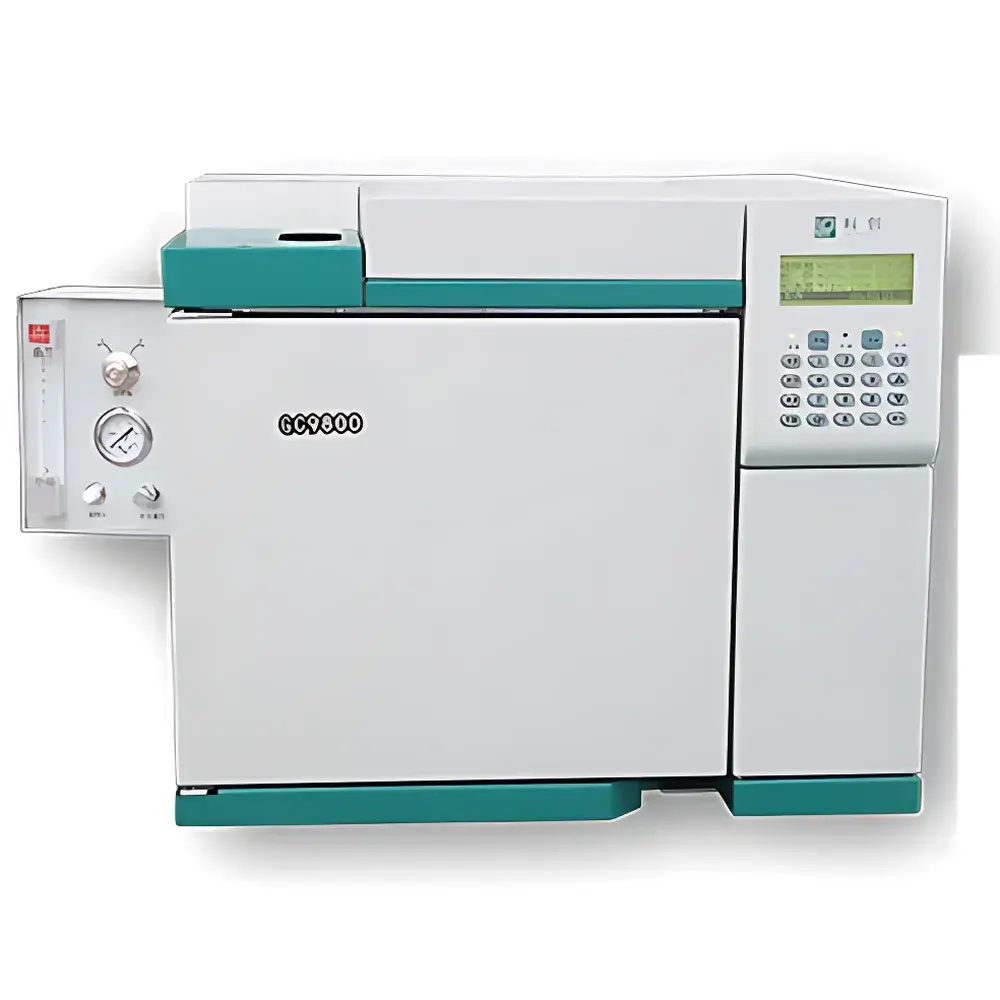
Kechuang GC9800N/TFH High-Purity Helium Analysis Gas Chromatograph
| Brand | Kechuang |
|---|---|
| Origin | Shanghai, China |
| Manufacturer Type | Direct Manufacturer |
| Country of Origin | China |
| Model | GC9800N/TFH |
| Detection Targets | Trace impurities in high-purity helium (Ne, O₂, N₂, H₂, CO₂, CH₄), hydrogen, nitrogen, and carbon dioxide |
| Detectors | TCD (TC-1H) + FID + Ni methanizer |
| Minimum Detectable Concentration | Ne: 0.18 ppb v/v, O₂: 0.09 ppb v/v, N₂: 0.08 ppb v/v |
| Temperature Range | 8 °C above ambient to 400 °C |
| Temperature Control Accuracy | ±0.5% |
| Programmable Temperature Ramping | 8-step, 0–39 °C/min (0.1 °C/min increment) |
| Baseline Noise | ≤0.01 mV |
| Baseline Drift | ≤0.1 mV/30 min |
| Linear Range | 10⁵ |
| Column Oven | Motorized auto-back-opening, near-ambient operation (≥8 °C above ambient) |
Overview
The Kechuang GC9800N/TFH is a dedicated high-purity special gas analysis system engineered for ultra-trace impurity quantification in helium matrixes—critical for semiconductor manufacturing, fiber optic production, cryogenic research, and high-integrity calibration gas certification. Built upon classical gas chromatographic separation principles, the instrument separates gaseous components using packed or capillary columns under controlled carrier gas flow (typically argon or helium), followed by dual detection via thermal conductivity (TCD) and flame ionization (FID) detectors. The integrated nickel catalytic converter enables sensitive methane conversion of CO and CO₂, extending analytical coverage without requiring additional hardware. Its architecture conforms to fundamental GC performance benchmarks defined in ISO 6425, ASTM D1945, and IEC 60079-29-1 for hazardous area-compatible instrumentation design. All temperature zones—including oven, injector, and detector blocks—are independently regulated with digital PID feedback, ensuring retention time stability and inter-run reproducibility essential for GLP-compliant trace gas verification.
Key Features
- Modular dual-detector configuration: High-sensitivity TCD (TC-1H) with ≥5000 mV·mL/mg response to benzene and ultra-low baseline noise (≤0.01 mV); FID optimized for hydrocarbon detection down to sub-ppb levels.
- Advanced temperature control system: Six independent zones with 8-step programmable ramping, precision of ±0.5% across 8 °C above ambient to 400 °C, and motor-driven column oven auto-back-opening for rapid cooldown.
- Network-enabled architecture: 10/100 M Ethernet interface supporting remote instrument control, real-time data streaming, and centralized fleet management—up to 253 units per subnet—enabling multi-lab QA/QC coordination.
- Digital signal output: Integrated chromatography workstation provides native Ethernet-based analog-to-digital conversion; raw voltage signals transmitted directly over LAN without USB intermediaries.
- Self-diagnostic firmware: Real-time fault logging identifies anomalies in heater circuits, sensor drift, or pressure regulation failures; automatic thermal cutoff activates if any zone exceeds user-defined safety thresholds.
Sample Compatibility & Compliance
The GC9800N/TFH is validated for analysis of helium-grade gases containing trace-level impurities including neon (Ne), oxygen (O₂), nitrogen (N₂), hydrogen (H₂), carbon monoxide (CO), carbon dioxide (CO₂), and methane (CH₄). It supports both manual gas-tight syringe injection and automated valve-based sampling systems (e.g., 6-port or 10-port valves) compatible with standard CGA-580 or ISO 8573-1 sampling interfaces. Method development aligns with USP <642>, ISO 8573-5, and SEMI F57-0301 standards for electronic specialty gases. Data integrity meets FDA 21 CFR Part 11 requirements when paired with compliant LIMS integration and audit-trail-enabled software configurations. All wetted materials are electropolished stainless steel or fused silica, minimizing surface adsorption and memory effects during repeated high-purity analyses.
Software & Data Management
The embedded workstation delivers vendor-neutral ASCII and CDF (NetCDF) export formats, facilitating third-party spectral library matching (e.g., NIST MS Search) and statistical process control (SPC) integration. Raw chromatograms retain full timestamped metadata—including inlet pressure, detector gain, and column head pressure—for retrospective method validation. Batch processing supports IS (internal standard) and external calibration curves with polynomial weighting options. Audit trails record all parameter modifications, user logins, and report generation events—configurable for GMP-aligned review cycles. Remote access allows supervisors to monitor instrument uptime, recent chromatogram thumbnails, and alarm history via web browser without local client installation.
Applications
- Helium purity certification for ISO 8573-1 Class 1 compressed air and inert gas specifications.
- Residual gas analysis in vacuum chamber qualification for particle-free semiconductor tooling.
- Verification of ultra-high-purity (UHP) helium used in helium leak detection systems (ASTM E493).
- Quantitative profiling of impurity breakthrough in helium purification skids (e.g., PSA or cryo-trap systems).
- Reference gas blending validation where certified mixtures require <100 ppt-level accuracy for Ne/O₂/N₂.
FAQ
Does the GC9800N/TFH support compliance with FDA 21 CFR Part 11 for electronic records?
Yes—when deployed with role-based user authentication, electronic signatures, and immutable audit logs enabled via the networked workstation, it satisfies predicate rule requirements for analytical instrument data integrity.
Can the system analyze non-helium matrices such as hydrogen or nitrogen?
Yes—the dual-detector architecture and Ni converter allow quantitative analysis of impurities in high-purity H₂, N₂, Ar, and CO₂, following method adaptation per ISO 14687-2 for fuel cell grade hydrogen.
What column types are recommended for ppb-level Ne/O₂/N₂ separation?
Molecular sieve 5A (60/80 mesh) packed columns operated at sub-ambient temperatures (via optional chiller) deliver optimal resolution for permanent gases; capillary PLOT Al₂O₃/KCl columns are suitable for higher throughput applications.
Is remote diagnostic support available from the manufacturer?
Kechuang provides secure remote maintenance access through TLS-encrypted VNC sessions, subject to end-user authorization and firewall configuration per ISO/IEC 27001 guidelines.
How is baseline stability maintained during extended unattended runs?
Continuous digital baseline correction algorithms compensate for minor thermal fluctuations; combined with active oven insulation and zero-gas auto-zero routines, drift remains ≤0.1 mV/30 min over 72-hour sequences.







