
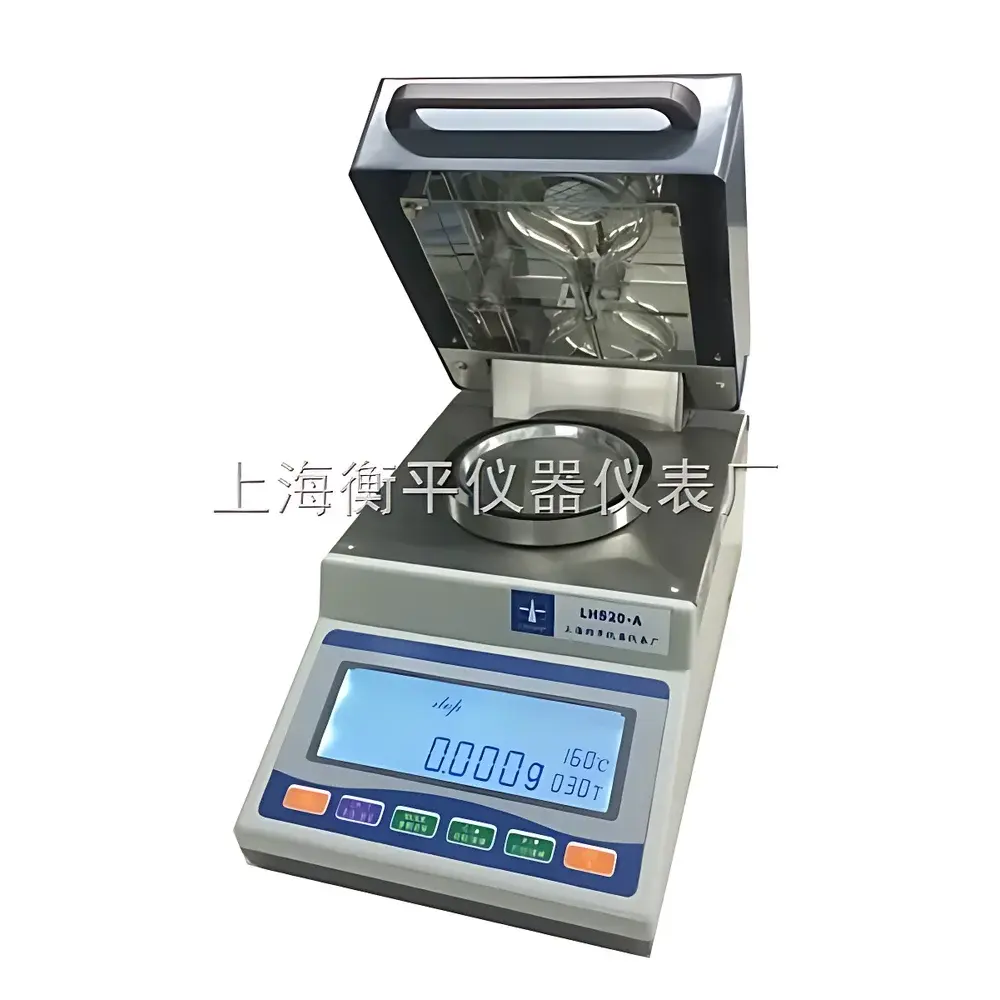
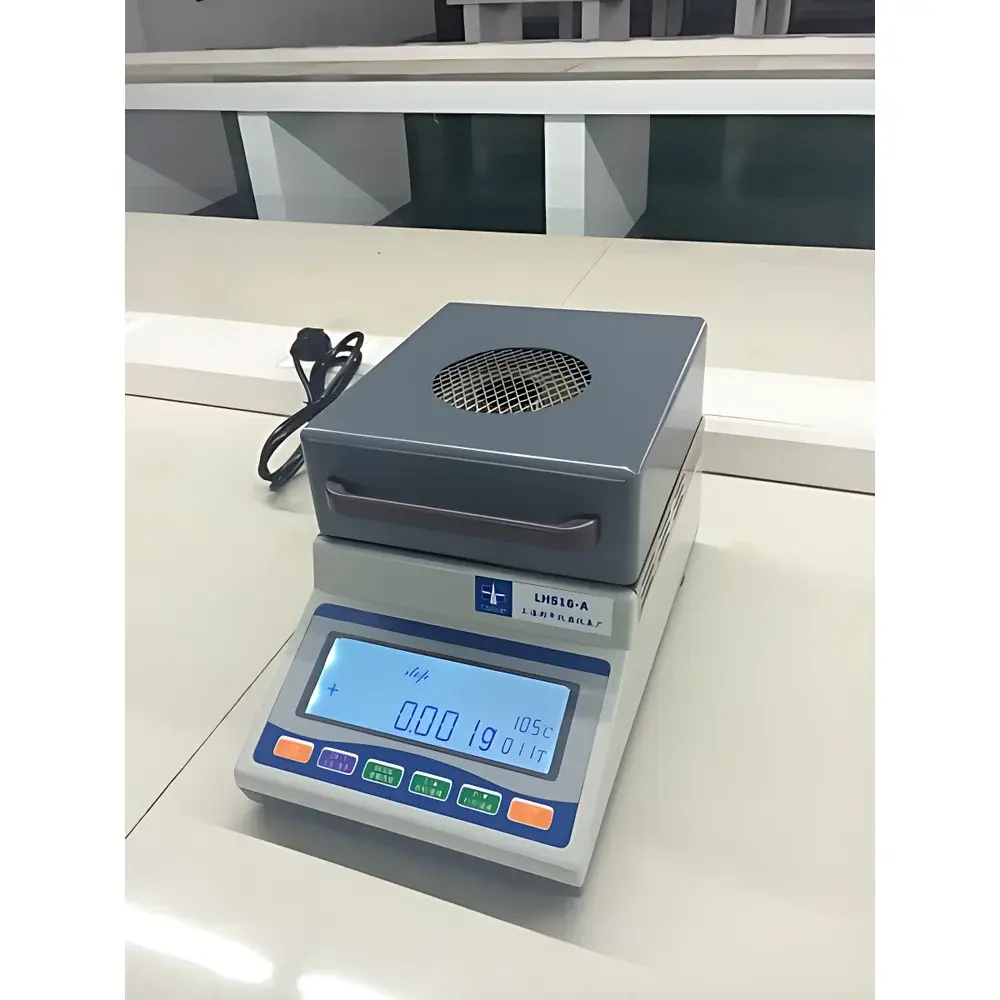
Shanghai Hengping LHS20-A Halogen Moisture Analyzer
| Brand | Hengping |
|---|---|
| Origin | Shanghai, China |
| Model | LHS20-A |
| Measurement Principle | Halogen Lamp Heating + Gravimetric Loss-on-Drying (LOD) |
| Moisture Range | 0.01%–100% |
| Accuracy | <1% (relative to reference method) |
| Repeatability | ±0.2% RSD (for samples ≥2 g) |
| Minimum Sample Mass | 2 g |
| Readability | 0.001 g |
| Weighing Capacity | 200 g |
| Temperature Range | Ambient to 200 °C |
| Temperature Control Accuracy | ±1 °C |
| Timer Range | 0–120 min |
| Display Parameters | 8 configurable values |
| Interface | RS-232 for printer or PC connectivity |
| Pan Diameter | Φ90 mm |
| Dimensions | 235 × 195 × 195 mm |
| Power Supply | 220 V, 50 Hz or 110 V ±11 V, 60 Hz |
Overview
The Shanghai Hengping LHS20-A Halogen Moisture Analyzer is a gravimetric moisture determination instrument engineered for precision and operational efficiency in routine quality control and laboratory environments. It operates on the standardized loss-on-drying (LOD) principle: a pre-weighed sample is heated uniformly using a high-intensity halogen lamp, driving off volatile components—primarily water—while an integrated electromagnetic balance continuously monitors mass loss in real time. The final moisture content is calculated as a percentage of the initial sample mass, based on ISO 5477, ASTM D4442, and USP <921> guidelines for thermogravimetric moisture analysis. Unlike infrared or near-infrared methods, halogen-based heating provides rapid, reproducible thermal energy transfer with minimal thermal lag, enabling consistent drying profiles across heterogeneous matrices such as powders, granules, slurries, and fibrous materials. Designed for benchtop deployment, the LHS20-A delivers reliable results within 3–15 minutes depending on sample type and target endpoint criteria.
Key Features
- Integrated dual-function architecture: high-resolution electromagnetic balance (0.001 g readability, 200 g capacity) combined with focused halogen heating (ambient to 200 °C, ±1 °C control stability)
- Programmable drying protocols: user-defined temperature ramps, hold times, and automatic endpoint detection via slope-based termination (e.g., ≤0.1 mg/min over 60 s)
- Eight configurable display parameters including current mass, moisture %, dry residue %, heating time, temperature, rate of mass loss, initial mass, and final mass
- Four data output modes compatible with RS-232 serial interface—ideal for integration into LIMS or QC documentation workflows
- Rugged aluminum alloy housing with Φ90 mm stainless-steel weighing pan, optimized for thermal uniformity and ease of cleaning
- Onboard calibration routine with internal weight verification; supports external calibration per ISO/IEC 17025 traceability requirements
Sample Compatibility & Compliance
The LHS20-A accommodates solid and semi-solid samples with minimum mass requirements of 2 g to ensure statistical representativeness and minimize edge-effect errors during drying. It is routinely validated for use with pharmaceutical excipients (e.g., lactose monohydrate, microcrystalline cellulose), food-grade starches and flours, tobacco leaf cuts, polymer pellets, catalyst supports, and municipal sludge solids. All measurement procedures align with Good Laboratory Practice (GLP) and support audit-ready documentation when paired with compliant printers or validated PC software. While not intrinsically 21 CFR Part 11–compliant, its RS-232 output enables integration with validated third-party data acquisition systems meeting FDA regulatory expectations for electronic records.
Software & Data Management
The analyzer supports direct ASCII data streaming via RS-232 at 9600 baud, allowing seamless capture into spreadsheet applications or custom QA databases. Eight parameter outputs—including real-time moisture trend, endpoint confirmation flag, and temperature log snapshot—can be selected individually. Optional Windows-compatible configuration utilities enable batch ID assignment, operator login tagging (when used with external authentication), and CSV export formatting. Audit trails are maintained externally; however, timestamped printouts (via connected serial printers) provide permanent, tamper-evident records suitable for internal QC review and supplier certification submissions.
Applications
- Pharmaceutical manufacturing: raw material identity verification, excipient moisture specification checks prior to wet granulation
- Food processing: flour hydration control, snack product crispness assurance, dairy powder shelf-life stability screening
- Tobacco quality assurance: leaf moisture optimization for curing consistency and combustion behavior prediction
- Environmental testing labs: sludge solids content determination per EPA Method 1684, soil moisture profiling for landfill leachate modeling
- Chemical production: catalyst drying validation, solvent residue quantification in API intermediates
- Academic research: kinetic modeling of desorption processes, comparative thermal stability studies across polymer families
FAQ
What standards does the LHS20-A comply with for moisture analysis?
It conforms to the gravimetric principles outlined in ISO 5477 (moisture in plastics), ASTM D4442 (wood moisture), and USP <921> (moisture content of pharmaceutical substances).
Can the instrument be calibrated internally?
Yes—it includes built-in calibration routines supporting both automatic internal verification and external weight-based adjustment per manufacturer-specified procedures.
Is the halogen heating system safer than traditional infrared or hotplate methods?
Halogen lamps offer faster thermal response and more uniform surface irradiance than ceramic IR emitters, reducing localized charring risks in heat-sensitive organics while maintaining compliance with IEC 61000-4 EMC standards.
Does the LHS20-A support GLP-compliant reporting?
When used with a validated serial printer or compliant data acquisition software, it generates time-stamped, operator-identified reports meeting core GLP documentation requirements for non-clinical laboratory studies.
What maintenance is required for long-term accuracy?
Routine cleaning of the weighing chamber and halogen reflector assembly every 50 operating hours; annual verification of temperature sensor drift and balance linearity using NIST-traceable standards is recommended.







