
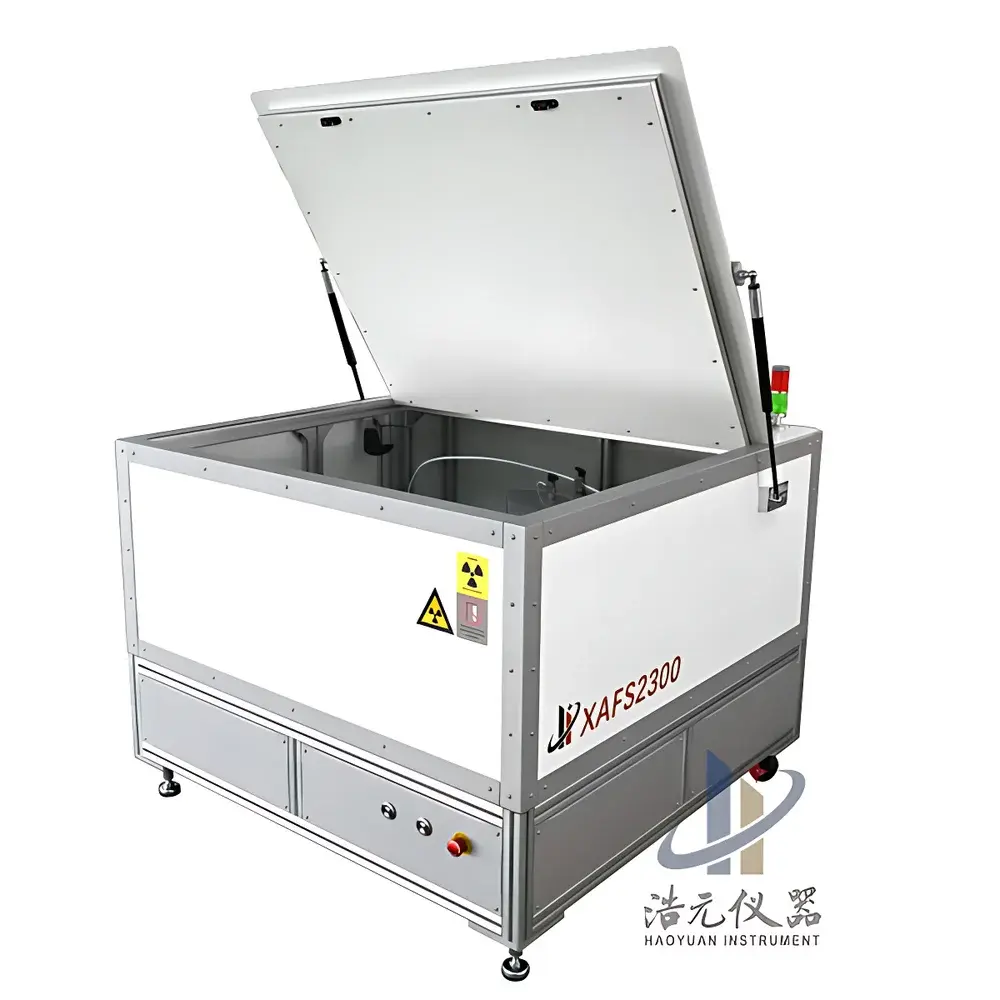
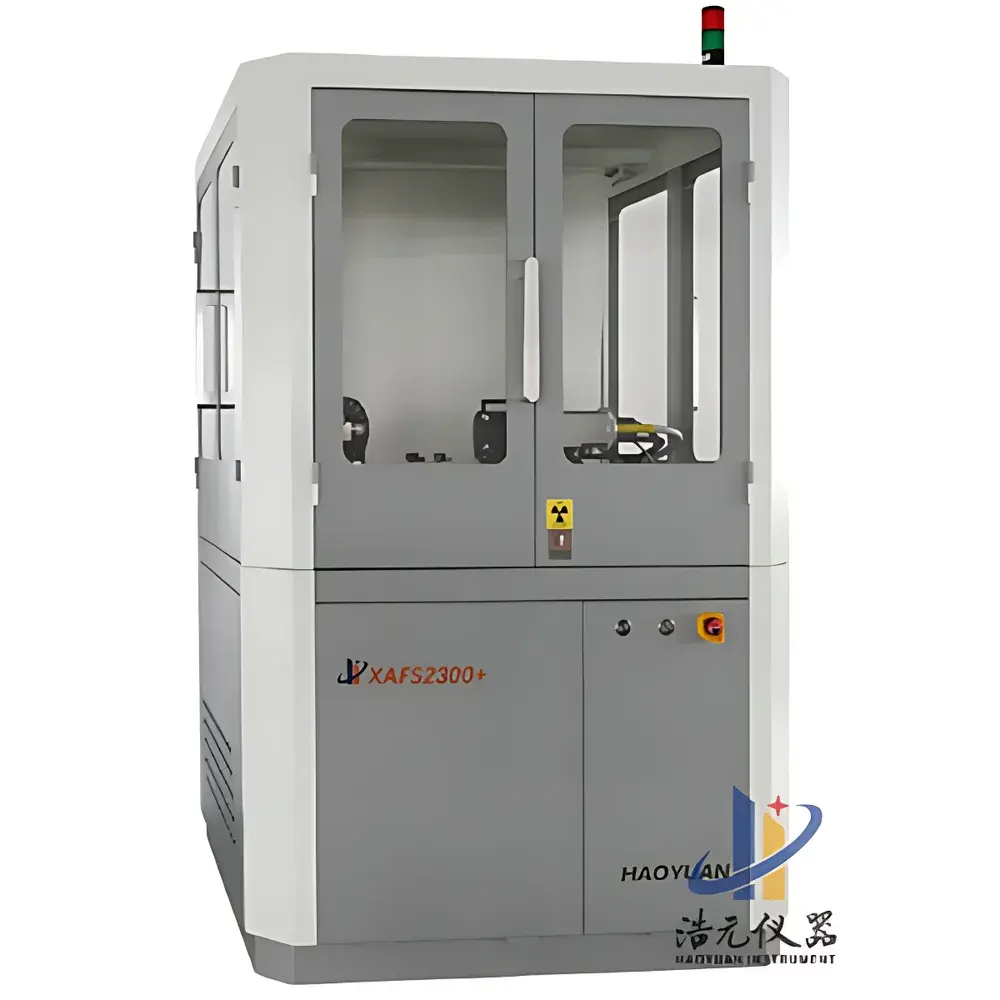
Haoyuan XAFS2300 Laboratory-Scale X-ray Absorption Fine Structure Spectrometer
| Brand | Haoyuan |
|---|---|
| Origin | Liaoning, China |
| Manufacturer Type | Direct Manufacturer |
| Model | XAFS2300 |
| X-ray Source Power (XAFS mode) | 3 kW |
| X-ray Source Power (XES mode) | 50 W |
| Monochromatic Photon Flux | ≥2×10⁶ photons/sec @ 7–9 keV |
| Detectable Elemental Concentration Limit | 0.1 wt% |
| Tunable X-ray Energy Range | 4.5–25 keV |
| XAFS Scan Speed | 0.1–2.0 eV/s |
| Energy Resolution | 0.5–3 eV |
| Energy Drift Stability | < 50 meV per 8-hour operation |
| Dual-Mode Operation | XAFS & XES |
| Monochromator Type | Spherically Bent Crystal (Rolan Circle Geometry) |
| Detector | High-Resolution Silicon Drift Detector (SDD) |
Overview
The Haoyuan XAFS2300 is a benchtop, laboratory-scale X-ray Absorption Fine Structure (XAFS) spectrometer engineered to deliver synchrotron-comparable data quality without dependence on large-scale light sources. It operates on the physical principle of core-level X-ray absorption spectroscopy—where incident X-rays excite electrons from inner-shell atomic orbitals, generating element-specific absorption edges and oscillatory fine structure (EXAFS and XANES) that encode local structural and electronic information. Unlike conventional XRF or XRD systems, the XAFS2300 resolves short-range order (≤5 Å), quantifying coordination numbers, interatomic distances, disorder parameters (Debye–Waller factors), oxidation states, and ligand geometry around target atoms—even in amorphous, heterogeneous, or dilute systems. Its dual-mode architecture supports both transmission and fluorescence detection geometries, enabling robust analysis of bulk, thin-film, and low-concentration samples across diverse matrices.
Key Features
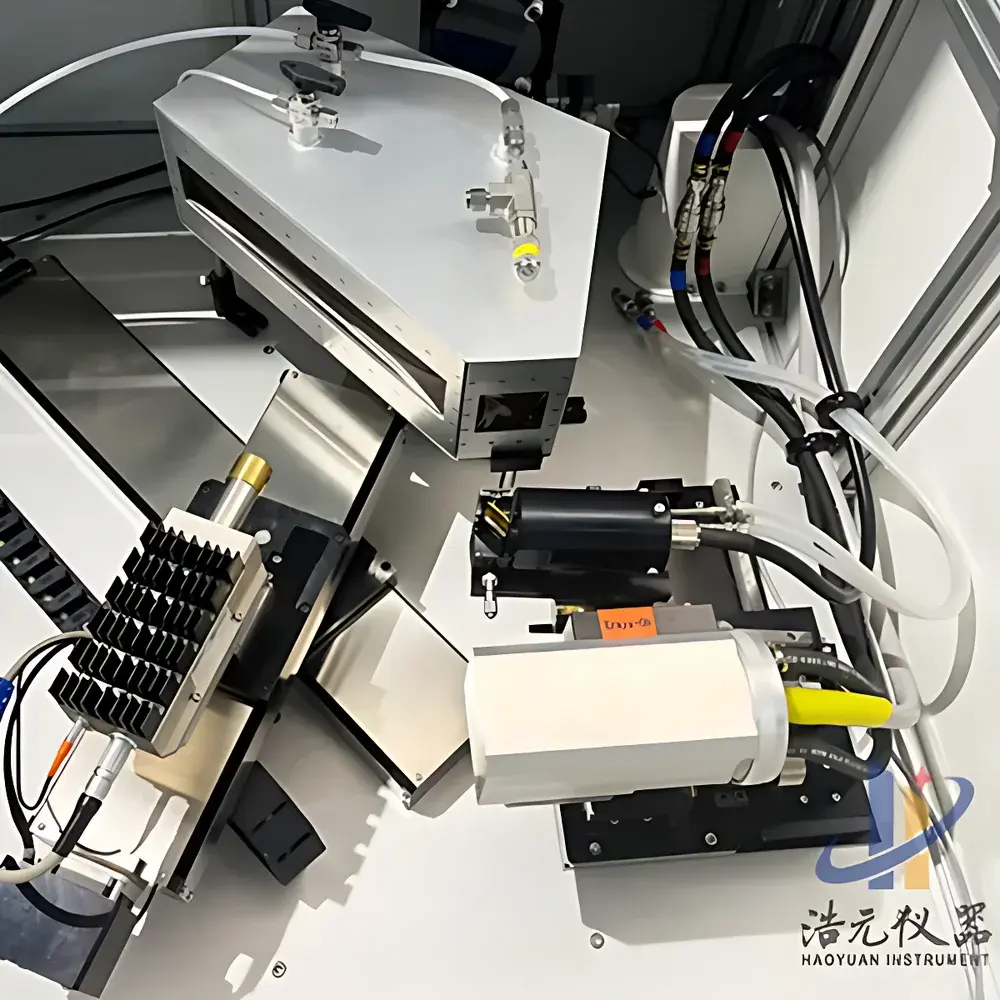
- Integrated high-flux X-ray source: 3 kW metal-ceramic side-window tube (XAFS mode) with selectable anode targets (e.g., Mo, Rh, Ag); 50 W microfocus end-window tube (XES mode) for high-energy-resolution emission spectroscopy.
- Spherically bent crystal monochromator mounted on a precision Rolan-circle goniometer, ensuring intrinsic energy calibration stability and eliminating need for repeated recalibration during multi-hour experiments.
- High-resolution silicon drift detector (SDD) with optimized solid-angle collection and pulse-processing electronics for high-count-rate, low-noise fluorescence detection.
- Dual operational modes—XAFS and X-ray Emission Spectroscopy (XES)—with pre-aligned beamline configurations; seamless switching between modes without realignment or recalibration.
- Energy tunability across 4.5–25 keV, covering K-edges of elements from P (1.8 keV, extended via harmonics) through L₃-edges of 5d transition metals (e.g., Pt at 11.6 keV) and M-edges of actinides.
- Sub-50 meV energy scale reproducibility over 8-hour continuous operation, meeting requirements for long-duration in situ/operando studies under controlled atmospheres or electrochemical cells.
Sample Compatibility & Compliance
The XAFS2300 accommodates solid powders, pressed pellets, thin films, frozen solutions, and sealed capillary samples—compatible with standard XAFS sample holders and cryostat interfaces. It supports ambient, inert-gas, and vacuum environments (optional chamber integration). Data acquisition and processing workflows align with community standards including IUPAC-recommended XAFS data formatting (IFEFFIT-compatible .dat), and support for ASTM E2923-22 (Standard Guide for XAFS Data Collection and Analysis) and ISO/IEC 17025 traceability frameworks. The system’s hardware timing control and detector dead-time correction enable compliance with GLP audit requirements for materials certification and catalyst qualification studies.
Software & Data Management
The instrument is operated via Haoyuan’s proprietary XAFS Control Suite, a Windows-based platform offering real-time spectrum preview, automated edge-step normalization, and integrated Athena–Artemis pipelines (via embedded Demeter libraries). All raw scans include full metadata logging: motor positions, HV settings, detector gain, live time, and environmental sensor readings (temperature, pressure). Audit trails are timestamped and user-logged in accordance with FDA 21 CFR Part 11 principles—supporting electronic signatures, role-based access control, and export of PDF-certified reports. Raw data exports comply with NeXus/HDF5 format standards for interoperability with third-party tools (e.g., Larch, PyXAFS, or custom Python workflows).
Applications
The XAFS2300 serves as a primary analytical tool in academic and industrial R&D labs focused on functional material design. In catalysis, it characterizes active-site evolution in operando CO₂ hydrogenation catalysts, distinguishing Ni⁰/Ni²⁺ speciation and Cu–ZnO interface dynamics during methanol synthesis. In battery research, it tracks Mn oxidation state hysteresis and Li–O bond contraction in layered NMC cathodes during cycling. For environmental science, it identifies As(III)/As(V) partitioning in iron oxide-coated soils and U(IV)/U(VI) redox transitions in nuclear waste forms. In bioinorganic chemistry, it resolves Fe–S cluster distortions in nitrogenase mimics and Zn coordination symmetry loss in metalloenzyme inhibitors. Its ability to probe dilute (<1 wt%) dopants in wide-bandgap semiconductors and quantify spin-state populations via Kβ XES makes it indispensable for next-generation energy and quantum materials development.
FAQ
Does the XAFS2300 require synchrotron beamtime for calibration or validation?
No. The Rolan-circle monochromator and fixed-crystal geometry ensure intrinsic energy calibration stability; certified reference foils (e.g., Fe, Ni, Cu) are used for absolute energy alignment during setup, with no dependency on external facilities.
Can the system perform in situ electrochemical XAFS measurements?
Yes—through optional electrochemical cell integration with Kapton X-ray windows and potentiostat synchronization, enabling time-resolved monitoring of electrode active sites during galvanostatic cycling.
Is XES mode limited to transition metals?
No. While most sensitive for 3d/4d/5d elements due to strong Kβ/Kα intensity ratios, the 4.5–25 keV range supports L-edge XES of lanthanides and M-edge XES of heavier elements such as Pb and Th.
What sample preparation protocols are recommended for low-concentration (<0.5 wt%) analysis?
Homogeneous dispersion in borosilicate glass or BN matrix, followed by pelletization under 10–15 ton pressure, is recommended to minimize self-absorption and improve signal-to-noise ratio in fluorescence mode.
How does the system handle radiation damage in sensitive biological or organic samples?
The 50 W XES tube and programmable dwell-time control allow dose management; cryogenic sample stages (optional) further mitigate beam-induced reduction or decomposition during prolonged scans.





