
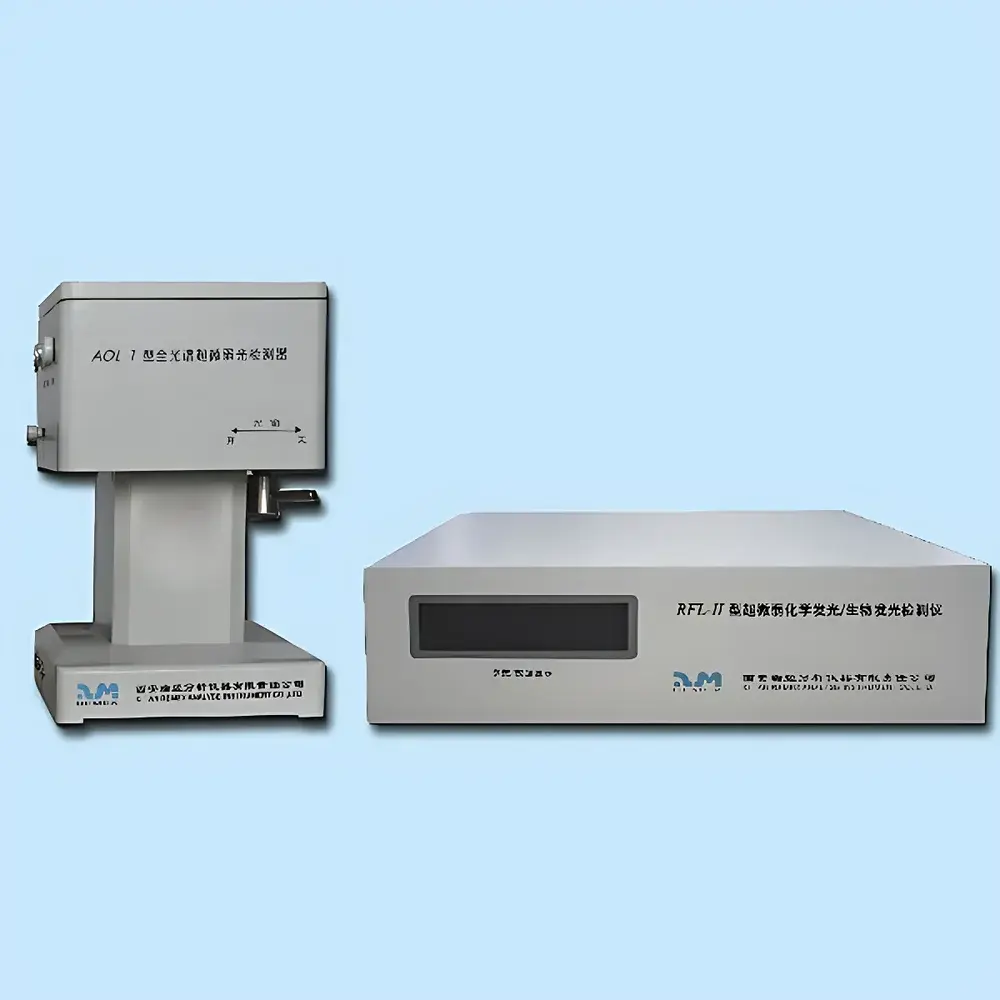
REMEX RFL-II Ultra-Weak Chemiluminescence and Bioluminescence Detection System
| Brand | REMEX (Xi’an Remex Instrument Co., Ltd.) |
|---|---|
| Origin | Shaanxi, China |
| Model | RFL-II |
| Detector Type | Electrochemical Luminescence Analyzer with Integrated Spectral Photomultiplier Module |
| High-Voltage Power Supply | −100 V to −1000 V (stability ±0.05%, output current ≥5 mA) |
| Gain Settings | 1×, 10×, 100×, 1000× |
| Filter Frequencies | 10 Hz, 20 Hz, 50 Hz, 100 Hz |
| Signal Noise | ≤0.5 mV<sub>P-P</sub> (at 1× gain) |
| Input Impedance | ≥10 MΩ |
| Integration Time Range | 0.01–1000 s |
| Sampling Rate | 1–1000 Hz |
| Spectral Response | 230–920 nm (peak sensitivity at 630 nm) |
| Anode Sensitivity | >2000 A/lm |
| Software Functions | Real-time signal acquisition, auto-zero calibration, AGC (Automatic Gain Control), peak/area quantification, spectral export (TXT), VFD-based local parameter display |
Overview
The REMEX RFL-II Ultra-Weak Chemiluminescence and Bioluminescence Detection System is a dedicated photonic measurement platform engineered for quantitative detection of extremely low-intensity luminescent emissions—spanning chemiluminescence, bioluminescence, electrochemiluminescence (ECL), and flame-induced molecular/atomic emission. Its core architecture integrates a high-stability negative high-voltage power supply, low-noise analog signal conditioning chain, and a spectrally broad AOL-1 photodetector module optimized for weak-light capture across the UV–NIR range (230–920 nm). Unlike conventional fluorescence readers or general-purpose photometers, the RFL-II operates on a charge-integration and energy-integrated detection paradigm, enabling sub-picoampere-level photocurrent resolution via precision current-to-voltage conversion and digital sampling. This makes it particularly suitable for applications requiring high dynamic range (up to 6 orders of magnitude), low dark-current operation, and immunity to transient electromagnetic interference—critical in electrochemical cell integration and microfluidic assay environments.
Key Features
- Integrated −100 V to −1000 V negative high-voltage supply with ±0.05% long-term stability and ≥5 mA output capacity—optimized for PMT biasing under variable load conditions.
- Four-stage programmable gain amplifier (1×, 10×, 100×, 1000×) with selectable low-pass filtering (10/20/50/100 Hz) to suppress line-frequency noise and harmonics without phase distortion.
- Dual-mode signal acquisition: real-time analog voltage output + digitally synchronized charge-integration mode with adjustable integration time (0.01–1000 s), supporting both kinetic and endpoint assays.
- AOL-1 full-spectrum photodetection module featuring 230–920 nm spectral response, peak quantum efficiency at 630 nm, and anode sensitivity exceeding 2000 A/lm—enabling direct compatibility with common bioluminescent reporters (e.g., luciferase, coelenterazine) and ECL reagents (e.g., Ru(bpy)32+/TPA).
- Vacuum fluorescent display (VFD) interface for local monitoring of HV setting, gain, filter frequency, integration time, and real-time signal amplitude—reducing dependency on host PC during routine calibration or field deployment.
- Embedded signal processing firmware supporting automatic zero-point compensation, adaptive gain control (AGC), and baseline drift correction—ensuring reproducible quantitation across multi-hour experiments.
Sample Compatibility & Compliance
The RFL-II accommodates standard cuvette-based, flow-cell, and electrode-integrated configurations. Its AOL-1 detector module functions as an EMI-shielding enclosure when mounted directly onto electrochemical cells—mitigating capacitive coupling and ground-loop artifacts common in potentiostat-coupled luminescence measurements. While not certified to IEC 61000-4-x EMC standards out-of-box, its analog front-end design complies with fundamental low-noise instrumentation practices aligned with ISO/IEC 17025 method validation requirements for luminometric assays. The system supports traceable calibration using NIST-traceable light sources (e.g., calibrated LED standards at 470 nm and 630 nm) and is routinely deployed in laboratories adhering to GLP-compliant workflows for environmental toxicity screening (e.g., Microtox®-compatible protocols) and pharmaceutical ECL immunoassay development.
Software & Data Management
The proprietary RFL-II acquisition software provides a Windows-native interface for instrument control, data visualization, and post-acquisition analysis. It implements serial communication over RS-232 or USB-Virtual COM, with configurable baud rates up to 115200 bps. Core functionalities include file-based project management (creation, save/load), real-time oscilloscope-style waveform display, manual peak detection with cursor-assisted area integration, and export of raw time-series data in plain-text (CSV/TXT) format for third-party statistical or kinetic modeling (e.g., MATLAB, Origin, GraphPad Prism). All measurement parameters—including HV setting, gain, filter cutoff, integration duration, and timestamp—are embedded in metadata headers. Though not FDA 21 CFR Part 11 compliant by default, audit trails can be enabled via external logging middleware compatible with laboratory information management systems (LIMS).
Applications
- Quantitative analysis of reactive oxygen species (ROS) via luminol- or lucigenin-enhanced chemiluminescence in cellular lysates and tissue homogenates.
- High-sensitivity bioluminescent ATP assays for microbial viability testing in food safety and pharmaceutical water system monitoring.
- Electrochemiluminescence-based immunoassays (ECLIA) utilizing ruthenium complexes immobilized on screen-printed carbon electrodes.
- Kinetic profiling of enzyme-catalyzed light emission (e.g., firefly luciferase kinetics under substrate titration or inhibitor screening).
- Flame emission spectroscopy support for alkali metal (Na, K) and alkaline earth (Ca, Ba) quantification in combustion effluents—leveraging the wide spectral window and low-noise amplification.
- Method development for microfluidic chemiluminescent sensors where compact footprint and electromagnetic isolation are essential.
FAQ
What types of photodetectors are supported by the RFL-II system?
The RFL-II is natively configured with the AOL-1 full-spectrum photomultiplier module. It is electrically compatible with alternative PMTs, photodiodes, and vacuum phototubes via its standardized BNC input and HV connector—but optical alignment and spectral responsivity must be validated independently.
Can the RFL-II perform simultaneous dual-wavelength detection?
No. The AOL-1 detector provides broadband spectral response but lacks internal monochromator or dichroic splitting; wavelength selectivity requires external optical filters placed in the light path.
Is the high-voltage supply isolated from the signal ground?
Yes. The −100 V to −1000 V output is galvanically isolated with ≥1 kV DC withstand rating, ensuring safe integration with grounded electrochemical workstations.
Does the system support trigger-synchronized acquisition?
Yes. External TTL-level trigger input is available for time-resolved measurements, such as delayed luminescence decay profiling or pump-probe ECL initiation.
What is the minimum detectable photon flux under optimal conditions?
Based on typical PMT quantum efficiency (~25% at 630 nm) and system noise floor (<0.5 mVP-P), the practical lower limit approximates 10–50 photons per second at unity gain—dependent on integration time, optical coupling efficiency, and background shielding.
Related Products





