
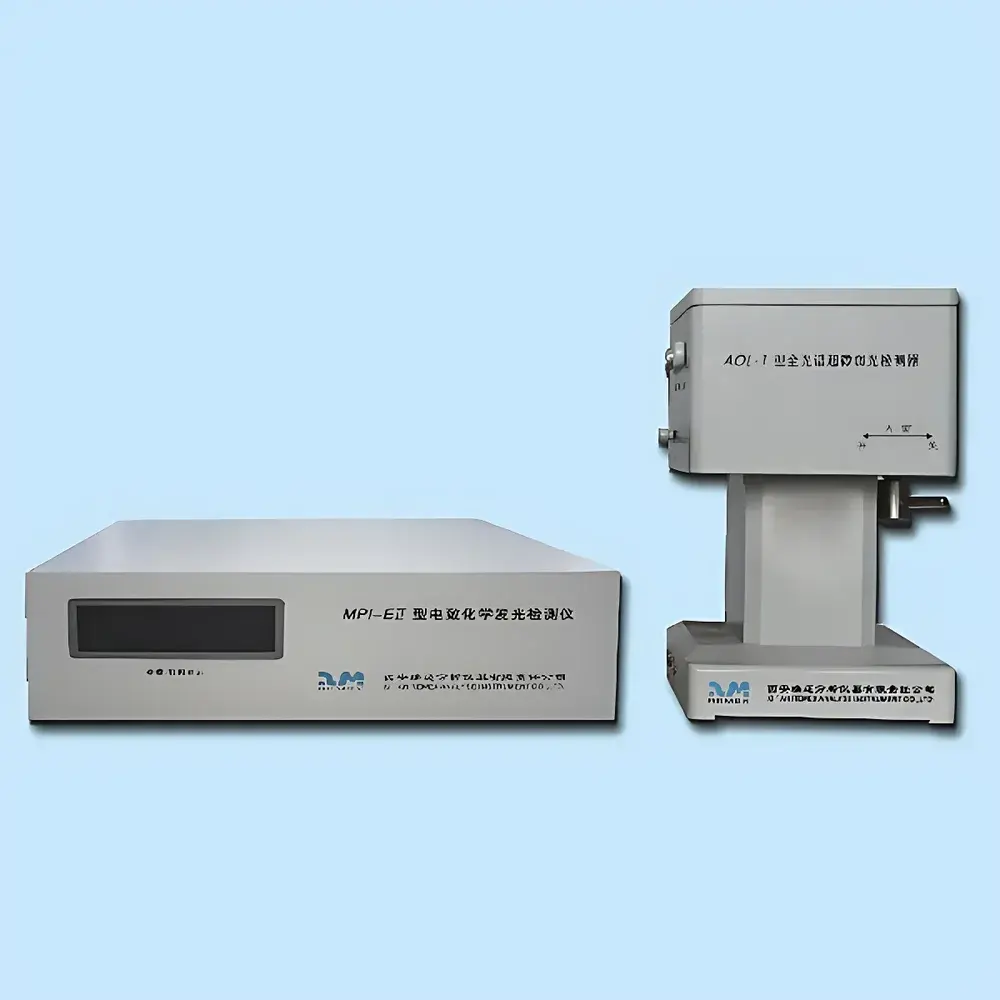
REMEX MPI-EII Electrochemiluminescence Detector
| Brand | REMEX |
|---|---|
| Origin | Shaanxi, China |
| Manufacturer Type | Authorized Distributor |
| Country of Origin | China |
| Model | MPI-EII |
| Pricing | Available Upon Request |
| Electrochemical Potential Range | −10 V to +10 V |
| Current Range | ±250 mA |
| Reference Electrode Input Impedance | 10 MΩ |
| Current Sensitivity | 1 × 10⁻⁹ A to 1 × 10⁻² A (8 decades) |
| Input Bias Current | <50 pA |
| Potential Increment | 1 mV |
| Scan Rate | 0.001–65 V/s |
| Luminescence Dynamic Range | >5 decades |
| Photometric Accuracy | <0.05% |
| Gain Settings | 1×, 10×, 100×, 1000× |
| Filter Frequencies | 10 Hz, 20 Hz, 50 Hz, 100 Hz |
| Amplifier Drift | <0.05% |
| Peak-to-Peak Noise | ≤0.5 mV (1× gain) |
| Input Impedance (Optical) | ≥10 MΩ |
| Integration Time | 0.01–10 s |
| Sampling Rate | 1–200 Hz |
| PMT High Voltage | −100 V to −1000 V |
| Spectral Range | 230–920 nm (λₚₑₐₖ = 630 nm) |
| Anode Sensitivity | >2000 A/lm |
Overview
The REMEX MPI-EII Electrochemiluminescence Detector is a dual-functional analytical platform engineered for high-sensitivity, quantitative detection of electrochemiluminescent (ECL), chemiluminescent (CL), and static-injection chemiluminescent signals. Built upon a modular architecture integrating synchronized electrochemical control and ultra-weak photon counting, the system enables precise spatiotemporal correlation between electrode potential/current transients and luminescence emission kinetics. Its core operational principle relies on the electrochemical generation of reactive intermediates—such as Ru(bpy)₃²⁺/tripropylamine or luminol/H₂O₂ systems—at controlled potentials, followed by photon emission upon electron-transfer-induced excited-state formation. The MPI-EII serves as the central electrochemical stimulus and signal acquisition unit, while the co-integrated AOL-1 full-spectrum ultralow-light detector provides spectrally resolved, time-gated photon detection with sub-picoampere current resolution and nanosecond-level temporal fidelity. Designed for compatibility with standard three-electrode electrochemical cells (working, reference, counter), the instrument supports rigorous method development in regulated environments where trace-level analyte quantification and mechanistic reaction profiling are required.
Key Features
- Integrated electrochemical module supporting potentiostatic, galvanostatic, cyclic voltammetry (CV), linear sweep voltammetry (LSV), and amperometric detection with programmable scan parameters
- Dual-mode optical detection: simultaneous ECL/CL acquisition with automatic gain optimization and real-time baseline correction
- AOL-1 photomultiplier tube (PMT) detector featuring adjustable high-voltage bias (−100 V to −1000 V), spectral response from 230 nm to 920 nm, and peak quantum efficiency at 630 nm
- USB 2.0 interface compliant with Windows-based control software (Windows 10/11, 64-bit); driver-level integration ensures deterministic timing synchronization (<10 µs jitter) between electrochemical waveform generation and photon sampling
- Onboard digital signal processing including adaptive filtering (10–100 Hz selectable), auto-zeroing circuitry, and integration-controlled photon accumulation over user-defined time windows (0.01–10 s)
- Electrochemical current measurement with eight-decade dynamic range (1 nA–250 mA), input bias current <50 pA, and potential resolution of 1 mV
Sample Compatibility & Compliance
The MPI-EII accommodates standard aqueous and organic-phase electrochemical cells—including screen-printed electrodes, carbon paste, gold, platinum, and glassy carbon working electrodes—and supports flow-cell configurations for continuous monitoring applications. It is routinely deployed in laboratories adhering to GLP (Good Laboratory Practice) and GMP (Good Manufacturing Practice) frameworks, particularly for assay validation of ECL-based immunoassays and nucleic acid hybridization tests. While not pre-certified to ISO/IEC 17025, the system’s hardware design aligns with key metrological requirements outlined in ASTM E2587 (Standard Practice for Use of Electrochemical Detection in Liquid Chromatography) and USP (Analytical Instrument Qualification). Data integrity features—including audit-trail-enabled software logging, electronic signature support, and non-modifiable raw data export (CSV, HDF5)—facilitate compliance with FDA 21 CFR Part 11 when implemented within validated workflows.
Software & Data Management
Control and analysis are performed via REMEX ECL Studio v3.x—a native Windows application offering scriptable method sequencing, multi-channel time-resolved plotting, and batch-processing pipelines. Raw electrochemical waveforms and photon count histograms are stored in timestamped binary archives with embedded metadata (electrode configuration, gain setting, integration time, HV value). Export formats include ASCII-compatible CSV for third-party statistical packages (e.g., OriginLab, MATLAB) and vendor-neutral HDF5 for long-term archival. Software modules support calibration curve fitting using weighted least-squares regression (1/x² weighting), limit-of-detection (LOD) calculation per IUPAC recommendations, and kinetic deconvolution of ECL decay profiles using exponential series models. All user actions—including parameter edits, file saves, and report generation—are logged with operator ID, timestamp, and IP address (if network-connected).
Applications
- Quantitative detection of pharmaceutical compounds (e.g., antibiotics, anticancer agents) via ECL-labeled aptamer or antibody conjugates
- Sequence-specific DNA/RNA hybridization assays leveraging ruthenium-tagged probes and tripropylamine coreactant systems
- Real-time monitoring of protein–ligand binding kinetics using ECL resonance energy transfer (ECL-RET) configurations
- Enzyme activity profiling (e.g., horseradish peroxidase, alkaline phosphatase) in point-of-care diagnostic platforms
- Surface-confined ECL studies on modified electrodes for biosensor development and interfacial electron-transfer mechanism elucidation
- High-throughput screening of redox-active metabolites in cell lysates and microdialysates
FAQ
What electrochemical techniques does the MPI-EII support?
Potentiostatic amperometry, cyclic voltammetry, linear sweep voltammetry, differential pulse voltammetry, and square-wave voltammetry—all fully programmable via the ECL Studio interface.
Can the system perform spectral ECL measurements?
The AOL-1 detector provides broadband sensitivity (230–920 nm) but lacks monochromator-based spectral resolution; it is optimized for total photon flux quantification rather than emission wavelength deconvolution.
Is remote operation supported?
Yes—via secure RDP or VNC connections to the host PC; however, USB latency constraints require local physical connection between the MPI-EII hardware and the controlling computer.
What maintenance is required for the PMT detector?
The AOL-1 PMT requires periodic verification of dark current stability and high-voltage supply linearity; REMEX recommends annual recalibration against NIST-traceable light sources.
Does the system comply with electromagnetic compatibility (EMC) standards?
The MPI-EII meets CISPR 11 Group 1 Class B emission limits and IEC 61326-1 immunity requirements for laboratory equipment, verified per manufacturer test reports (available upon request).
Related Products




