
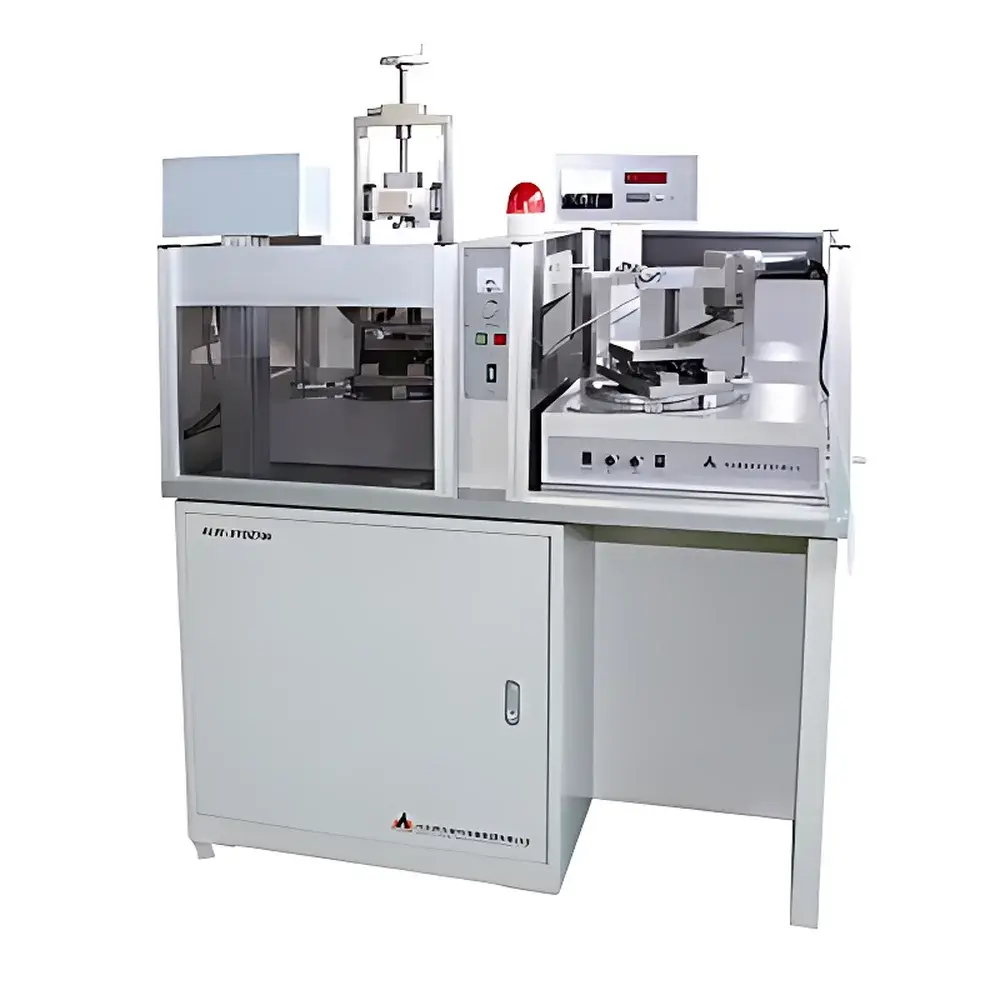
Aolong ALW-XYDZ 700 Sapphire Ingot X-ray Orientation and Bonding Instrument with Dual-Axis (X & Y) Precision Alignment
| Brand | Aolong |
|---|---|
| Origin | Liaoning, China |
| Manufacturer Type | Direct Manufacturer |
| Model | ALW-XYDZ 700 |
| Power Supply | AC 220 V, 50 Hz, 0.25 kW |
| X-ray Tube | Cu anode, fan-cooled, grounded anode |
| Max. Tube Voltage/Current | 30 kV / 5 mA (continuously adjustable |
| Detector Options | Proportional counter (DC 1000 V max) or scintillation detector (DC 1200 V max) |
| Time Constant Settings | Fast (1) / Slow (2) |
| Angular Range | 2θ = −10° to 110°, θ = −5° to 55° |
| Angular Resolution | 1 arcsecond (1″), equivalent to 0.000278° |
| Angular Reproducibility | ±15″ / ±30″ (double-diffraction mode, verified with NIST-traceable quartz reference crystal) |
| Optical Shutter | Manual main shutter |
| Display Interface | Real-time angle readout + X-ray intensity meter |
| Dimensions (L×W×H) | 1132 × 642 × 1460 mm |
| Weight | 300 kg |
Overview
The Aolong ALW-XYDZ 700 is a specialized X-ray orientation instrument engineered for high-precision crystallographic alignment of sapphire ingots prior to wafer slicing and surface processing. It operates on the principle of Bragg diffraction using monochromatic Cu-Kα radiation (λ = 1.5418 Å) to determine lattice plane orientations relative to the physical geometry of cylindrical sapphire (Al₂O₃) crystals. Unlike conventional powder or thin-film diffractometers, the ALW-XYDZ 700 implements a dual-stage mechanical architecture: the left station performs X-axis (radial) orientation by aligning the crystal’s primary growth direction (typically c-axis) perpendicular to the incident X-ray beam, while the right station enables Y-axis (end-face) angular verification—critical for establishing precise reference planes (e.g., R-plane or M-plane) used in subsequent lapping, grinding, and polishing operations. Designed explicitly for industrial sapphire fabrication lines, it supports ingots ranging from 2-inch to 6-inch diameter with minimum lengths of 20 mm, enabling batch-oriented adhesive mounting onto flitch plates without repositioning.
Key Features
- Dual independent workbenches: Left-stage for X-axis alignment and multi-ingot bonding via precision linear guide rails; right-stage for end-face angular measurement and fixture-based Y-axis orientation.
- High-resolution angular encoding: Digital readout calibrated to 1 arcsecond (1″), with selectable display modes (DMS or decimal degree) and programmable preset angle targeting.
- Configurable X-ray detection: User-selectable proportional counter (operating up to DC 1000 V) or NaI(Tl) scintillation detector (up to DC 1200 V), optimized for low-noise Bragg peak acquisition under varying count-rate conditions.
- Thermally stable X-ray source: Air-cooled copper-target tube with grounded anode design, rated for continuous operation at ≤2.0 mA to ensure tube longevity and minimize bremsstrahlung-induced background.
- Manual optical shutter and real-time intensity monitoring: Enables operator-controlled exposure timing and immediate feedback on beam stability during alignment procedures.
- Rugged industrial frame: Steel-reinforced base with vibration-damped leveling feet; total mass of 300 kg ensures mechanical stability during fine angular adjustments.
Sample Compatibility & Compliance
The ALW-XYDZ 700 is validated for use with single-crystal sapphire (Al₂O₃) ingots conforming to ASTM F1577–22 specifications for optical-grade substrates. Its angular accuracy of ±15″ (±30″ in double-diffraction mode) is traceably certified using NIST SRM 1976b (standard quartz crystal). While optimized for sapphire, the instrument may accommodate other hexagonal or rhombohedral crystals—including silicon carbide (SiC) and lithium niobate (LiNbO₃)—provided lattice parameters fall within measurable 2θ range (−10° to 110°). The system complies with IEC 61000-6-3 (EMC emissions) and meets Class I radiation safety requirements per GBZ 138–2019 (Chinese national standard for analytical X-ray equipment), incorporating interlocked shielding and warning indicators. Documentation supports GLP-compliant recordkeeping when integrated with external lab notebooks or LIMS.
Software & Data Management
The ALW-XYDZ 700 operates in hardware-synchronized manual mode without embedded microprocessor control; all angular positioning, exposure timing, and intensity logging are performed via analog/digital hybrid instrumentation. Angle values and exposure duration are recorded manually or via optional RS-232 interface (available upon request) for integration with third-party data acquisition software. For regulated environments, users may implement 21 CFR Part 11-compliant electronic logbooks to capture operator ID, date/time stamps, reference crystal ID, measured angles, and deviation tolerances—ensuring full auditability during ISO 9001 or IATF 16949 audits. Firmware-free architecture eliminates cybersecurity vulnerabilities associated with networked controllers and ensures deterministic response during critical alignment steps.
Applications
- Precision orientation of sapphire boules prior to diamond-wire sawing to minimize off-cut waste and maximize usable wafer yield.
- Establishment of crystallographic reference planes (e.g., R-plane for GaN epitaxy or A-plane for LED substrate fabrication) with angular repeatability sufficient for sub-micron epitaxial layer registration.
- Verification of rotational symmetry and axial homogeneity across multi-segment ingots intended for high-power laser host materials.
- Process validation in GMP-certified sapphire substrate manufacturing facilities requiring documented angular tolerance compliance per customer technical datasheets (e.g., ≤ ±20″ for aerospace-grade optics).
- Research-scale crystal growth labs performing post-growth lattice quality assessment via rocking curve width analysis (FWHM) using the same detector configuration.
FAQ
What crystal orientations can be measured with the ALW-XYDZ 700?
It measures any Bragg-reflective plane in sapphire (e.g., (0006), (101̅4), (112̅0)) within its 2θ range; common targets include c-axis (0001), R-plane (112̅2), and M-plane (101̅0).
Is automated scanning or motorized goniometry available?
No—the system relies on manual rotation and digital vernier readout to maintain mechanical rigidity and eliminate encoder drift in production environments.
Can the instrument be upgraded for powder diffraction?
Not without major structural modification; its fixed-source/fixed-detector geometry and lack of theta-theta drive preclude standard powder XRD configurations.
What safety certifications does the unit carry?
It conforms to GBZ 138–2019 (China), IEC 61010-1 (safety), and IEC 61000-6-3 (EMC); full radiation survey documentation is provided with each shipment.
How is calibration verified between maintenance cycles?
Users perform daily checks using supplied quartz reference wafers; annual recalibration is recommended using traceable interferometric angle standards.
Related Products





