
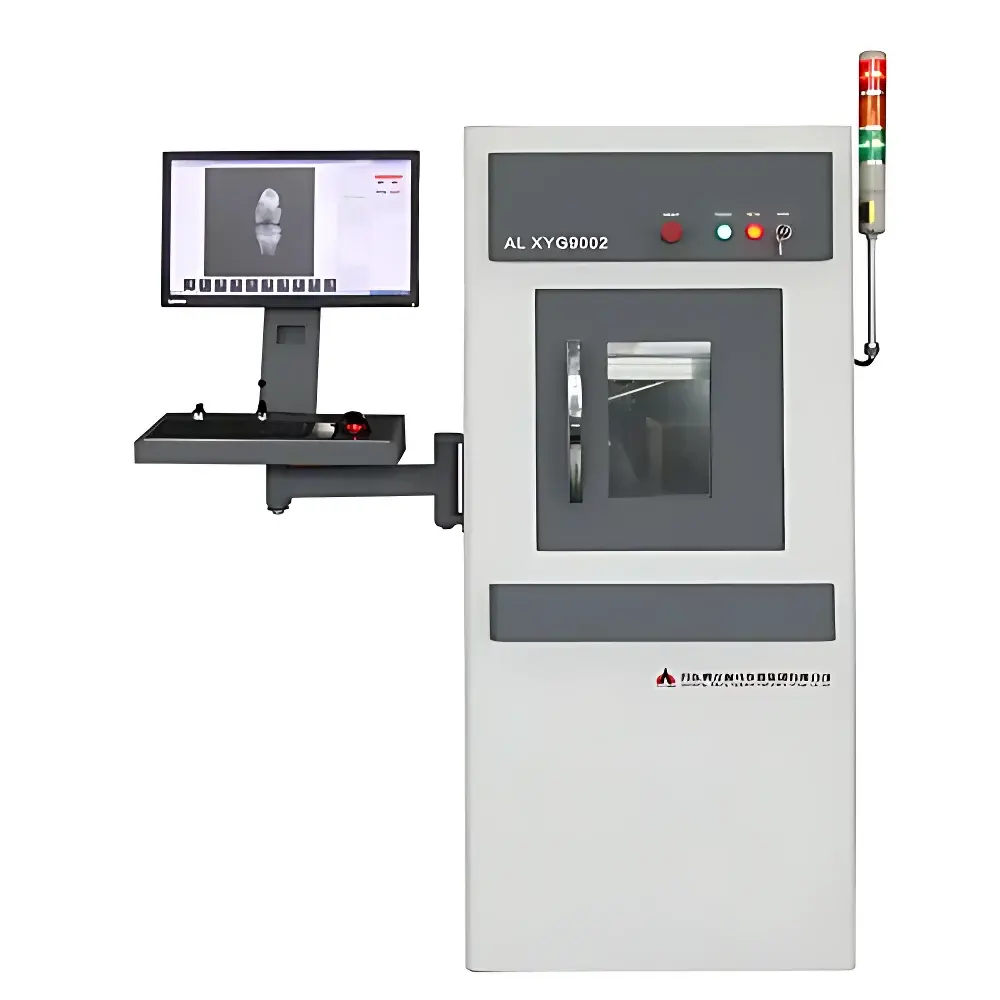
Along AL-WJ-0902 Microfocus X-ray Inspection System (Industrial Micro-CT NDT)
| Brand | Along |
|---|---|
| Origin | Liaoning, China |
| Manufacturer Type | Direct Manufacturer |
| Regional Category | Domestic (China) |
| Model | AL-WJ-0902 |
| Voltage Range | 20–225 kV |
| Current Range | 0–3 mA |
| Focal Spot Sizes | 1 µm, 5 µm, 30 µm |
| System Resolution | 70 LP/cm |
| Maximum Geometric Magnification | 5000× |
| Motion Axes | Motorized X-Y-Z Translation Stages |
| Sample Compatibility | BGA/CSP/Flip-Chip, PCB Assemblies, Li-ion Batteries, IC Packages, Passive Components, Metallic & Dielectric Materials, Lightweight Composites, Heating Elements, Pearls, Precision Mechanical Assemblies |
Overview
The Along AL-WJ-0902 Microfocus X-ray Inspection System is a high-resolution industrial micro-computed tomography (micro-CT) platform engineered for non-destructive evaluation (NDE) and failure analysis in electronics manufacturing, advanced materials R&D, and quality assurance laboratories. Based on transmission radiography and computed laminography principles, the system employs a sealed-tube microfocus X-ray source with selectable focal spot sizes (1 µm, 5 µm, and 30 µm) to balance spatial resolution, photon flux, and thermal stability across diverse sample geometries and densities. Its geometric magnification capability of up to 5000×—achieved through precise source-to-detector and source-to-object distance control—enables sub-micron feature visualization without physical sectioning. The system complies with ISO 17025 foundational requirements for testing laboratories and supports traceable calibration protocols aligned with ASTM E2737 (Standard Practice for Digital Radiographic Testing) and EN 14784-1 (Non-destructive testing — Industrial computed tomography — Part 1: General principles).
Key Features
- Triple-focal-spot X-ray source (1 µm / 5 µm / 30 µm) optimized for high-resolution imaging of fine-pitch solder joints and low-noise volumetric reconstruction of bulk components
- Motorized precision X-Y-Z translation stage with ±0.1 µm repeatability and programmable trajectory sequencing for automated multi-angle acquisition
- Digital flat-panel detector with real-time frame averaging, dynamic range >16-bit, and hardware-based dead-pixel correction
- Real-time virtual 3D reconstruction engine supporting volume rendering, orthogonal slice navigation, and depth-encoded depth-of-field projection
- Integrated measurement suite compliant with ISO 15530-3 for coordinate metrology: calibrated pixel-to-length conversion, edge-detection–assisted profile fitting, curvature radius calculation, and statistical reporting of dimensional deviations
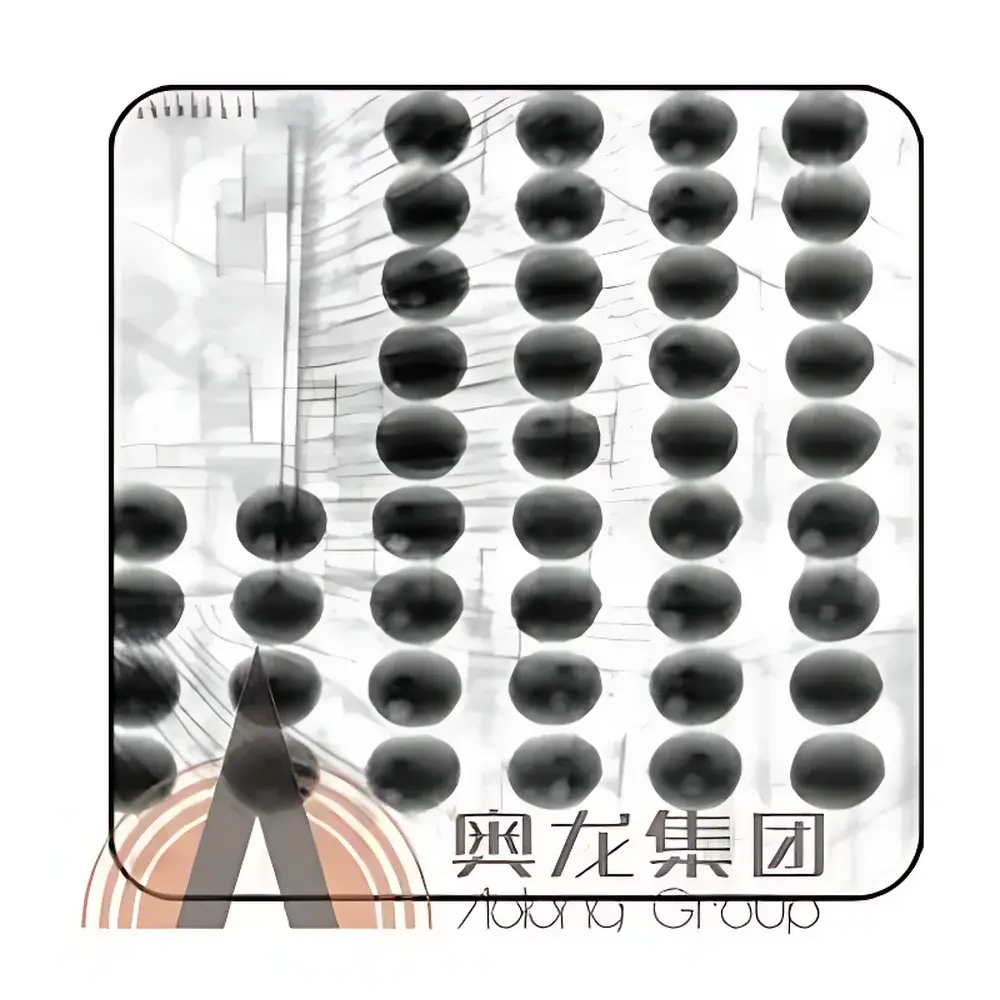
- BGA-specific analysis module including automated solder ball detection, void segmentation (with % void area quantification), centroid localization, and positional tolerance mapping against IPC-A-610 Class 2/3 criteria
Sample Compatibility & Compliance
The AL-WJ-0902 accommodates samples ranging from miniature passive components (0201, 01005) to assembled PCBs up to 300 × 300 mm and cylindrical battery cells (up to Ø80 mm × H120 mm). Its variable kV/mA output (20–225 kV, 0–3 mA) enables optimal contrast differentiation in heterogeneous structures—e.g., copper traces within FR-4 substrates, electrolyte distribution in pouch cells, or porosity networks in sintered metal powders. All image acquisition and processing workflows adhere to GLP-relevant audit trail requirements: timestamped metadata embedding, user-access logging, and immutable DICOM-SR export. System validation documentation includes IQ/OQ reports referencing ASTM E2698 (Standard Practice for Radiographic Examination Using Digital Detector Arrays) and supports FDA 21 CFR Part 11 compliance when deployed with validated LIMS integration.
Software & Data Management
The proprietary AlongVision™ software provides a unified interface for acquisition control, reconstruction (FDK and iterative SART algorithms), quantitative analysis, and report generation. Raw projections are stored in lossless TIFF format; reconstructed volumes are exported as NIfTI or VTK for third-party finite element modeling (FEM) or machine learning preprocessing. Batch processing pipelines support automated void analysis across hundreds of BGA packages using configurable ROI templates and threshold-based segmentation. Audit logs record every parameter change, measurement execution, and export action—including operator ID, timestamp, and hash-verified file integrity checksums. Data retention policies align with ISO/IEC 27001 Annex A.8.3.2 for secure storage and retrieval.
Applications
- Electronics: Void quantification in flip-chip underfill, intermetallic layer thickness estimation in wire-bond interfaces, warpage-induced crack detection in stacked die packages
- Battery QA: Electrode coating uniformity assessment, separator wrinkling analysis, anode/cathode particle cracking post-cycling, dry-out zone identification in prismatic cells
- Advanced Manufacturing: Porosity mapping in additively manufactured Ti-6Al-4V turbine blades, fiber orientation analysis in carbon-fiber reinforced polymer (CFRP) laminates
- Materials Science: In-situ deformation monitoring under mechanical loading (via optional stage), phase distribution in multiphase alloys, inclusion morphology in high-purity aluminum ingots
- Forensics & Authentication: Internal structure verification of luxury goods (e.g., pearl nacre layer integrity), counterfeit IC die inspection, heritage artifact conservation documentation
FAQ
What regulatory standards does the AL-WJ-0902 support for GMP/GLP environments?
The system supports audit-ready operation via configurable electronic signatures, immutable acquisition logs, and DICOM-compliant data packaging—enabling alignment with FDA 21 CFR Part 11, EU Annex 11, and ISO/IEC 17025 Clause 7.7 requirements.
Can the system perform quantitative porosity analysis per ASTM E1558?
Yes—using calibrated grayscale thresholding, morphological filtering, and volumetric fraction computation on reconstructed CT volumes, with traceability to NIST-traceable step wedges.
Is remote operation and monitoring supported?
The system includes TLS-secured web-based remote access for acquisition supervision, real-time image preview, and diagnostic telemetry—compatible with enterprise firewall policies and zero-trust network architectures.
What is the typical throughput for full-volume reconstruction of a 10 mm × 10 mm × 2 mm PCB sample?
At 1 µm focal spot and 1024² projection matrix, full 3D reconstruction (512³ volume) completes in ≤18 minutes using GPU-accelerated FDK on a dual-NVIDIA RTX 6000 Ada workstation.
Does Along provide application-specific method development services?
Yes—Along’s Application Engineering team offers on-site or virtual method optimization, including kV/mA parameter tuning, detector exposure calibration, and custom measurement script development per IPC, JEDEC, or customer-defined specifications.
Related Products



