
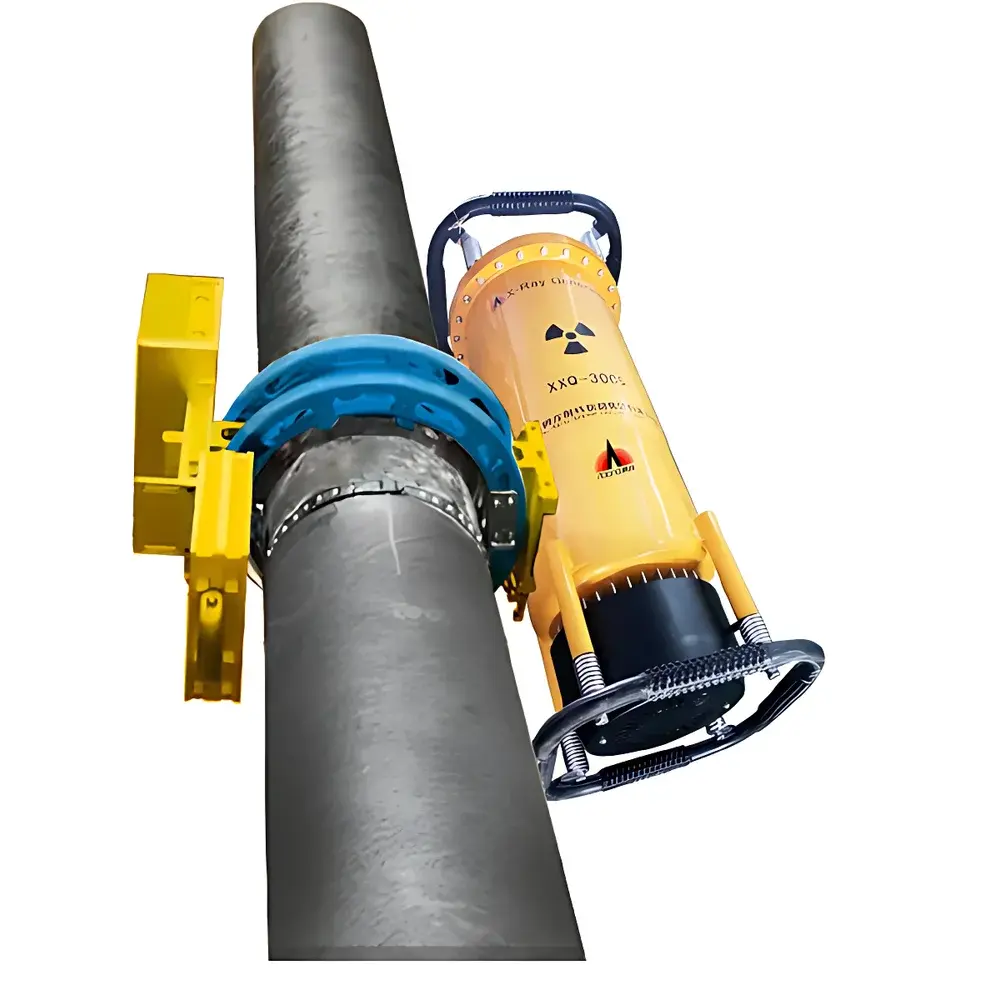
Aolong X-ray Online Pipe Inspection System
| Brand | Aolong |
|---|---|
| Origin | Liaoning, China |
| Manufacturer Type | Manufacturer |
| Product Origin | Domestic |
| Model | X-ray Online Pipe Inspection System |
| Price | Upon Request |
| X-ray Source | 160–350 kV (selectable) |
| Tube Current | 0–5 mA |
| Flat Panel Detector Area | 13×13 cm to 43×43 cm |
| Pixel Size | 85 µm or 127 µm |
| Frame Rate | 5–60 fps |
| Inspection Speed | 3 m/min |
| Operating Temperature | −25°C to +60°C |
| Relative Humidity | ≤85% RH |
| Max Detectable Wall Thickness | ≤45 mm |
| Pipe Diameter Range | φ273 mm to φ1422 mm |
Overview
The Aolong X-ray Online Pipe Inspection System is an industrial-grade digital radiography (DR) platform engineered for real-time, non-destructive evaluation (NDE) of longitudinal and circumferential welds in large-diameter steel pipelines during fabrication, field installation, or in-service integrity assessment. Unlike conventional film-based radiography or portable X-ray units requiring manual positioning and post-processing, this system integrates high-voltage X-ray generation, high-resolution flat-panel detection, motion-synchronized imaging, and automated defect recognition logic into a unified, production-integrated architecture. It operates on the principle of differential X-ray attenuation—where variations in material density and discontinuities (e.g., porosity, lack of fusion, slag inclusions, cracks) produce measurable contrast gradients in the acquired DR image. Designed specifically for pipeline manufacturing yards and pipeline right-of-way (ROW) inspection crews, the system delivers metrologically traceable, repeatable radiographic data compliant with ASME B31.4/B31.8, ISO 17636-2:2013, and EN 1435, while enabling full integration into quality management systems (QMS) supporting ISO 9001 and API Q1.
Key Features
- Modular high-voltage X-ray source (160–350 kV selectable) with stable tube current regulation (0–5 mA), optimized for penetration of carbon steel pipe walls up to 45 mm thickness.
- Large-area amorphous silicon (a-Si) flat panel detector with configurable active area (13×13 cm to 43×43 cm) and dual pixel pitch options (85 µm and 127 µm) to balance spatial resolution and detection efficiency across varying pipe diameters.
- Synchronized motion control architecture: servo-driven rotational fixture enables precise angular indexing and continuous helical scanning at up to 3 m/min line speed, ensuring full coverage without image stitching artifacts.
- Real-time image acquisition at frame rates from 5 to 60 fps, allowing dynamic adjustment based on pipe geometry, wall thickness, and required signal-to-noise ratio (SNR).
- Radiation safety–optimized workflow: exposure time per image <10 s; automatic beam cutoff upon completion of each scan segment; integrated interlock sensors and dose monitoring compliant with IEC 61331-1 and national radiation protection regulations.
- Zero-chemical imaging workflow: eliminates darkroom processing, silver halide film, developer/fixer solutions, and associated hazardous waste streams—fully aligned with ISO 14001 environmental management requirements.
Sample Compatibility & Compliance
The system accommodates seamless and welded steel pipes conforming to ASTM A106, ASTM A53, API 5L (Gr. B through X80), and ISO 3183 specifications. Its mechanical fixture set supports nominal pipe sizes from NPS 10 (φ273 mm) to NPS 56 (φ1422 mm), with wall thicknesses ranging from 6 mm to 45 mm. All hardware and software components meet electromagnetic compatibility (EMC) standards per IEC 61000-6-2/6-4 and operate reliably under ambient conditions from −25°C to +60°C and ≤85% relative humidity (non-condensing). Radiographic interpretation follows SY/T 4109–2013 (China Petroleum & Chemical Industry Standard) and NB/T 47013.2–2015 (Non-destructive Testing of Pressure Equipment – Part 2: Radiographic Testing), with optional calibration traceability to NIST-traceable reference phantoms for IQI sensitivity verification.
Software & Data Management
The embedded inspection software provides DICOM-compliant image acquisition, geometric distortion correction, contrast enhancement (CLAHE, unsharp masking), and defect annotation tools with customizable templates. Image metadata—including exposure parameters, GPS-tagged location (when equipped), pipe ID, weld joint number, and operator ID—is automatically embedded and encrypted. Audit trails record all user actions (image acquisition, modification, export) in accordance with FDA 21 CFR Part 11 and GLP/GMP requirements. Export formats include TIFF (16-bit), JPEG2000, and PDF reports with embedded digital signatures. Optional cloud synchronization enables remote review by QA/QC supervisors and integration with enterprise asset management (EAM) platforms via RESTful API.
Applications
- Automated weld inspection in pipeline girth weld shops and spool fabrication facilities.
- In-field hydrotest validation and pre-commissioning integrity screening along ROW segments.
- Periodic in-service inspection of buried or above-ground transmission pipelines for corrosion mapping and crack growth monitoring.
- Quality assurance auditing for third-party certification bodies (e.g., TÜV, DNV, BV) conducting API RP 1160 or ISO 15643 compliance assessments.
- Training and qualification of Level II/III NDT personnel using standardized digital image libraries and pass/fail benchmark sets.
FAQ
Does the system support automated defect classification?
Yes—optional AI-assisted analysis modules provide binary classification (accept/reject) and bounding-box localization for common weld defects (porosity clusters, linear indications, incomplete penetration), trained on datasets validated against ASME Section V Case 187.
Can the system be integrated with existing ERP or CMMS platforms?
Yes—via standard OPC UA or MQTT protocols; custom middleware development is available for SAP PM, IBM Maximo, or Infor EAM environments.
Is radiation shielding included in the base configuration?
No—shielding design must be site-specific and certified by a qualified Radiation Protection Officer (RPO); the system includes mounting interfaces for lead-acrylic barriers and collimator attachments.
What is the typical calibration interval for the X-ray source and detector?
Source output stability is verified daily using a calibrated ion chamber; annual full calibration per ISO/IEC 17025 is recommended, with detector gain/offset correction performed before each shift.
Are training and certification services provided for operators and interpreters?
Yes—Aolong offers Level I/II RT certification courses accredited by CNAS (China National Accreditation Service) and aligned with ISO 9712:2012 requirements.
Related Products



