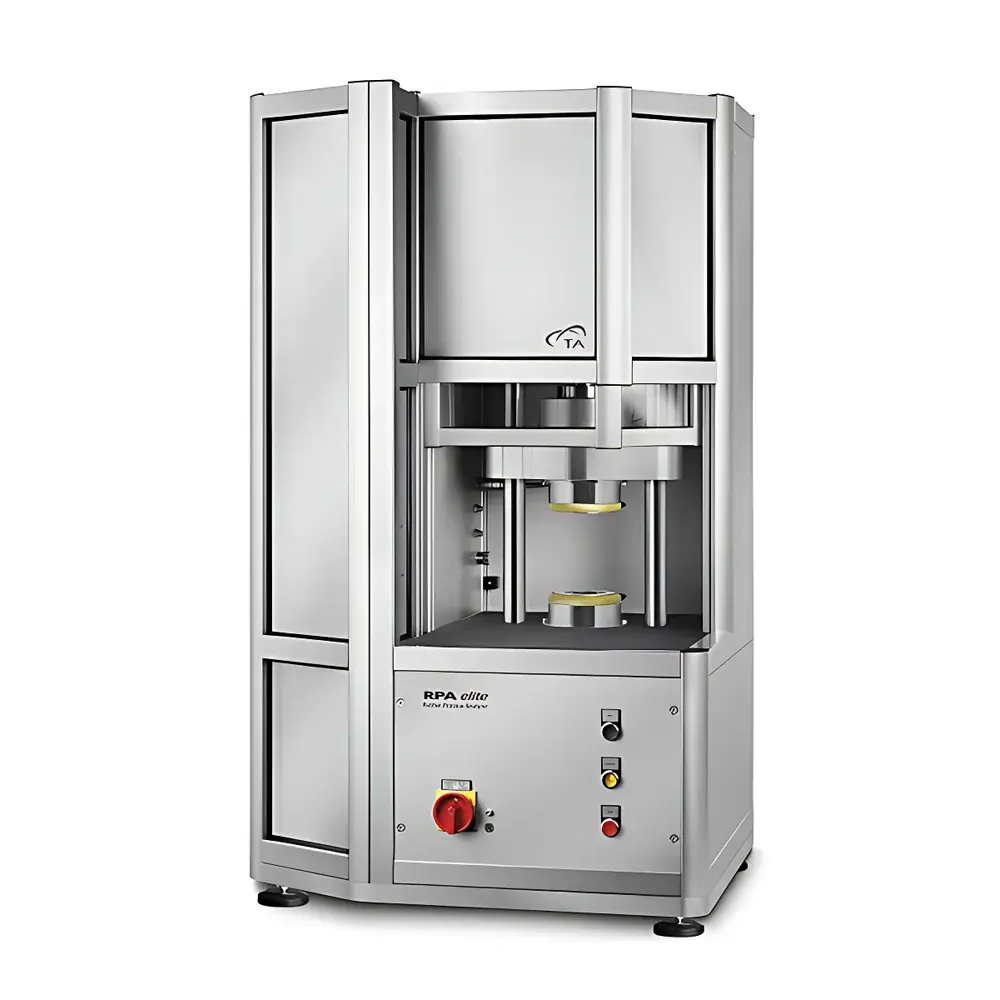
Rubber Process Analyzer RPA elite by TA Instruments
| Brand | TA Instruments |
|---|---|
| Origin | Germany |
| Model | RPA elite |
| Drive Type | Direct-drive motor with high-resolution strain control |
| Torque Sensor | Patented high-stiffness, wide-range sensor with low noise floor |
| Frame Stiffness | Ultra-rigid monolithic frame eliminating instrument compliance |
| Temperature Control | Integrated gas-cooling unit for rapid and stable thermal regulation |
| Pressure Control | Pneumatically actuated, user-adjustable die closure pressure |
| Automation | Optional robotic autosampler for unattended operation |
| Calibration | User-performed torque and geometry calibration |
| Compliance | Designed to support ASTM D6204, ISO 6673, and ISO 10985 test methods |
Overview
The RPA elite Rubber Process Analyzer by TA Instruments is a state-of-the-art dynamic vulcanization and viscoelastic characterization system engineered for precision measurement of uncured rubber compounds under simulated processing conditions. Operating on the principle of oscillatory shear deformation in a sealed, temperature- and pressure-controlled cavity, the RPA elite applies controlled sinusoidal strain or stress to a sample while continuously monitoring torque response. This enables real-time quantification of complex modulus (G*), storage modulus (G′), loss modulus (G″), tan δ, and scorch onset—parameters critical to compound development, quality assurance, and process optimization in tire, automotive, and industrial rubber manufacturing. Its design adheres to fundamental rheological standards for polymer melts and elastomeric dispersions, ensuring data traceability and method reproducibility across global R&D and production laboratories.
Key Features
- High-resolution direct-drive motor delivering precise, programmable strain amplitudes from 0.1% to 100% with sub-millidegree angular resolution—enabling true small-strain linear viscoelastic (LVE) region identification and large-strain nonlinear behavior mapping.
- Patented high-stiffness torque transducer with ±0.001 N·m minimum detectable torque and 0.01–100 N·m full-scale range, optimized for low-noise signal acquisition even during high-frequency sweeps (0.01–100 Hz).
- Monolithic aluminum-alloy frame with integrated thermal mass management, minimizing mechanical compliance and eliminating frame resonance artifacts up to 200 Hz.
- Fully programmable test parameters: independent control of strain amplitude, frequency sweep profile, temperature ramp/soak (−70 °C to 250 °C), dwell time, and pneumatic die closure pressure (0–1.2 MPa).
- Modular cavity geometry support: interchangeable rotor designs (e.g., standard biconical, serrated, or custom geometries) and user-replaceable dies with tool-free installation and factory-traceable calibration certificates.
- Integrated gas-cooling system using dry nitrogen or compressed air, enabling rapid cooling rates up to 15 °C/min and thermal stability of ±0.2 °C over extended test durations.
Sample Compatibility & Compliance
The RPA elite accommodates raw rubber compounds, masterbatches, thermoplastic elastomers (TPEs), and filled elastomer systems—including carbon-black-, silica-, and oil-modified formulations. Sample volume requirements range from 3.5 g to 7.0 g depending on rotor configuration. All testing protocols align with internationally recognized standards: ASTM D6204 (Standard Test Method for Rubber Property—Viscosity, Stress Relaxation, and Cure Characteristics of Uncured Rubber Compounds Using Large Amplitude Oscillatory Shear), ISO 6673 (Rubber—Determination of Vulcanization Characteristics), and ISO 10985 (Rubber—Determination of Scorch Time). The system architecture supports GLP-compliant audit trails, electronic signatures, and 21 CFR Part 11–ready software configurations when deployed with TA’s TRIOS Enterprise platform.
Software & Data Management
Controlled via TRIOS Software v6.x, the RPA elite offers intuitive method creation, real-time data visualization, and automated report generation in PDF, CSV, and XML formats. The software includes built-in analysis modules for Mooney viscosity equivalence, Payne effect quantification, Arrhenius activation energy calculation, and time–temperature superposition (TTS) modeling. Data integrity safeguards include timestamped operator logs, version-controlled method templates, and encrypted database storage. Remote monitoring and secure cloud-based data backup are supported through optional TRIOS Connect integration—facilitating multi-site collaboration and centralized QC oversight without compromising local data sovereignty.
Applications
- Compound formulation screening: Comparative evaluation of curing kinetics, filler dispersion efficiency, and plasticizer migration effects across batch variations.
- Scorch safety assessment: Onset time (ts1, ts2) and minimum torque (ML) determination for extrusion and calendering process window definition.
- Viscoelastic profiling: Construction of master curves for predictive modeling of compound behavior under service conditions (e.g., rolling resistance, heat build-up).
- Recycled rubber compatibility testing: Quantification of interfacial adhesion and network reformation in devulcanized or reclaimed blends.
- Quality control release testing: Routine verification of incoming raw material consistency against reference spectra per internal SOPs or customer specifications.
FAQ
What standards does the RPA elite comply with for rubber testing?
ASTM D6204, ISO 6673, and ISO 10985 are natively supported through pre-validated test templates and reporting structures.
Can the RPA elite operate below room temperature?
Yes—the integrated gas-cooling system enables stable operation down to −70 °C, critical for low-temperature cure profiling and crystallinity studies in natural rubber compounds.
Is user calibration possible without service engineer intervention?
Yes—torque zeroing, strain calibration, and geometry verification can be performed in-house using certified reference standards and guided workflows within TRIOS Software.
How is data security ensured during regulatory audits?
TRIOS Enterprise supports role-based access control, immutable audit logs, electronic signature capture, and full 21 CFR Part 11 compliance when configured with validated server infrastructure and digital certificate management.
What maintenance is required for long-term torque sensor accuracy?
Annual verification using NIST-traceable torque standards is recommended; no routine recalibration is needed between verifications due to the sensor’s drift-compensated design and thermal self-compensation circuitry.