
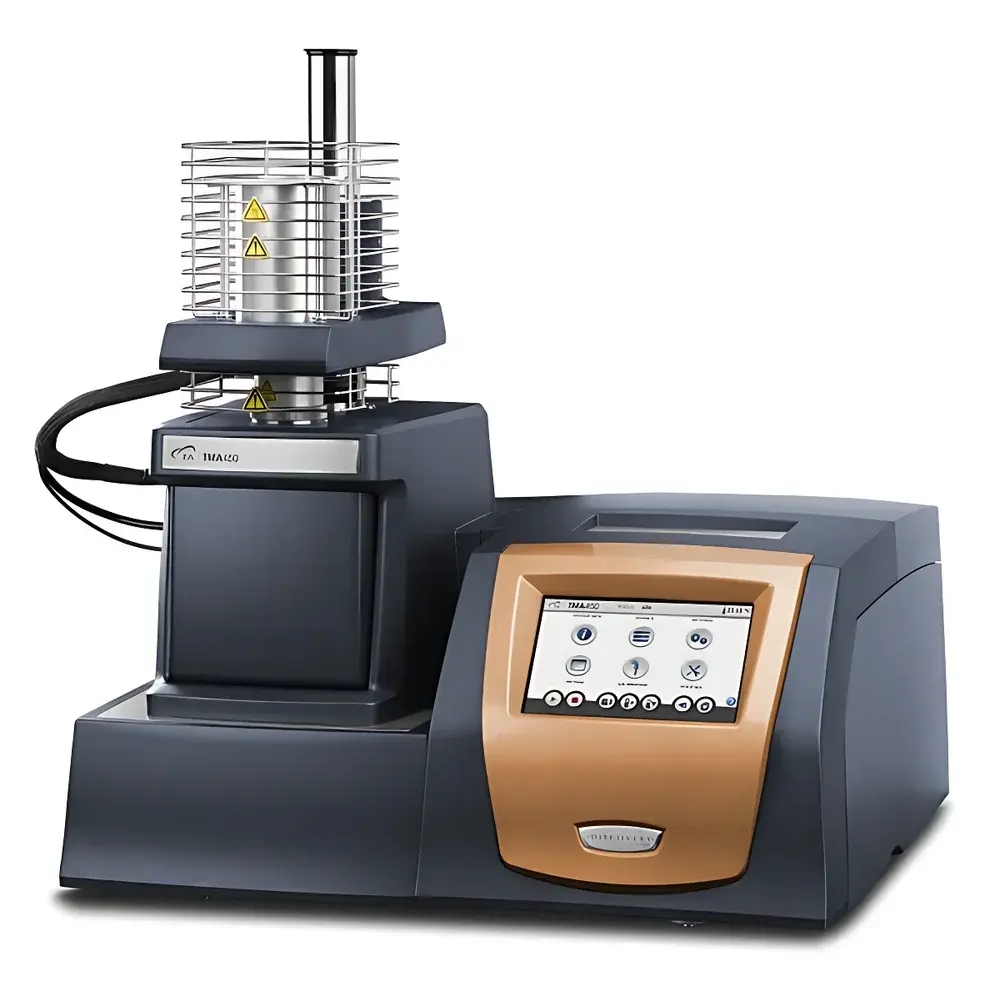
TA Instruments Discovery TMA 450 Thermomechanical Analyzer
| Brand | TA Instruments |
|---|---|
| Origin | USA |
| Model | Discovery TMA 450 |
| Temperature Range | −150 to 1000 °C |
| Temperature Accuracy | ±1 °C |
| Force Range | 0.001–2 N |
| Frequency Range | 0.01–2 Hz |
| Displacement Resolution | 15 nm |
| Maximum Sample Length | 26 mm |
| Displacement Range | ±2.5 mm |
| Cooling Option | Mechanical Cooling Accessory (MCA 70) to −70 °C |
Overview
The TA Instruments Discovery TMA 450 is a high-precision thermomechanical analyzer engineered for quantitative measurement of dimensional changes in solid and semi-solid materials as a function of temperature, time, and applied force. Based on the fundamental principle of controlled-force or controlled-displacement mechanical probing under precisely regulated thermal conditions, the instrument employs a non-contact, frictionless voice-coil motor to apply calibrated loads while monitoring sample expansion, contraction, softening, or creep behavior with nanoscale resolution. Its operational envelope spans from cryogenic conditions (−150 °C with optional liquid nitrogen cooling) to high-temperature regimes (up to 1000 °C), making it suitable for characterizing polymers, composites, ceramics, metals, pharmaceuticals, and electronic packaging materials across industrial R&D, quality control, and regulatory-compliant laboratories.
Key Features
- Non-contact voice-coil actuator delivering precise, repeatable forces from 0.001 N to 2 N—enabling characterization of both highly compliant elastomers and rigid carbon-fiber composites without mechanical hysteresis or stiction artifacts.
- Nanometer-resolution displacement sensing (15 nm) over a ±2.5 mm range, supporting high-fidelity tracking of subtle thermal transitions including glass transitions (Tg), coefficient of thermal expansion (CTE) inflections, and stress relaxation onset points.
- Modular furnace architecture with five-year limited warranty on heating elements—ensuring long-term thermal stability, uniformity, and reproducibility across repeated thermal cycles.
- Modulated TMA (MTMA™) mode, enabling simultaneous acquisition of both elastic and viscous dimensional responses—providing enhanced discrimination between reversible thermal expansion and irreversible viscoelastic deformation.
- Integrated Dynamic TMA, Creep, and Stress Relaxation test protocols—extending conventional static TMA into time-dependent mechanical domain for comprehensive viscoelastic profiling under thermal load.
- Optional Mechanical Cooling Accessory (MCA 70) achieves stable operation down to −70 °C without liquid nitrogen, reducing operational complexity, safety risks, and consumable costs in routine low-temperature CTE or Tg analysis.
Sample Compatibility & Compliance
The Discovery TMA 450 accommodates samples up to 26 mm in length and supports a wide variety of probe geometries—including tension, compression, penetration, and dual cantilever configurations—to address diverse material forms (films, fibers, molded parts, powders, and thin coatings). Its design conforms to ASTM E831 (linear thermal expansion), ASTM D696 (CTE of plastics), ISO 11359-2 (TMA of polymers), and USP <1231> (thermal characterization of pharmaceutical excipients). Data acquisition and instrument control comply with FDA 21 CFR Part 11 requirements when configured with TRIOS software’s audit trail, electronic signature, and user-access-level management modules—supporting GLP/GMP environments and regulatory submissions.
Software & Data Management
TRIOS software serves as the unified platform for instrument control, real-time data visualization, advanced curve fitting, multi-sample comparison, and automated report generation. Its application-driven interface includes pre-validated method templates for CTE, Tg, softening point, and modulus profiling—reducing method development time and operator dependency. Raw data are stored in vendor-neutral HDF5 format, ensuring long-term archival integrity and third-party interoperability. Batch processing, customizable pass/fail criteria, and export to CSV, Excel, or PDF facilitate integration into enterprise LIMS and QMS systems. The intuitive touchscreen interface features One-Touch-Away™ workflow navigation—minimizing training overhead and supporting rapid deployment across multi-user laboratory settings.
Applications
- Determination of linear coefficient of thermal expansion (CTE) in aerospace composites and microelectronic substrates.
- Identification of glass transition temperature (Tg) and secondary relaxations in amorphous and semi-crystalline polymers.
- Characterization of curing shrinkage and post-cure dimensional stability in thermosetting resins and adhesives.
- Analysis of thermal stress development at interfaces in multilayer packaging films and solder joint assemblies.
- Quantification of creep compliance and stress relaxation kinetics in biomedical hydrogels and elastomeric implants.
- Evaluation of dimensional stability during thermal cycling in battery electrode materials and solid electrolytes.
FAQ
What temperature range is achievable with standard configuration?
The Discovery TMA 450 operates from −150 °C (with liquid nitrogen cooling) to 1000 °C. With the optional MCA 70 mechanical cooler, the low-temperature limit is −70 °C—eliminating the need for cryogen handling.
Is displacement calibration traceable to NIST standards?
Yes—displacement transducers are factory-calibrated using laser interferometry traceable to NIST, and users can perform periodic verification using certified reference standards per ASTM E228.
Can the instrument be integrated into an automated lab environment?
Yes—TRIOS supports remote control via TCP/IP and offers COM/ActiveX API for integration with robotic sample handlers, centralized data lakes, and MES/QMS platforms.
Does the system support dynamic mechanical testing under thermal ramp conditions?
Yes—Dynamic TMA mode allows continuous acquisition of dimensional response during programmed temperature ramps at rates up to 100 °C/min, with simultaneous force modulation up to 2 Hz.
What maintenance is required to sustain metrological performance?
Annual verification of thermal uniformity, force calibration, and displacement linearity is recommended. TA Instruments provides certified service plans including on-site calibration and firmware updates aligned with ISO/IEC 17025 practices.
Related Products



