
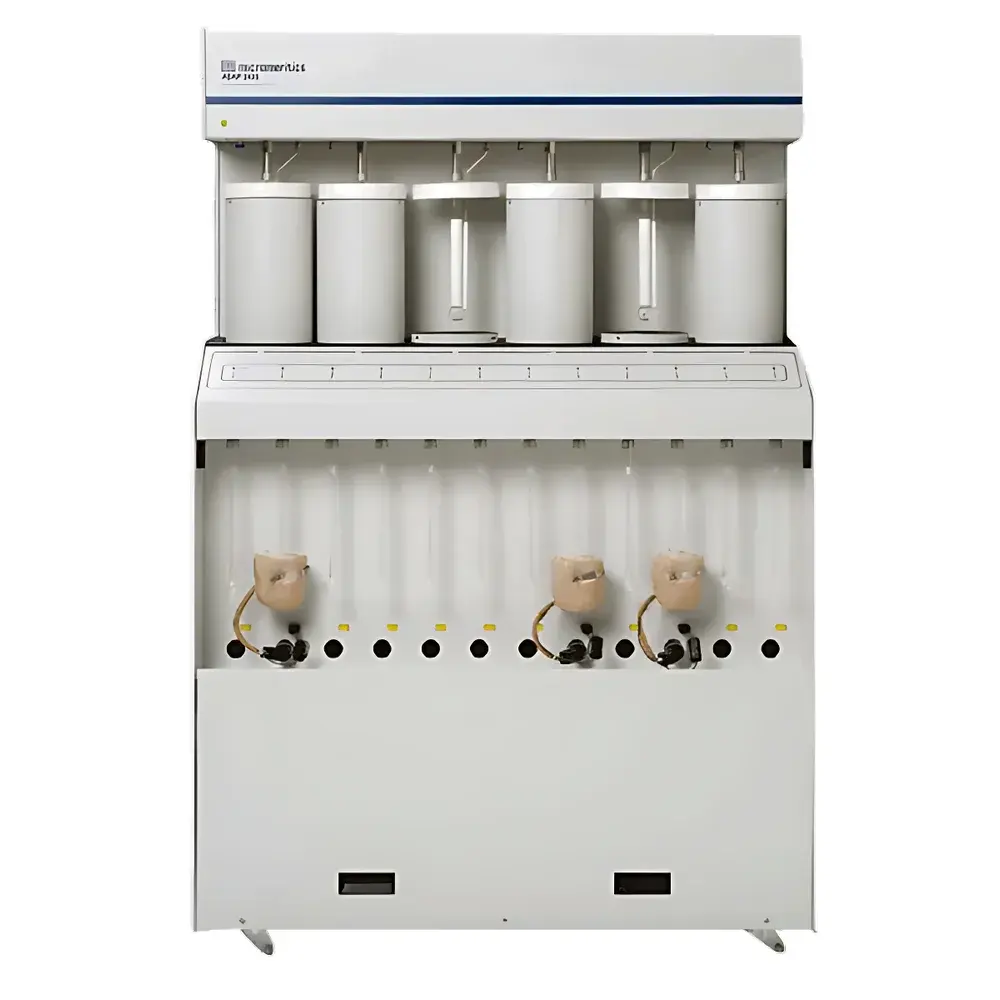
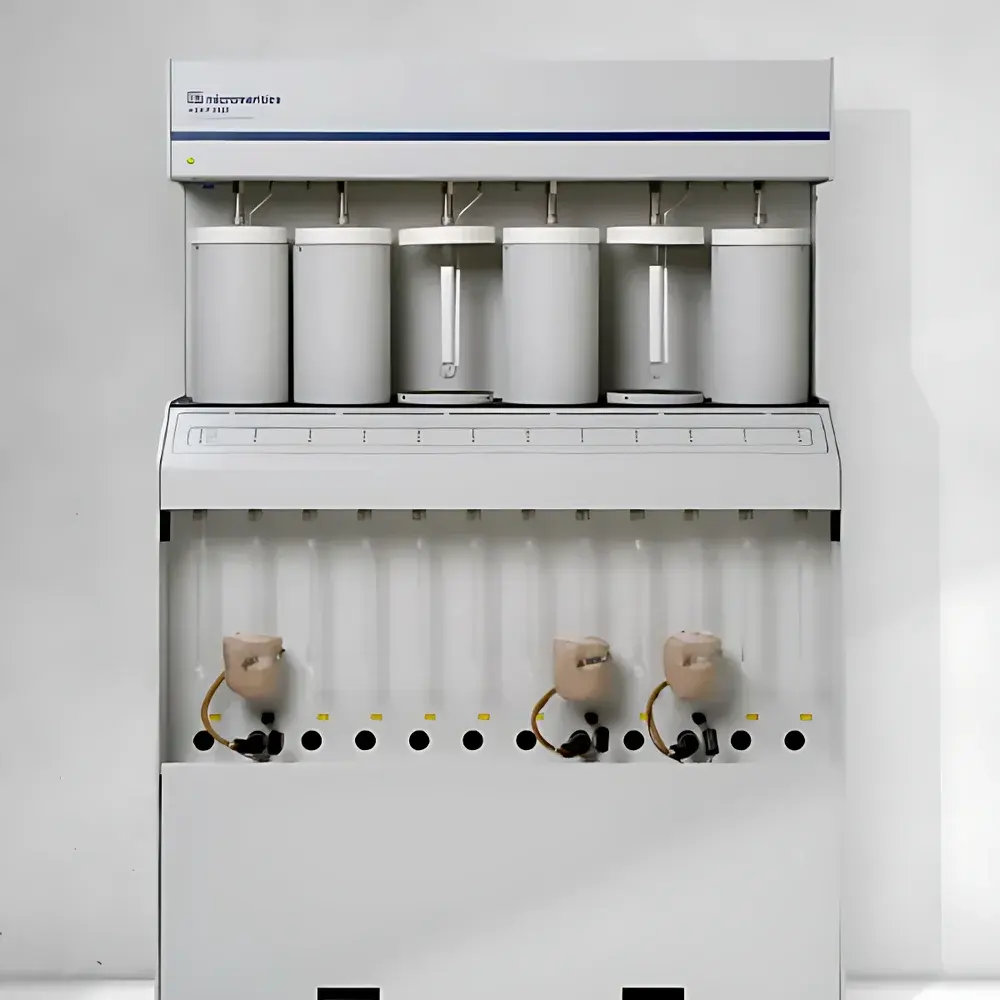
Micromeritics ASAP 2425 Multi-Station Fully Automated Surface Area and Porosimetry Analyzer
| Brand | Micromeritics |
|---|---|
| Origin | USA |
| Model | ASAP 2425 |
| Instrument Type | Specific Surface Area and Pore Size Analyzer |
| Principle | Static Gas Adsorption (Volumetric Method) |
| Number of Analysis Stations | 6 |
| Pore Size Range | 0.35–500 nm |
| Pressure Range | 0–950 mmHg |
| Adsorption Theory | Brunauer-Emmett-Teller (BET), t-plot, Langmuir, DFT, NLDFT |
| Sample Preparation Stations | 12 independent, temperature-controlled (ambient to 450 °C) |
| Optional Configurations | Low-surface-area mode (Kr adsorption, 10 mmHg transducer), Micropore-enhanced mode (1 mmHg transducer) |
| Software | MicroActive v5.x with ASTM/ISO-compliant reporting, FDA 21 CFR Part 11 audit trail capability |
Overview
The Micromeritics ASAP 2425 Multi-Station Fully Automated Surface Area and Porosimetry Analyzer is a high-precision, static volumetric gas adsorption system engineered for rigorous characterization of specific surface area, pore volume, pore size distribution, and adsorption isotherms across solid and porous materials. Based on the fundamental principles of physical adsorption—primarily nitrogen (77 K) and krypton (77 K) gas uptake—the instrument quantifies monolayer coverage, multilayer formation, and capillary condensation in mesopores and macropores according to internationally recognized theoretical frameworks including BET, Langmuir, t-plot, and density functional theory (DFT/NLDFT). Its six independent analysis stations operate in parallel or autonomously, enabling uninterrupted throughput while maintaining thermodynamic equilibrium via integrated isothermal jackets and long-duration Dewar flasks. Designed for compliance-driven laboratories, the ASAP 2425 meets the metrological requirements of ASTM D3663, ISO 9277, ISO 15901, and USP , supporting GLP/GMP workflows through traceable calibration, hardware-level pressure stabilization, and software-enforced data integrity protocols.
Key Features
- Six fully independent analysis stations with dedicated pressure transducers (0–950 mmHg range), each capable of simultaneous or staggered operation without cross-interference
- Integrated 12-position automated sample preparation manifold with individual PID-controlled heating (ambient to 450 °C), programmable ramp rates, dwell times, and real-time vacuum monitoring
- High-stability isothermal enclosure with dual-stage thermal regulation for sample tubes and reference P0 tubes, minimizing thermal drift during extended isotherm acquisition
- MicroActive software v5.x with interactive isotherm analysis: drag-adjustable data windows for BET linear region selection, t-plot slope determination, and DFT kernel fitting; supports linear/logarithmic axis toggling and multi-isotherm overlay
- Optional low-surface-area configuration featuring Kr adsorption capability, 10 mmHg high-resolution transducer, and five active analysis stations optimized for materials with surface areas below 1 m²/g
- Micropore-enhanced option with 1 mmHg ultra-low-pressure transducer, improved signal-to-noise ratio below P/P0 = 10−6, and extended DFT model applicability down to 0.35 nm
- Five independently controllable gas inlets with dedicated free-space measurement port, servo-regulated dosing valves for precise incremental gas delivery, and automatic dead-volume correction
Sample Compatibility & Compliance
The ASAP 2425 accommodates a broad spectrum of powdered, granular, and monolithic solids—including catalysts, pharmaceutical excipients, battery electrode materials, MOFs, activated carbons, ceramics, metal oxides, and geological samples—without modification to core hardware. All sample holders conform to standard 6-mm and 9-mm OD glass tubes compliant with ASTM D3663 geometry specifications. The system supports full traceability per FDA 21 CFR Part 11 through electronic signatures, immutable audit logs, role-based access control, and secure report generation with embedded metadata (operator ID, timestamp, calibration certificate IDs, instrument configuration hash). Data export formats include ASTM E131-compliant .csv, ISO-standardized .txt, and proprietary .asap binary archives compatible with third-party modeling tools. Routine verification follows Micromeritics’ certified reference material (CRM) protocol using NIST-traceable silica gel (BET SA ≈ 190 m²/g) and activated carbon (BET SA ≈ 1100 m²/g).
Software & Data Management
MicroActive software serves as both acquisition interface and advanced post-processing engine. It enables real-time visualization of adsorption/desorption isotherms, automated equilibrium detection via user-defined pressure stability thresholds (e.g., ΔP < 0.001 mmHg over 60 s), and batch processing of up to 25 isotherms—including mercury intrusion porosimetry (MIP) datasets—for comparative pore network analysis. Reporting modules support customizable templates aligned with internal SOPs or regulatory submissions: all reports embed raw isotherm data, calculation parameters (e.g., BET C-constant, t-plot thickness curve), uncertainty estimates per ISO/IEC 17025 guidelines, and graphical summaries (Barrett-Joyner-Halenda [BJH] pore size histograms, DFT-derived slit/cylindrical pore distributions). Audit trails record every parameter change, manual override, and calibration event with cryptographic timestamping and operator attribution.
Applications
The ASAP 2425 delivers quantitative surface and pore metrics essential to R&D and QC in regulated and industrial settings. In pharmaceutical development, it characterizes excipient surface heterogeneity affecting dissolution kinetics and tablet compaction behavior. Catalyst manufacturers rely on its reproducible micropore volume measurements (< 2 nm) to correlate Pt dispersion with turnover frequency. Battery researchers quantify electrode coating porosity and tortuosity to model Li-ion diffusion pathways. Ceramics engineers assess sintering-induced pore coalescence using sequential isotherms from green-body to fired-state samples. Environmental labs apply Kr-BET for low-area soil clays and volcanic ash, while nanomaterial producers validate synthesis consistency via DFT-mode pore size repeatability (RSD < 2.5% across n=6 replicates). Additional validated use cases span aerospace thermal barrier coatings, fuel cell gas diffusion layers, cosmetic pigment dispersibility assessment, and geological reservoir rock wettability screening.
FAQ
What gases are supported for adsorption analysis?
Nitrogen (77 K) is standard for routine BET and BJH analysis; krypton (77 K) is available for low-surface-area materials (< 1 m²/g); argon (87 K) may be used for select DFT model validation.
Can the system perform both degassing and analysis concurrently?
Yes—12 independent degas stations operate in parallel with up to six active analysis stations, eliminating workflow bottlenecks.
Is P0 measurement automated or manual?
Both options are supported: continuous P0 monitoring during analysis or discrete calibration intervals; users may input certified P0 values from external vapor pressure tables.
How does the system ensure measurement reproducibility across multiple operators?
Through standardized method templates, hardware interlocks preventing out-of-spec parameter entry, and built-in CRM verification routines that auto-flag deviations exceeding ±3% from historical control limits.
Does MicroActive support third-party data import/export for modeling?
Yes—raw isotherm data exports in ASCII-delimited formats (.csv, .txt) with column headers compliant with IUPAC-recommended conventions; DFT output files are structured for direct ingestion into MATLAB, Python (scikit-learn), or commercial modeling suites.



