
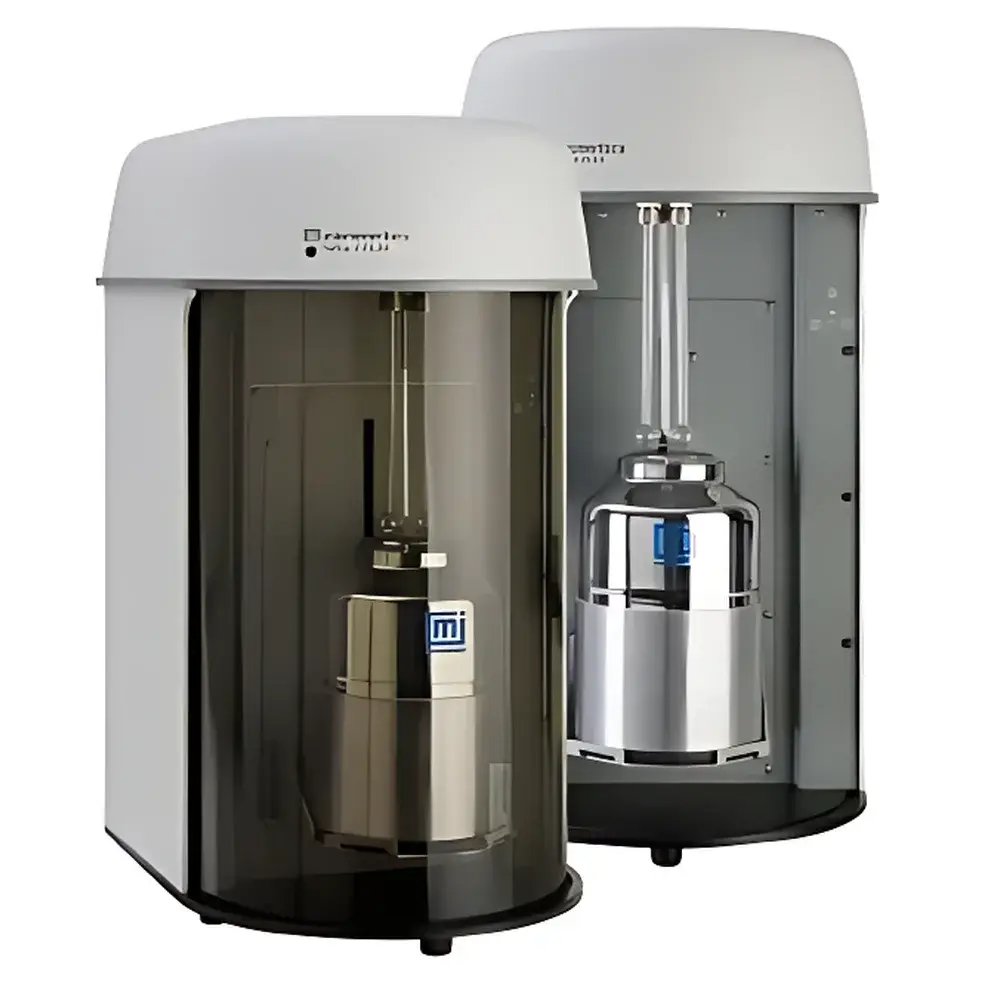
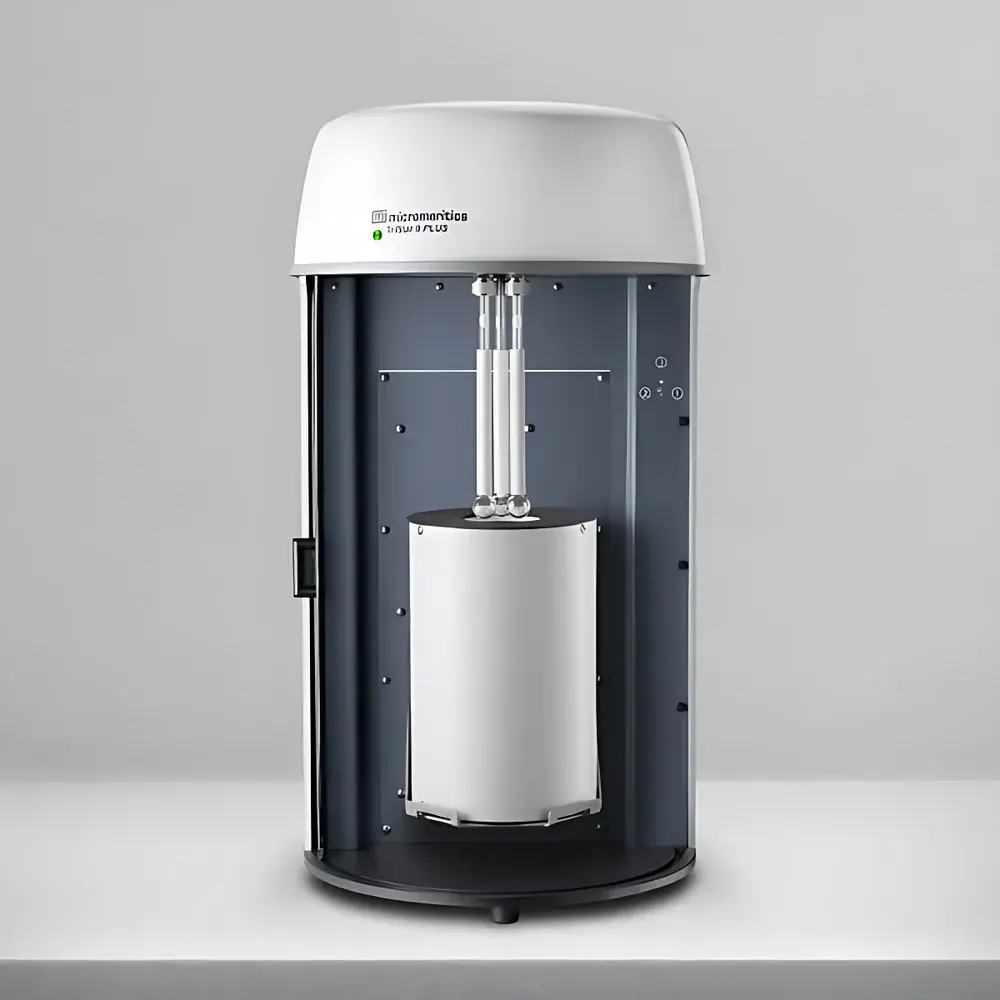
Micromeritics TriStar II Plus 3030 Specific Surface Area and Pore Size Analyzer
| Brand | Micromeritics |
|---|---|
| Origin | USA |
| Model | TriStar II Plus 3030 |
| Instrument Type | Specific Surface Area and Pore Size Analyzer |
| Principle | Static Volumetric Gas Adsorption |
| Number of Analysis Stations | 3 |
| Specific Surface Area Range | 0.001 m²/g to unlimited |
| Pressure Range | 0–1000 mmHg |
| Theoretical Basis | Gas Adsorption Analysis |
| Construction | Corrosion-Resistant Stainless Steel Manifold |
| Cryogenic Duration | >40 hours with optimized Dewar design |
| Software Platform | MicroActive v4.x with Python scripting support |
| Compliance Ready | ASTM D3663, ISO 9277, ISO 15901-2, USP <846>, IUPAC 2015 recommendations |
Overview
The Micromeritics TriStar II Plus 3030 is a high-precision, fully automated specific surface area and pore size analyzer engineered for laboratories requiring rigorous gas adsorption characterization under static volumetric conditions. Based on the fundamental principles of physical gas adsorption—primarily nitrogen (77 K) and carbon dioxide (273 K)—the instrument quantifies monolayer coverage, pore volume distribution, and adsorption isotherm behavior across microporous, mesoporous, and macroporous materials. Its tri-station architecture enables parallel analysis of up to three samples without cross-contamination, significantly increasing throughput while maintaining measurement integrity. The system employs high-stability pressure transducers, ultra-low-drift temperature control, and a vacuum-tight stainless steel manifold designed to minimize outgassing and ensure long-term calibration stability—critical for reproducible BET, t-plot, Langmuir, and non-local density functional theory (NLDFT) modeling.
Key Features
- Three independent analysis stations with individual dosing valves, pressure sensors, and thermal management—enabling true concurrent measurements.
- Corrosion-resistant stainless steel manifold with electropolished internal surfaces, reducing adsorption hysteresis and improving repeatability for aggressive or reactive samples (e.g., catalysts, MOFs, acidic oxides).
- Optimized Dewar flask design providing >40 hours of continuous cryogenic temperature stability at 77 K—eliminating manual liquid nitrogen refills during extended isotherm acquisition.
- Integrated 7-inch touchscreen display showing real-time status of vacuum level, temperature deviation, valve actuation, and maintenance alerts—including predictive diagnostics for pump oil life and cold trap saturation.
- Krypton expansion option (Kr-adsorption at 77 K) extending low-surface-area detection limit to 0.001 m²/g—validated per ASTM D3663 Annex A2 for catalyst supports and highly sintered ceramics.
- Hardware-level dead volume calibration using helium expansion method—performed automatically before each analysis cycle to correct for system void volume with traceable uncertainty propagation.
Sample Compatibility & Compliance
The TriStar II Plus 3030 accommodates standard 6 mm and 9 mm sample tubes, as well as custom geometries up to 12 mm OD, supporting powders, granules, monoliths, foams, and thin-film-coated substrates. Sample degassing is programmable via integrated heating jacket (up to 400 °C) with ramp/soak profiles and real-time pressure monitoring to prevent thermal decomposition. The platform meets analytical requirements defined in ISO 9277 (BET surface area), ISO 15901-2 (pore size distribution by NLDFT/QSDFT), and USP for pharmaceutical excipient characterization. Data audit trails, electronic signatures, and user-access controls align with FDA 21 CFR Part 11 readiness when deployed in regulated GMP/GLP environments.
Software & Data Management
MicroActive software (v4.x) provides an intuitive, browser-based interface with native support for interactive isotherm visualization, model overlay, and parameter sensitivity analysis. Users may apply BET, Langmuir, t-plot, αs-plot, and multiple NLDFT kernel libraries—including carbon slit-pore, silica cylindrical, and alumina cylindrical models—within a single workflow. Up to 25 isotherms (including mercury intrusion porosimetry datasets) can be loaded, aligned, and compared graphically. Custom report templates—editable via drag-and-drop layout editor—generate PDF/CSV outputs containing summary statistics, tabulated results, and publication-ready plots. Python API integration allows automation of batch processing, custom model fitting, and LIMS interfacing without modifying core firmware.
Applications
This instrument serves advanced materials development and quality control across sectors including heterogeneous catalysis (zeolites, Pt/C, NiMo sulfides), battery electrode materials (Si anodes, NMC cathodes), pharmaceutical solid-state characterization (API crystallinity, excipient porosity), carbon capture sorbents (activated carbons, COFs), and ceramic membrane fabrication. Its dual-isotherm capability—simultaneous CO2 (273 K) and N2 (77 K) acquisition—enables robust micropore analysis in carbons and MOFs where narrow-pore filling mechanisms differ substantially between probe gases. The system also supports inverse gas chromatography (IGC) mode for surface energy mapping when configured with optional pulse injection hardware.
FAQ
What standards does the TriStar II Plus 3030 comply with for BET surface area reporting?
It adheres to ASTM D3663, ISO 9277, and IUPAC 2015 guidelines—including recommended relative pressure ranges (P/P₀ = 0.05–0.30), minimum data point density, and linear regression criteria for monolayer capacity determination.
Can the instrument perform both micropore and mesopore analysis in a single run?
Yes—via sequential CO₂ (273 K) and N₂ (77 K) isotherms on the same sample, followed by unified NLDFT pore size distribution modeling that spans 0.3–500 nm using appropriate kernel libraries.
Is remote monitoring supported?
Yes—MicroActive includes secure HTTPS-based remote access, enabling real-time observation of active runs, historical log review, and diagnostic telemetry without local network exposure.
How is system dead volume calibrated?
Using automated helium expansion at ambient temperature prior to each analysis; results are stored with timestamp and operator ID for full traceability.
Does the software support GLP-compliant data archiving?
Yes—when configured with network storage and role-based authentication, all raw isotherms, calculation parameters, audit logs, and report generations are archived with SHA-256 checksums and immutable timestamps.



