
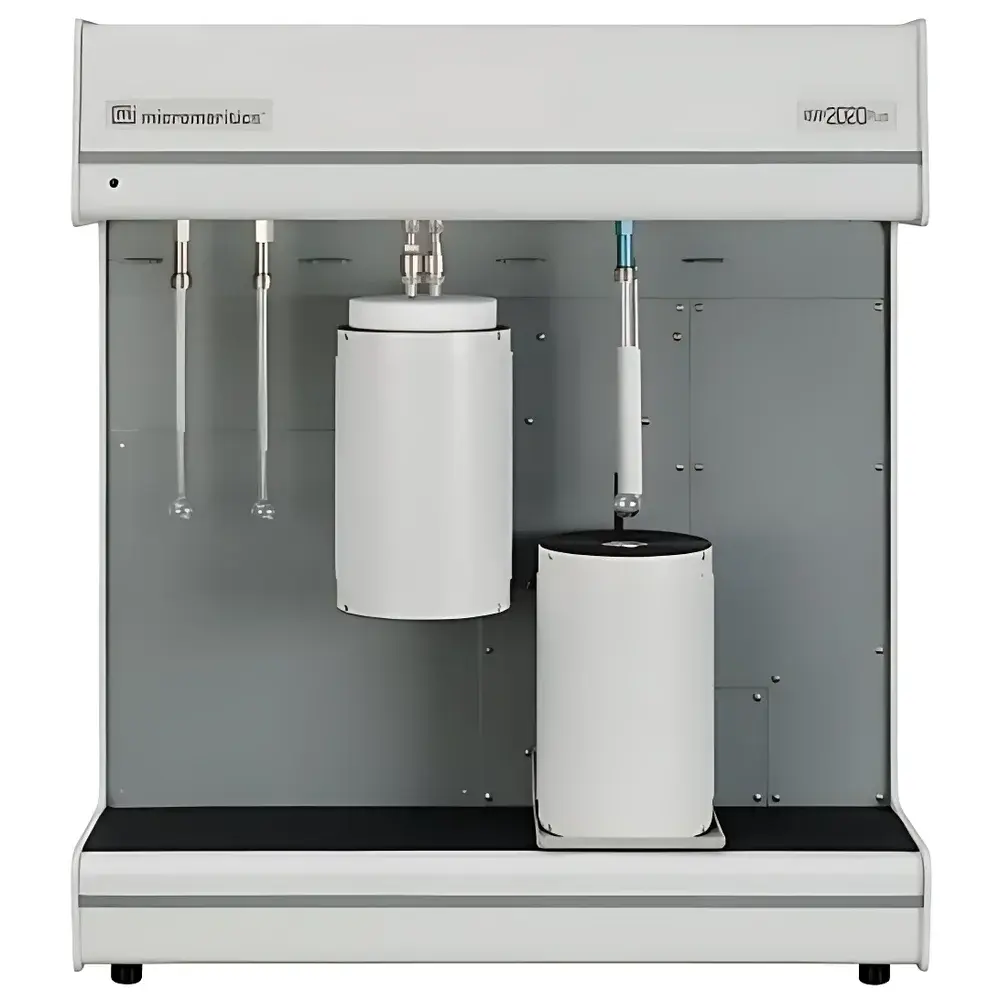
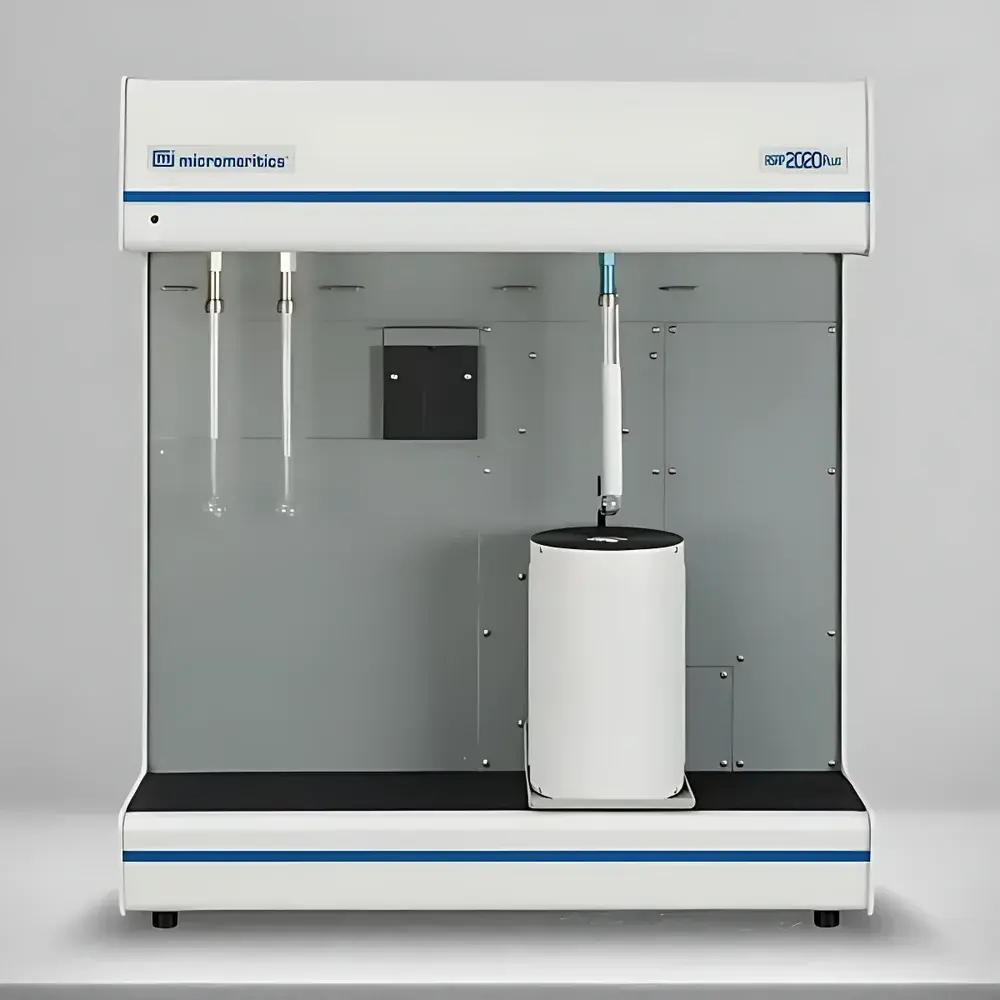
Micromeritics ASAP 2020 Plus HD88 Series Research-Grade High-Performance Automated Gas Adsorption Analyzer
| Brand | Micromeritics |
|---|---|
| Origin | USA |
| Model | ASAP 2020 Plus HD88 Series |
| Instrument Type | Specific Surface Area and Pore Size Analyzer |
| Principle | Static Volumetric Method |
| Analysis Stations | 1 adsorption station |
| Degassing Stations | 2 independent stations |
| Pressure Range | 0–1000 mmHg |
| Applicable Pore Types | Micropores, Mesopores, Low Surface Area Materials |
| Theory | BET, Langmuir, BJH, DFT, NLDFT, t-plot, αs-method |
| Repeatability | <1% RSD |
Overview
The Micromeritics ASAP 2020 Plus HD88 Series is a research-grade, fully automated gas adsorption analyzer engineered for high-precision characterization of specific surface area, pore size distribution, pore volume, and adsorption isotherms across microporous, mesoporous, and low-surface-area materials. Based on the static volumetric (manometric) principle, the system precisely measures gas uptake at controlled equilibrium pressures using calibrated reference volumes, high-stability pressure transducers, and thermally stabilized sample and reference manifolds. Its dual-vacuum architecture—comprising one dedicated analysis vacuum line and a separate degassing vacuum line—enables concurrent sample preparation and measurement, significantly reducing total experimental turnaround time without compromising analytical integrity. Designed for rigorous academic and industrial R&D environments, the ASAP 2020 Plus HD88 meets the metrological demands of peer-reviewed publication, regulatory submission, and method validation workflows in catalysis, battery materials, MOFs, pharmaceutical excipients, and advanced ceramics.
Key Features
- Independent dual vacuum system: One high-vacuum line for adsorption analysis and a second for simultaneous sample degassing—eliminating cross-contamination and enabling true parallel operation.
- Thermally regulated isothermal jacket with active cooling zone control: Ensures uniform temperature (<±0.05 °C stability) across the sample tube and P0 reference tube, critical for accurate saturation pressure (P0) determination and reproducible isotherm acquisition.
- Dedicated, temperature-controlled P0 sensor: Measures saturation vapor pressure under identical thermal conditions as the adsorption measurement—no manual P0 input or external calibration required.
- Coated, thermostatted stainless-steel manifold: Provides inert, non-reactive gas pathways; minimizes surface adsorption artifacts and ensures long-term baseline stability.
- Modular expandability: Factory-integrated options include cryogenic liquid nitrogen dewar (with refillable design), chemical-resistant corrosion package (for acidic/basic vapors), optional steam adsorption module, and external detector interface for in situ spectroscopic coupling.
- Ultra-stable pressure sensing architecture: Independent, low-hysteresis transducers with rapid response times (<10 ms) and optimized signal-to-noise ratio—essential for high-resolution micropore analysis and low-pressure data fidelity.
Sample Compatibility & Compliance
The ASAP 2020 Plus HD88 accommodates a broad spectrum of solid materials—including metal–organic frameworks (MOFs), zeolites, activated carbons, catalysts, nanomaterials, pharmaceutical powders, and geological samples—across diverse pretreatment requirements (e.g., thermal, vacuum, or reactive gas degassing). Its configurable gas handling system supports N2, Ar, CO2, Kr, H2, and organic vapors (with optional corrosion package), enabling compliance with ASTM D3663 (BET surface area), ISO 9277 (gas adsorption methods), and IUPAC recommendations for physisorption data reporting. The instrument’s hardware and software architecture support GLP/GMP-aligned operation, including audit-trail-enabled user authentication, electronic signatures, and full data provenance tracking—facilitating FDA 21 CFR Part 11 readiness when deployed with validated MicroActive software configurations.
Software & Data Management
MicroActive software—Micromeritics’ proprietary, interactive data analysis platform—provides real-time visualization and model-based interpretation of adsorption isotherms. Users manipulate dynamic calculation sliders to interactively select data ranges, exclude outliers, and compare multiple theoretical models (BET, Langmuir, DFT, NLDFT, BJH, t-plot, αs-method) side-by-side on linear or logarithmic scales. All calculations are traceable, with full metadata logging (temperature, pressure, dwell time, degas parameters, instrument configuration). Raw data export complies with ASTM E2657 and ISO/IEC 17025 requirements, supporting third-party integration via ASCII, CSV, or XML formats. Software updates are delivered through secure, version-controlled channels, and instrument firmware is field-upgradable without hardware modification.
Applications
- Quantitative BET and Langmuir surface area determination for catalyst supports and battery electrode materials.
- Micropore volume and narrow-pore-size distribution analysis (0.3–2 nm) using CO2 at 273 K or N2 at 77 K with DFT/NLDFT kernel libraries.
- Mesopore characterization (2–50 nm) via BJH, DH, or Dollimore–Healy methods from N2 or Ar isotherms.
- Low-surface-area measurement (0.01–1 m²/g) using Kr adsorption at 77 K, minimizing statistical uncertainty.
- Chemisorption and temperature-programmed desorption (TPD) studies when configured with optional thermal conductivity detector (TCD) and gas dosing modules.
- Stability assessment of porous materials under cyclic adsorption/desorption or humid aging protocols.
FAQ
What gases can be used for analysis on the ASAP 2020 Plus HD88?
N2, Ar, CO2, Kr, H2, and selected organic vapors (e.g., water, ethanol) are supported—subject to appropriate manifold coating, sensor selection, and optional corrosion package installation.
Does the system comply with ISO or ASTM standards for surface area measurement?
Yes—the instrument’s hardware design, calibration protocol, and MicroActive software implementation align with ASTM D3663, ISO 9277, and IUPAC technical reports on physisorption methodology.
Can the ASAP 2020 Plus HD88 perform both degassing and analysis simultaneously?
Yes—its dual independent vacuum system allows two samples to be degassed while one sample undergoes adsorption analysis, maximizing throughput without sacrificing accuracy.
Is P0 measured in situ during each isotherm acquisition?
Yes—a dedicated, temperature-matched P0 sensor continuously monitors saturation pressure under identical thermal conditions as the sample, eliminating interpolation errors and manual P0 entry.
How is data integrity ensured for regulated environments?
MicroActive supports 21 CFR Part 11-compliant configurations, including role-based access control, electronic signatures, immutable audit trails, and encrypted raw data storage—all validated per GAMP 5 guidelines.



