
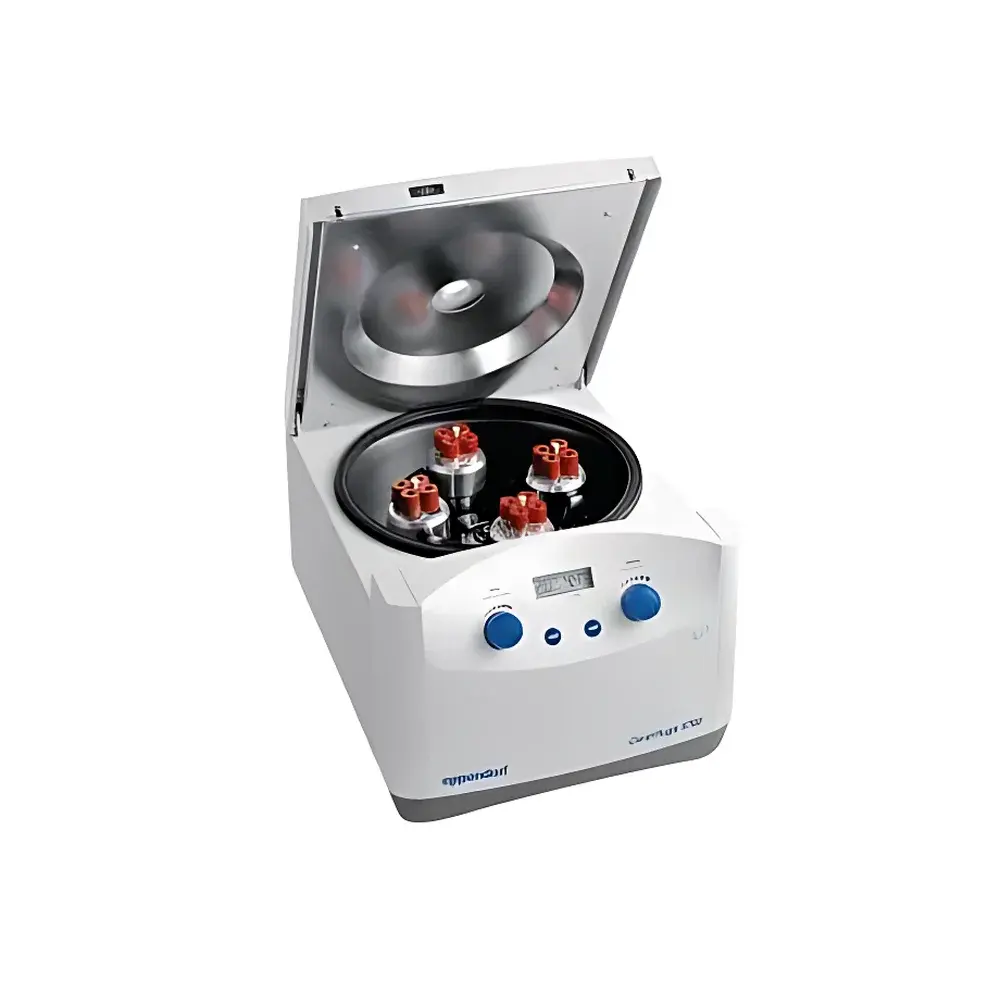
Eppendorf 5702 / 5702 R / 5702 RH Benchtop Centrifuge
| Brand | Eppendorf |
|---|---|
| Origin | Germany |
| Manufacturer Type | Original Equipment Manufacturer (OEM) |
| Product Category | Imported Instrument |
| Model | 5702 / 5702 R / 5702 RH |
| Instrument Type | Benchtop Centrifuge |
| Speed Class | Low-Speed Centrifuge (max. 4,400 rpm) |
| Functionality | Refrigerated Centrifuge (5702 R & 5702 RH) / Ambient-Temperature Centrifuge (5702) |
| Configuration | Fixed-Angle Rotor Centrifuge |
| Target Applications | Cell and Bacterial Pellet Separation |
| Maximum Capacity | 4 × 100 mL |
| Maximum Speed | 4,400 rpm |
| Maximum RCF | 3,000 × g |
| Dimensions (W × D × H) | 32 × 40 × 24 cm |
Overview
The Eppendorf 5702 series benchtop centrifuges are engineered for precision, safety, and operational efficiency in routine cell culture, clinical diagnostics, and microbiology laboratories. Designed around a robust horizontal-axis rotor architecture with passive air-cooled braking and optimized airflow dynamics, the 5702 platform delivers consistent sedimentation performance under both ambient and temperature-controlled conditions. The 5702 variant operates at room temperature, while the 5702 R and 5702 RH models integrate active refrigeration systems compliant with IEC 61010-1 safety standards for laboratory equipment. All variants employ fixed-angle rotors to generate radial acceleration fields suitable for pelleting mammalian cells, bacteria, yeast, and subcellular fractions—without requiring ultracentrifugal forces. With a maximum relative centrifugal force (RCF) of 3,000 × g at 4,400 rpm and a compact footprint of 32 × 40 × 24 cm, the system supports high ergonomics and space-constrained benchtop deployment.
Key Features
- Low-noise operation (<55 dB[A] at full speed), achieved via balanced rotor dynamics and vibration-damped chassis design
- SOFT deceleration mode enabling controlled brake profiles for density gradient applications (e.g., Percoll or Ficoll separations)
- “At set RPM” timing function: initiates countdown only after reaching target rotational speed—critical for protocol reproducibility across GLP/GMP workflows
- Automatic imbalance detection with real-time rotor monitoring; immediate shutdown if mass asymmetry exceeds ±5 g per rotor position
- Stainless-steel rotor chamber with IP22-rated ingress protection—resistant to common disinfectants and compatible with autoclave-safe rotor accessories
- Low lid height (≤18 cm above base) facilitating ergonomic sample loading/unloading without arm elevation
- Parameter lockout feature preventing unauthorized modification during multi-user lab environments
- For 5702 R and 5702 RH: Standby Cooling maintains preset temperature with lid closed; FastTemp reduces pre-cooling time by up to 40% vs. conventional refrigerated centrifuges
- 5702 RH adds active heating capability (range: –9 °C to +42 °C), ensuring thermal stability during extended runs involving heat-sensitive samples (e.g., primary lymphocytes or enzyme assays)
Sample Compatibility & Compliance
The 5702 series accommodates standard conical tubes (15–50 mL), microcentrifuge tubes (0.2–2.0 mL), and universal bottles up to 100 mL using six interchangeable fixed-angle rotors—including the FA-45-6-10 (6 × 15 mL), FA-45-24-11 (24 × 1.5/2.0 mL), and FA-45-4-100 (4 × 100 mL). All rotors are certified to ISO 13485:2016 and undergo mandatory annual validation per Eppendorf’s rotor lifetime tracking protocol. The system complies with EN 61326-1 (EMC), EN 61000-6-3 (emission), and FDA 21 CFR Part 11-ready firmware (audit trail enabled upon software configuration). Temperature control accuracy is ±1.5 °C over full range (5702 R/RH), verified per ASTM E2251-18 calibration methodology.
Software & Data Management
Equipped with Eppendorf’s proprietary Centrifuge Control Software v3.2 (optional USB interface), the 5702 R/RH supports export of run logs in CSV format—including timestamp, RCF, temperature, rotor ID, and cycle duration. Audit trails record user login, parameter changes, and emergency stops with SHA-256 hashing for integrity verification. Firmware updates preserve all stored protocols and comply with IEC 62304 Class B medical device software requirements. No cloud connectivity is embedded; data remains on-device unless manually exported—ensuring alignment with HIPAA and GDPR data sovereignty policies.
Applications
- Cell harvesting: mammalian suspension cultures (HEK293, CHO), bacterial pellets (E. coli BL21), and yeast (S. cerevisiae)
- Clinical specimen processing: serum/plasma separation from whole blood (EDTA/K2-EDTA tubes), PBMC isolation via Ficoll-Paque gradients
- Microbiology: concentration of environmental water samples prior to membrane filtration or qPCR analysis
- Protein biochemistry: crude lysate clarification prior to column chromatography or SDS-PAGE
- Virology: virus pellet recovery from cell culture supernatants (e.g., lentiviral vectors at 3,000 × g × 30 min)
- Quality control: batch consistency testing for biopharmaceutical intermediates under ISO 9001 Annex A.7
FAQ
What is the maximum allowable tube volume per rotor position in the FA-45-4-100 rotor?
Each position accepts one 100 mL conical tube (e.g., Falcon 352070) filled to ≤95 mL to prevent overflow during acceleration.
Does the 5702 R support continuous operation at –9 °C?
Yes—thermal stability is maintained for ≥8 hours at minimum setpoint, provided ambient temperature remains ≤25 °C and humidity <70% RH.
Can third-party rotors be used with the 5702 series?
No. Only Eppendorf-certified rotors with integrated RFID tags are recognized; non-OEM rotors trigger automatic interlock and error code E17.
How often must the refrigeration system be serviced?
Compressor oil and filter replacement is recommended every 36 months or after 10,000 operating hours—whichever occurs first—as per Eppendorf Service Bulletin SB-5702R-2023.
Is the “At set RPM” function available on all models?
Yes—this timing logic is firmware-standard across 5702, 5702 R, and 5702 RH units and does not require optional software licensing.



