
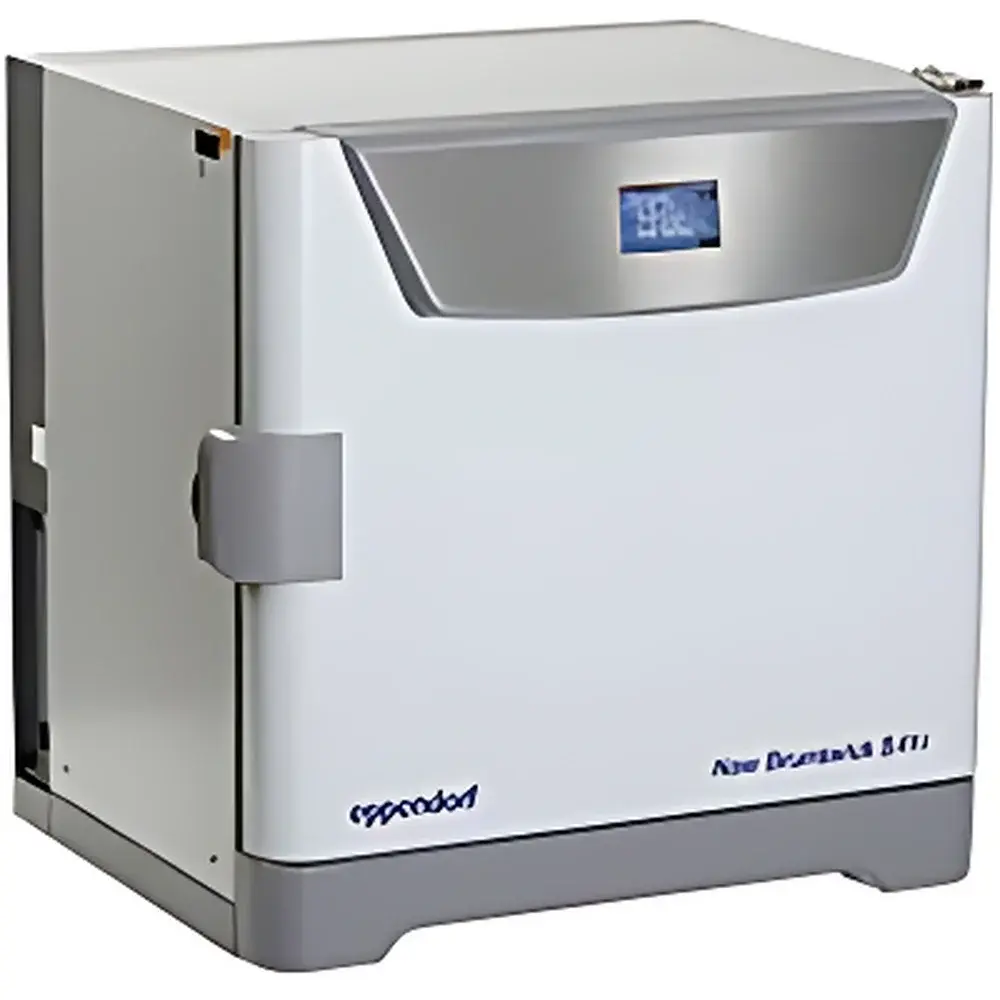
Eppendorf S41i CO₂ Incubated Shaker
| Brand | Eppendorf |
|---|---|
| Origin | USA |
| Manufacturer Type | Original Equipment Manufacturer (OEM) |
| Import Status | Imported |
| Model | S41i |
| Temperature Range & Accuracy | +4 °C above ambient to 50 °C |
| Temperature Uniformity | ±0.25 °C at 37 °C |
| Humidity Control | 90–95 % RH at 37 °C |
| Chamber Capacity | 170 L |
| Shaking Speed Range | 25–400 rpm (25–300 rpm when stacked) |
| Shelf Dimensions | 35.6 × 61 cm |
| Maximum Vessel Size | 4 L conical flask |
| Sterilization | Integrated high-temperature decontamination cycle |
Overview
The Eppendorf S41i CO₂ Incubated Shaker integrates precision incubation and orbital shaking within a single, compact 170 L chamber—engineered specifically for scalable suspension and adherent cell culture under physiologically relevant conditions. Unlike conventional CO₂ incubators or standalone shakers, the S41i employs a tri-eccentric drive mechanism located at the base of the unit, mechanically decoupled from the incubation chamber via four sealed support rods with thermal isolation gaskets. This architecture ensures minimal heat transfer from the motor assembly to the culture environment while delivering uniform, low-vibration orbital motion (25–400 rpm) across the full 35.6 × 61 cm platform. The system maintains CO₂ concentration (typically 5%), temperature (+4 °C above ambient to 50 °C), and humidity (90–95 % RH at 37 °C) in strict compliance with mammalian and stem cell culture requirements. Its dual-door design—comprising an insulated outer door and a gas-tight inner door—reduces CO₂ consumption by up to 40% during routine access and enhances environmental stability during frequent interventions.
Key Features
- Tri-eccentric drive system delivering consistent, low-shear orbital motion with <0.5 mm amplitude—optimized for sensitive suspension cultures including CHO, HEK293, and iPSC-derived lineages.
- Thermally isolated shaking platform: motor-generated heat is physically segregated from the incubation space, preserving ±0.25 °C temperature uniformity at setpoint (e.g., 37 °C).
- Integrated high-temperature decontamination cycle (up to 180 °C) validated per ISO 14644-1 Class 5 cleanroom standards, eliminating mycoplasma, bacteria, and spores without chemical agents.
- Intuitive 7-inch capacitive touchscreen interface with multi-level user access control (operator, supervisor, administrator), audit-trail enabled logging, and real-time parameter visualization (CO₂, temp, humidity, rpm, elapsed time).
- Modular shelving: standard perforated shelf supports simultaneous static (adherent) and dynamic (suspension) culture; optional second shelf enables vertical expansion without compromising airflow or mixing efficiency.
- Stackable configuration: two S41i units may be vertically integrated using certified alignment hardware, maintaining independent environmental control per unit and enabling 340 L total capacity in footprint-constrained labs.
Sample Compatibility & Compliance
The S41i accommodates standard microbiological and cell culture vessels—including 125 mL to 4 L Erlenmeyer flasks, roller bottles, multi-well plates (with compatible carriers), and custom bioreactor bags—without requiring vessel-specific adapters. All internal surfaces are electropolished stainless steel (AISI 316L), compliant with USP for extractables/leachables in biopharmaceutical applications. The system meets IEC 61010-1 safety requirements for laboratory equipment and supports GLP/GMP workflows through configurable electronic signatures, 21 CFR Part 11–compliant data integrity features (including immutable event logs and user-defined retention policies), and traceable calibration records for temperature, CO₂, and humidity sensors.
Software & Data Management
Eppendorf’s proprietary S41i Control Software (v3.2+) provides remote monitoring and control via Ethernet or Wi-Fi, with secure TLS 1.2 encrypted communication. Data export options include CSV, PDF report generation, and direct integration into LIMS or ELN platforms via RESTful API. All operational parameters—including setpoints, deviations, alarm events, and sterilization cycles—are timestamped, user-attributed, and stored locally on redundant SD cards (dual-slot failover). Audit trails comply with Annex 11 and ALCOA+ principles, supporting regulatory submissions for clinical-grade cell therapy manufacturing.
Applications
- Scalable suspension culture of therapeutic mammalian cells (e.g., monoclonal antibody production in CHO systems).
- Differentiation protocols for pluripotent stem cells under controlled mechanical stimulation and gas exchange.
- Microcarrier-based expansion of anchorage-dependent cells (e.g., MSCs, chondrocytes) with concurrent medium perfusion compatibility.
- Long-term kinetic studies requiring synchronized environmental perturbation (e.g., hypoxia-reoxygenation, pH modulation via CO₂ ramping).
- Bioprocess development in academic core facilities and contract development and manufacturing organizations (CDMOs) operating under ISO 13485 or FDA cGMP guidelines.
FAQ
Does the S41i support humidification without condensation buildup on optical surfaces or vessel lids?
Yes—the chamber employs a stainless-steel water reservoir with PID-controlled evaporation and a dedicated condensate drainage path, preventing dew formation on viewing windows and flask closures during extended 95 % RH operation.
Can CO₂ concentration be calibrated in-house, and is NIST-traceable documentation provided?
Each unit ships with factory-calibrated infrared CO₂ sensors (±0.1 % accuracy); field recalibration is supported using certified gas standards (0–20 % CO₂), and calibration certificates with NIST-traceable references are available upon request.
Is the shaking motion programmable in ramp-up/down profiles or only fixed-speed operation?
The controller supports multi-step shaking protocols—including linear acceleration/deceleration ramps, dwell periods, and speed cycling—with up to 16 user-defined segments per program.
What validation documentation is included for IQ/OQ/PQ execution?
Eppendorf supplies a comprehensive qualification toolkit: pre-approved test scripts, blank protocol templates aligned with ASTM E2500, sensor uncertainty budgets, and a DQ-ready mechanical design dossier covering materials, thermal modeling, and vibration spectral analysis.
Related Products



