
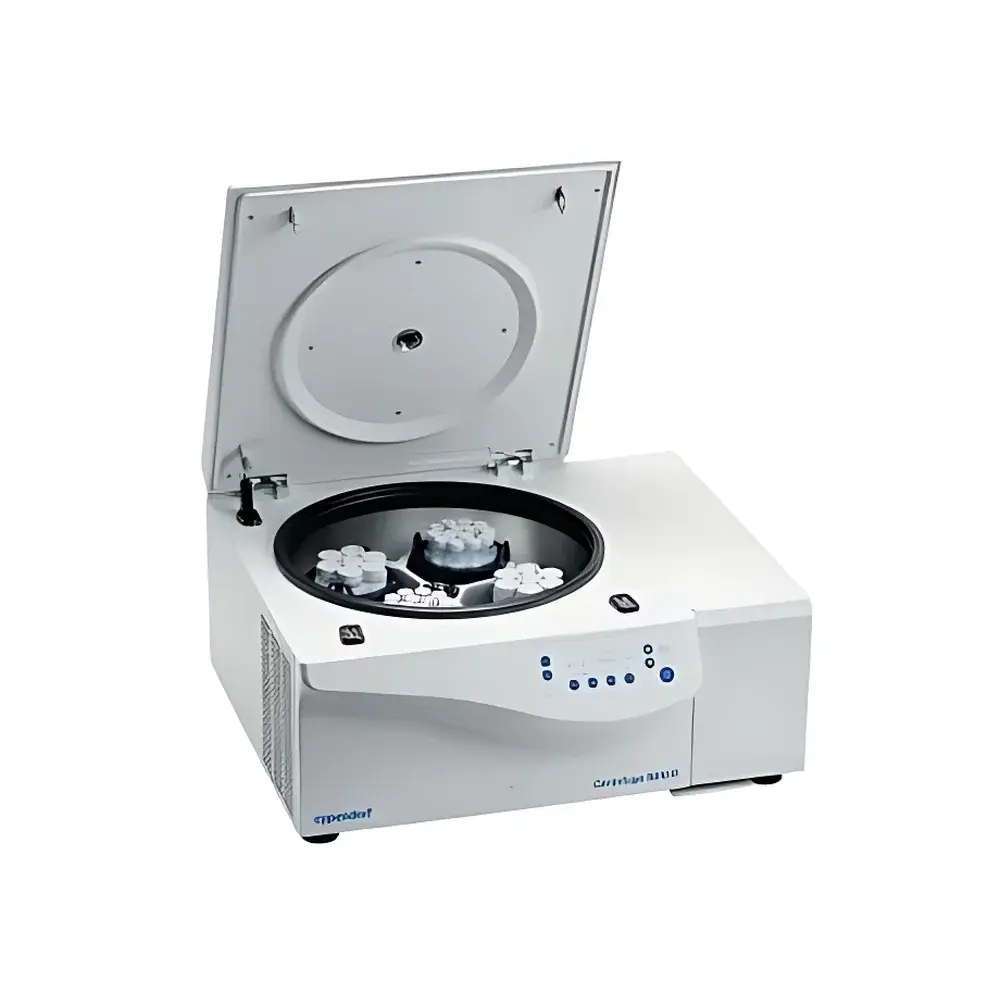
Eppendorf 5810/R Refrigerated Benchtop Centrifuge
| Brand | Eppendorf |
|---|---|
| Origin | Germany |
| Manufacturer Type | Original Equipment Manufacturer (OEM) |
| Import Status | Imported |
| Model | 5810/R |
| Instrument Type | Benchtop Centrifuge |
| Speed Range | Up to 14,000 rpm |
| Max RCF | 20,913 × g |
| Max Capacity | 4 × 750 mL or 4 × 4 MTP (Microtiter Plates) |
| Temperature Range (5810 R only) | –9 °C to 40 °C |
| Dimensions (W × D × H) | 70 × 61 × 35 cm |
| Rotor Recognition | Automatic |
| Imbalance Detection | Integrated |
| Noise Level | ≤ 59 dB(A) |
| QuickLock System | Yes |
| FastTemp Pre-cooling | Yes |
| ECO Standby Mode | Yes |
| Dynamic Compressor Control (DCC) | Yes |
Overview
The Eppendorf 5810/R is a high-performance, refrigerated benchtop centrifuge engineered for reproducible separation of biological samples across mid- to high-throughput laboratory workflows. Designed around the principles of rotor dynamics, gravitational sedimentation, and thermally controlled rotor chamber environments, this instrument delivers precise control over relative centrifugal force (RCF), rotational speed (rpm), and temperature—critical parameters for applications ranging from cell pelleting and subcellular fractionation to nucleic acid purification and protein precipitation. Its robust architecture supports both routine clinical processing and demanding research protocols under GLP-compliant conditions. The 5810/R variant integrates active refrigeration with dynamic compressor control (DCC), enabling stable thermal management during extended runs and rapid equilibration via FastTemp pre-cooling—ensuring sample integrity for temperature-sensitive biomolecules such as enzymes, antibodies, and RNA.
Key Features
- Automatic rotor recognition system prevents mismatched rotor–speed combinations and enforces safe operational limits per ISO 21501-4 and IEC 61010-2-020 safety standards.
- Integrated imbalance detection continuously monitors mass distribution during acceleration and deceleration, halting operation if deviation exceeds ±5 g tolerance—critical for maintaining mechanical longevity and operator safety.
- Eppendorf QuickLock sealing mechanism enables one-handed, tool-free rotor lid and bucket closure with validated leak-tightness compliant with EN 61326-1 for containment of biohazardous aerosols.
- Low-profile lid opening height (29 cm) reduces ergonomic strain during repeated loading/unloading cycles—a design consideration aligned with ISO 11228-1 guidelines on manual handling in laboratory settings.
- ECO standby mode deactivates the compressor after 8 hours of inactivity while retaining chamber setpoint memory, reducing annual energy consumption by up to 30% compared to conventional continuous-cooling systems.
- SilentDrive brushless motor technology ensures acoustic emission ≤59 dB(A) at 1 m distance, meeting WHO-recommended ambient noise thresholds for shared laboratory spaces.
Sample Compatibility & Compliance
The 5810/R accommodates a comprehensive range of primary sample containers—from 0.2 mL PCR tubes to 750 mL centrifuge bottles—and supports standardized microplate formats including 96-well, 384-well, and deep-well plates. Fixed-angle rotors are certified for use with volumes up to 85 mL and deliver maximum RCF values required for pelleting ribosomes or viral particles. Horizontal carriers comply with ASTM D4291 for uniform sedimentation geometry and are validated for use with blood collection tubes (e.g., Vacutainer®, Greiner Bio-One). All rotors undergo full traceable calibration against NIST-traceable tachometers and torque sensors. Device firmware adheres to FDA 21 CFR Part 11 requirements for electronic records and signatures when paired with Eppendorf’s Centrifuge Software Suite v3.x.
Software & Data Management
Centrifuge operation is managed through an intuitive membrane keypad interface with real-time display of rpm, RCF, time remaining, temperature, and rotor ID. Optional Ethernet or USB connectivity enables integration into LIMS environments and supports audit-trail generation for QC/QA documentation. Protocol templates can be stored locally (up to 99 methods) with timestamped execution logs—including start/stop times, user ID, rotor serial number, and deviation alerts. Export functionality supports CSV and PDF formats compatible with ISO/IEC 17025-accredited reporting frameworks.
Applications
- Cell culture harvesting and clarification (mammalian, insect, bacterial)
- Purification of plasmid DNA, genomic DNA, and total RNA using silica-membrane or phenol-chloroform extraction workflows
- Preparation of exosome-enriched fractions via differential ultracentrifugation (in combination with fixed-angle 4×85 mL rotors)
- Clinical diagnostics: serum/plasma separation from whole blood, urine sediment analysis, and PBMC isolation
- Quality control testing of biopharmaceutical intermediates per USP sterility and ancillary materials guidelines
- High-throughput screening support via MTP-compatible swing-out rotors for ELISA plate processing and bead-based immunoassays
FAQ
What is the minimum run time setting on the 5810/R?
The shortest programmable duration is 10 seconds, suitable for quick spin-down of condensation or brief pellet consolidation.
Can the 5810/R accommodate conical-bottom polypropylene tubes?
Yes—compatible with all major tube geometries including conical, round-bottom, and skirted formats, provided they meet Eppendorf’s dimensional tolerances specified in Technical Bulletin TB-5810-02.
Is rotor calibration required annually?
While not mandated by regulation, Eppendorf recommends biannual verification using certified tachometric and thermometric reference standards to maintain traceability per ISO/IEC 17025 Clause 6.5.2.
Does the 5810/R support remote monitoring via mobile devices?
Remote status viewing and alarm notification are available via Eppendorf’s LabConnect™ cloud service (subscription-based), with TLS 1.2 encrypted data transmission compliant with GDPR and HIPAA requirements.
How does Dynamic Compressor Control improve thermal stability?
DCC modulates refrigerant flow rate in real time based on load inertia and ambient fluctuations, minimizing temperature overshoot and maintaining ±0.5 °C uniformity across the rotor chamber during multi-hour protocols.



