
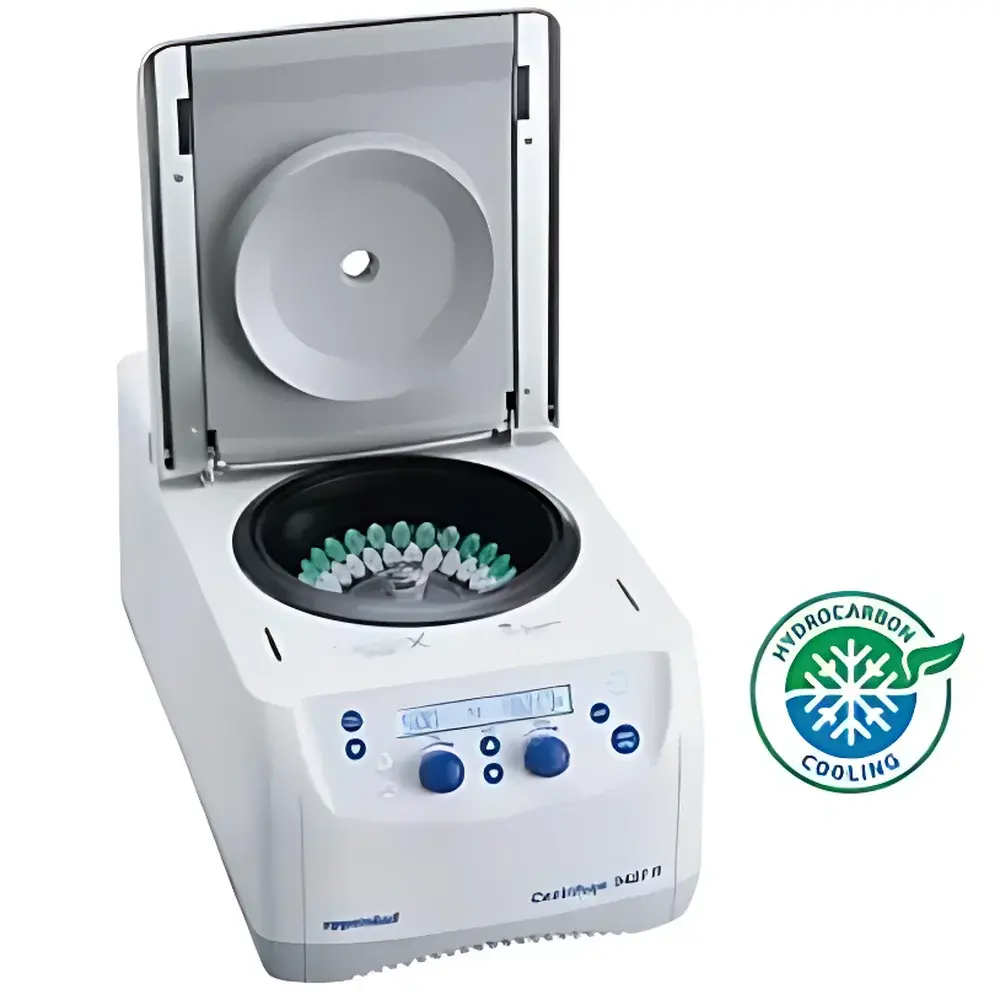
Eppendorf 5427 R Benchtop High-Speed Refrigerated Centrifuge
| Brand | Eppendorf |
|---|---|
| Origin | Germany |
| Manufacturer Type | Manufacturer |
| Origin Category | Imported |
| Model | 5427 R |
| Instrument Type | Benchtop Centrifuge |
| Feature Parameter | High-Speed Centrifuge (10,000–30,000 rpm) |
| Function | Refrigerated Centrifuge |
| Typical Configuration | Fixed-Angle Rotor Centrifuge |
| Maximum Capacity | 48 × 1.5/2.0 mL, 12 × 5 mL |
| Maximum Speed | 16,220 rpm |
| Maximum RCF | 25,001 × g |
| Dimensions | 31.9 × 54.0 × 25.4 cm |
| Noise Level | < 56 dB(A) |
| Acceleration/Deceleration Time | 18 s each |
| Timer Range | 5 s to 9 h 59 min, continuous operation enabled |
| Temperature Range | −11 °C to 40 °C |
| Refrigerant | R290 (propane) |
| Power Consumption | 495 W |
| Net Weight (without rotors) | 30 kg |
| Rotor Count | 9 |
| ECO Standby Options | 1, 2, 4, or 8 hours |
Overview
The Eppendorf 5427 R is a compact, high-performance benchtop refrigerated centrifuge engineered for precision, reproducibility, and sustainability in molecular biology, biochemistry, and clinical research laboratories. Utilizing fixed-angle rotor geometry and optimized air-cooled refrigeration with hydrocarbon-based R290 refrigerant, it delivers consistent temperature control (−11 °C to 40 °C) during high-speed separation—critical for preserving thermolabile biomolecules such as nucleic acids, proteins, and viral particles. Its maximum rotational speed of 16,220 rpm generates a relative centrifugal force (RCF) of 25,001 × g, enabling rapid pelleting of subcellular components, bacterial cells, and nucleic acid complexes without compromising sample integrity. Designed for daily high-throughput workflows, the 5427 R supports routine applications including plasmid purification, PCR product cleanup, column-based extractions, and small-volume sample concentration—all within a footprint measuring just 31.9 × 54.0 × 25.4 cm.
Key Features
- High-throughput 48-position fixed-angle rotor compatible with standard 1.5/2.0 mL microcentrifuge tubes and 5 mL conical tubes—reducing run time by up to 40% compared to sequential processing.
- Eppendorf QuickLock® rotor lid mechanism ensures secure, tool-free closure with tactile feedback and mechanical interlock verification—eliminating manual torque calibration errors.
- Certified airtight rotor covers validated per CAMR (UK) standards for containment of biosafety level 2 (BSL-2) agents; fully autoclavable at 121 °C for 20 minutes without degradation.
- Advanced acoustic damping architecture maintains noise levels below 56 dB(A) at maximum speed—suitable for shared lab environments and open-plan facilities.
- ECO standby mode automatically reduces compressor activity after user-defined idle periods (1, 2, 4, or 8 hours), lowering energy consumption by up to 35% annually while extending refrigeration system service life.
- Integrated condensate collection tray prevents internal moisture accumulation, mitigating corrosion risk and eliminating manual drainage requirements.
- Parameter lock function restricts real-time modification of speed, temperature, time, and acceleration/deceleration profiles during active runs—ensuring protocol compliance and audit readiness.
Sample Compatibility & Compliance
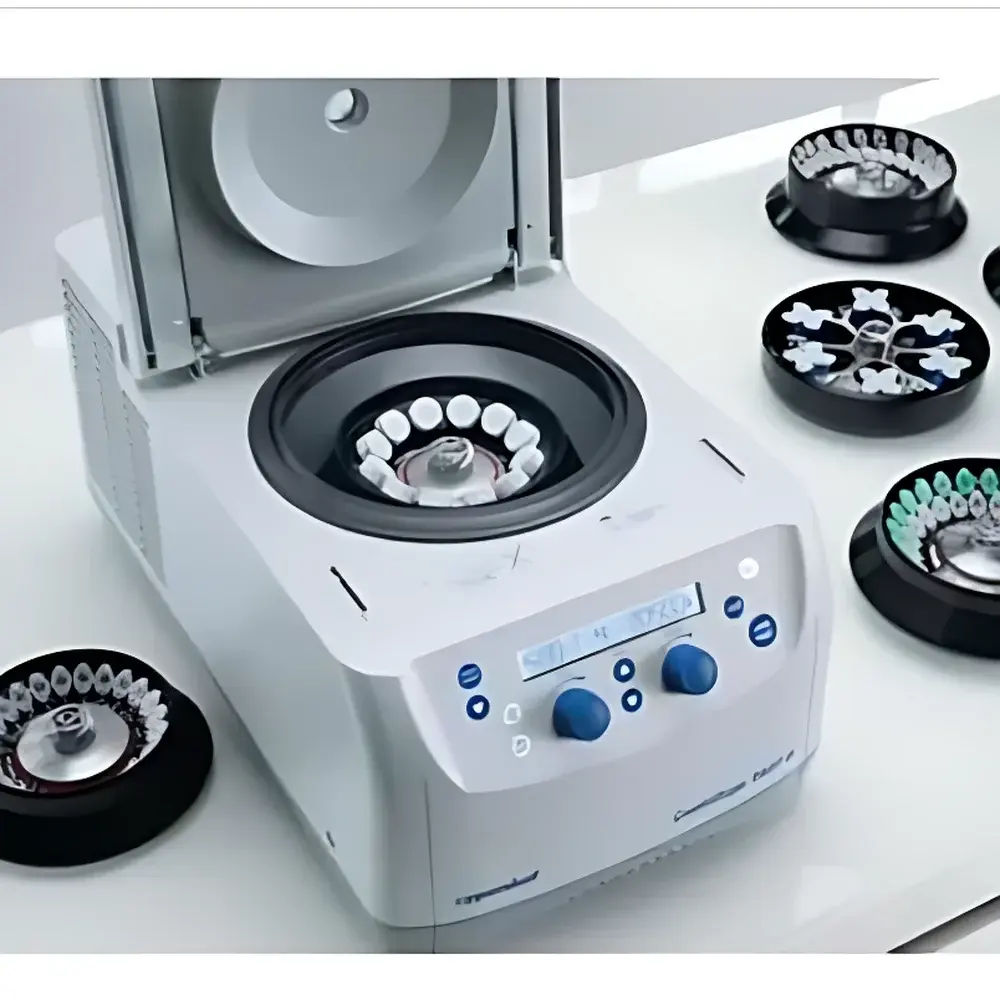
The 5427 R accommodates nine interchangeable rotors—including PCR strip rotors, spin-column adapters, high-speed horizontal rotors, and specialized 5 mL fixed-angle configurations—supporting diverse consumables: 0.2–2.0 mL PCR tubes, 8-well strips, spin columns (e.g., QIAprep, NucleoSpin), and low-retention microcentrifuge tubes. All rotors comply with ISO 13485:2016 for medical device manufacturing environments and meet IEC 61010-1 safety requirements for laboratory equipment. The use of R290 refrigerant carries the ACT (Advanced Clean Technology) Low Environmental Impact label, reflecting global GWP (Global Warming Potential) reduction mandates under the Kigali Amendment and EU F-Gas Regulation (No. 517/2014). For GLP/GMP-regulated labs, the instrument supports optional electronic log export and integrates with LIMS via RS232/USB interfaces.
Software & Data Management
While the 5427 R operates via an intuitive, menu-driven LCD interface with physical keypad navigation (no touchscreen), it provides full traceability through embedded event logging: start/stop timestamps, rotor ID recognition, actual vs. setpoint temperature and speed deviations, and error codes. All logs are exportable via USB to CSV format for integration into electronic lab notebooks (ELNs) or quality management systems. The parameter lock feature enforces SOP adherence, satisfying FDA 21 CFR Part 11 requirements when paired with appropriate access controls and audit trail documentation. Firmware updates are performed offline using signed binaries distributed through Eppendorf’s secure customer portal—ensuring regulatory continuity and cybersecurity compliance.
Applications
- Routine nucleic acid isolation (plasmid DNA, genomic DNA, RNA) using silica-membrane spin columns.
- Clarification of lysates prior to chromatography or electrophoresis.
- Concentration and desalting of oligonucleotides, peptides, and antibody fragments.
- Preparation of viral vectors and exosome pellets from cell culture supernatants.
- High-speed pelleting of E. coli, yeast, and mammalian cells for downstream proteomic analysis.
- Biosafety-compliant processing of clinical specimens requiring sealed rotor containment.
FAQ
What is the maximum RCF achievable with the 48-place rotor?
The 48 × 1.5/2.0 mL fixed-angle rotor achieves 25,001 × g at 16,220 rpm—verified per ISO 21501-4 for centrifuge performance validation.
Can the rotor covers be sterilized in an autoclave?
Yes. All supplied rotor covers are certified airtight by CAMR and withstand standard autoclaving cycles (121 °C, 20 min, saturated steam) without loss of seal integrity or mechanical function.
Does the 5427 R support 21 CFR Part 11 compliance?
When deployed with documented user access controls, parameter lock activation, and exported electronic logs, the system meets foundational requirements for electronic records and signatures—subject to site-specific validation protocols.
How does the ECO standby mode affect temperature stability?
During standby, the compressor enters low-power maintenance mode; chamber temperature drift is limited to ±1.5 °C over 8 hours—sufficient to preserve pre-chilled samples without active cooling.
Is third-party rotor compatibility supported?
No. Only Eppendorf-certified rotors and accessories are permitted to ensure mechanical balance, thermal performance, and safety certification validity—per manufacturer warranty and ISO 13485 design control obligations.



