
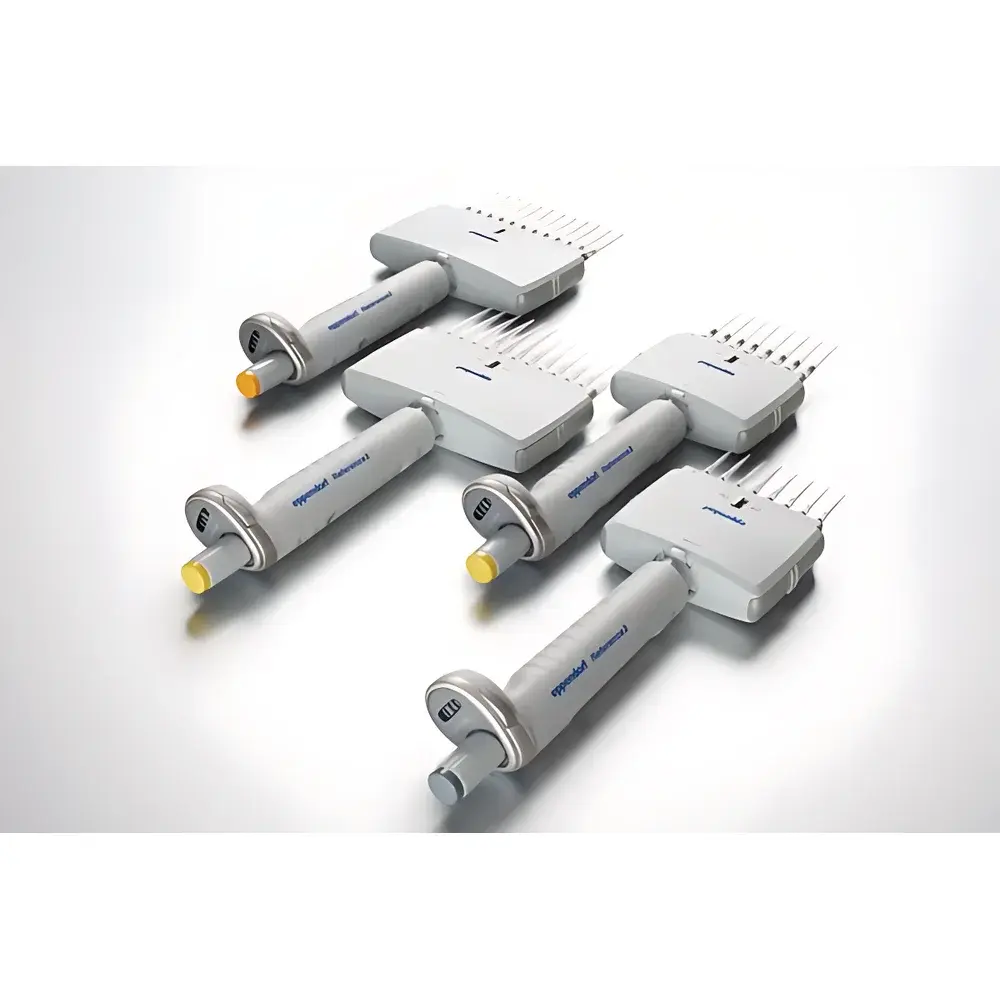
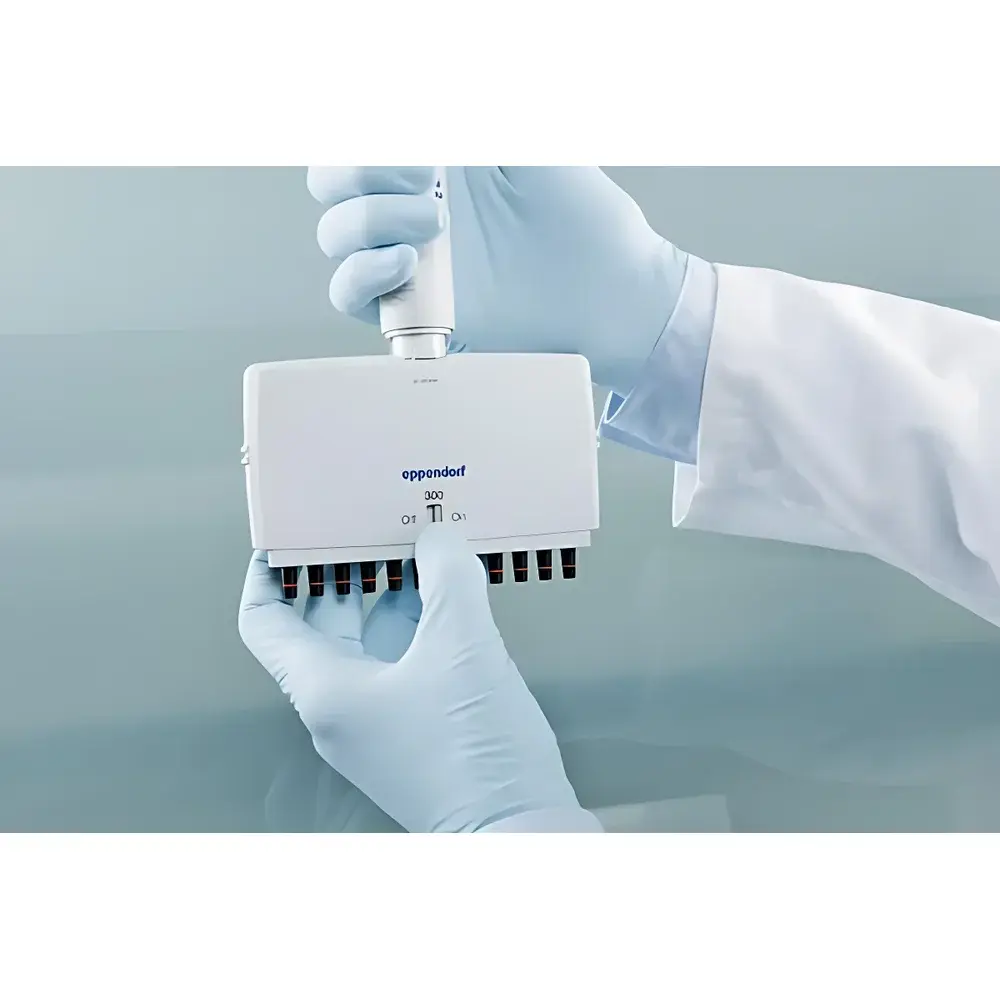
Eppendorf Reference 2 Multi-Channel Pipette
| Brand | Eppendorf |
|---|---|
| Origin | Germany |
| Manufacturer Type | Original Equipment Manufacturer (OEM) |
| Import Status | Imported |
| Model | Reference 2 Multi-Channel |
| Instrument Type | Multi-Channel Pipette |
| Automation Level | Manual |
| Channel Count | 8 or 12 |
| Volume Range | 0.5–300 µL |
| Maximum Capacity | 300 µL |
| Accuracy | ±0.6% |
| Sterilization | Fully autoclavable (121 °C, 20 min, saturated steam) |
| RFID Integration | Yes (requires Eppendorf TrackIT reader accessory) |
| Ergonomic Design | Single-button operation, tactile ejection feedback, low-force tip attachment/detachment, dual-side volume lock, stainless steel top rim, full-angle circular upper housing, four-digit angled volume display |
Overview
The Eppendorf Reference 2 Multi-Channel Pipette is a precision-engineered manual liquid handling instrument designed for high-throughput, reproducible parallel dispensing across 8 or 12 channels. Built upon Eppendorf’s decades-long heritage in positive-displacement pipetting mechanics, the Reference 2 employs an optimized air-cushion system with minimized dead volume and thermally stable internal components to ensure consistent volumetric delivery across variable ambient conditions and operator techniques. Its mechanical architecture adheres to ISO 8655-2 (2022) standards for piston-operated volumetric apparatus, supporting traceable calibration and routine verification in GLP- and GMP-regulated environments. Unlike semi-automated or electronic alternatives, the Reference 2 delivers metrological reliability without dependency on batteries, firmware updates, or software interfaces—making it ideal for core laboratories, QC/QA units, and regulated biomanufacturing workflows where operational continuity and audit readiness are critical.
Key Features
- Single-action pipetting and tip ejection: Reduces operator fatigue and minimizes aerosol generation through integrated mechanical synchronization of aspiration and tip release.
- Ergonomic low-force actuation: Requires ≤1.8 N for full-volume aspiration and ≤2.2 N for tip ejection—validated per ISO 8655-5 Annex C for repetitive motion safety.
- Tactile tip ejection feedback: Audible and haptic confirmation ensures complete tip detachment, preventing residual carryover and cross-contamination.
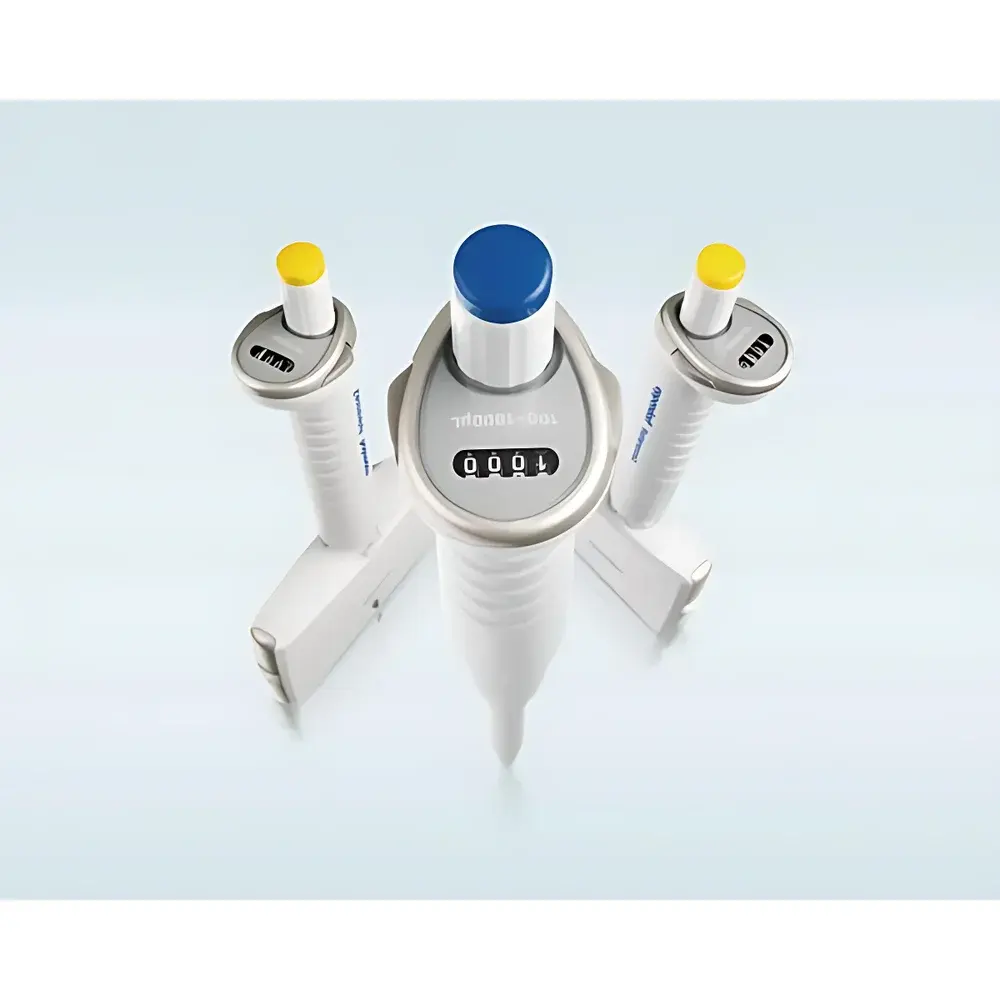
- Four-digit volume display with omnidirectional readability: High-contrast digits visible from ±45° angles; volume lock mechanism prevents accidental adjustment during bench transfer or rack loading.
- Autoclavable construction: Entire unit withstands 121 °C, 20 min steam sterilization (DIN EN 285) without disassembly—validated for ≥100 cycles with no measurable drift in accuracy.
- Dual-side volume locking: Stainless steel-reinforced top rim and bilateral locking levers protect the volume adjustment gear train from lateral impact and mechanical wear.
- Elastic tip cone technology: Self-centering conical interface ensures uniform sealing pressure across all channels—even with third-party tips meeting ISO 8655-3 dimensional tolerances—improving inter-channel consistency (CV ≤0.8% at 100 µL).
- Integrated RFID chip (TrackIT-ready): Stores immutable device metadata—including serial number, catalog number, manufacturing date, and last calibration timestamp—accessible only via Eppendorf-certified readers compliant with ISO/IEC 18000-3 Mode 1.
Sample Compatibility & Compliance
The Reference 2 Multi-Channel supports universal compatibility with standard conical polypropylene tips (DNAS, RNase-free, filtered, and low-retention variants), provided they conform to ISO 8655-3 geometric specifications. It is validated for aqueous solutions, buffers, serum-containing media, and glycerol-diluted reagents up to 40% (v/v). All models comply with CE marking under Directive 2014/30/EU (EMC) and 2014/35/EU (LVD), and meet RoHS 2011/65/EU material restrictions. Documentation packages include Declaration of Conformity, ISO 8655 calibration certificates (traceable to PTB, Germany), and FDA 21 CFR Part 11–ready audit trails when used with Eppendorf’s LabManager software and TrackIT hardware.
Software & Data Management
While fully functional as a standalone instrument, the Reference 2 integrates seamlessly into digital lab infrastructure via optional Eppendorf TrackIT hardware and LabManager 4.x software. The embedded RFID enables automatic device identification during calibration logging, maintenance scheduling, and user assignment tracking. Audit trails record every calibration event—including operator ID, environmental temperature/humidity, reference standard used (e.g., gravimetric ASTM E542-21), and pass/fail status—with immutable timestamps and digital signatures. All data exports comply with ALCOA+ principles (Attributable, Legible, Contemporaneous, Original, Accurate, Complete, Consistent, Enduring, Available) for regulatory submissions.
Applications
- High-density ELISA and cell-based assay plate setup (96-/384-well formats)
- Genomic library preparation: Parallel normalization of sheared DNA fragments prior to adapter ligation
- QC release testing of monoclonal antibody batches—buffer exchange and dilution series generation
- Microbiology: Inoculation of antimicrobial susceptibility test panels (e.g., CLSI M07-A11)
- qPCR master mix distribution with minimized well-to-well variability (critical for ΔΔCt reproducibility)
- Biobanking: Aliquoting of cryopreserved PBMCs or plasma samples under ISO 20387:2018-compliant SOPs
FAQ
Is the Reference 2 Multi-Channel compatible with non-Eppendorf tips?
Yes—provided tips meet ISO 8655-3 dimensional tolerances and have conical geometry matching DIN EN ISO 8655-3 Annex A specifications. Performance validation is recommended for each tip brand/lot.
Can the RFID chip be rewritten or reprogrammed by the user?
No. The RFID memory is factory-programmed and read-only. It stores immutable device identity and manufacturing metadata; no user-modifiable fields exist.
What is the recommended recalibration interval under ISO/IEC 17025 accreditation?
Annually—or after 10,000 operating cycles, whichever occurs first—as defined in ISO/IEC 17025:2017 Clause 7.7.1 and Eppendorf’s internal calibration SOP REF-CAL-02.
Does autoclaving affect the accuracy specification over time?
No. Accelerated lifecycle testing (n = 120 units, 100 cycles each) confirmed no statistically significant deviation (p > 0.05, ANOVA) from baseline accuracy (±0.6%) post-sterilization.
How is channel-to-channel consistency verified during factory calibration?
Using gravimetric analysis per ISO 8655-6:2022 Annex B, with eight independent weighings per channel at 10%, 50%, and 100% of nominal volume, followed by CV calculation and outlier rejection per ISO 5725-2.



