
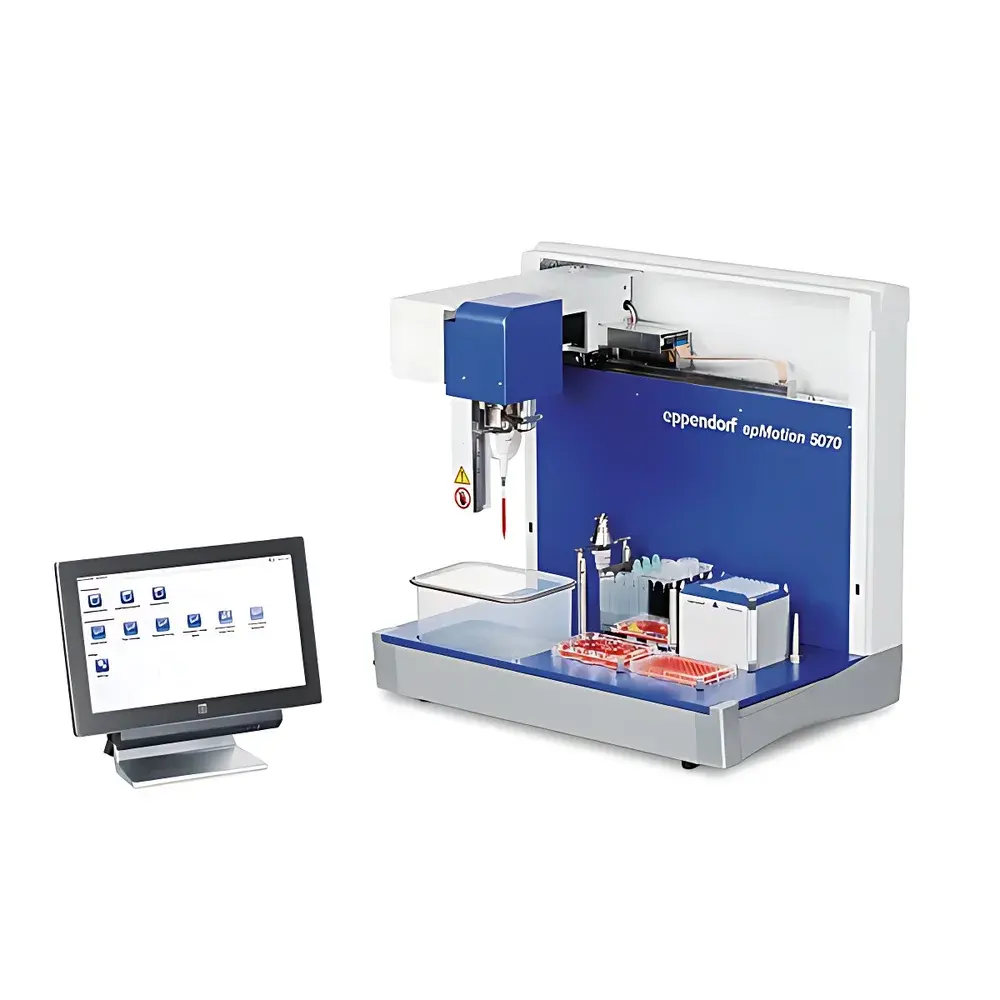
Eppendorf epMotion 5070/f Liquid Handling Workstation
| Brand | Eppendorf |
|---|---|
| Origin | Germany |
| Manufacturer Type | Original Equipment Manufacturer (OEM) |
| Import Status | Imported |
| Model | epMotion 5070/f |
| Plate Positions | 4 |
| Pipetting Accuracy | ±0.5 µL |
| Pipetting Range | 1–1000 µL |
| Sample Throughput | 4 plates per run |
| Dimensions | 65 × 48 × 63 cm |
Overview
The Eppendorf epMotion 5070/f is a fully automated, benchtop liquid handling workstation engineered for precision, reproducibility, and regulatory compliance in life science laboratories. Built upon Eppendorf’s proven positive-displacement gas-piston pipetting technology, the system replicates manual pipetting performance with enhanced consistency—enabling seamless translation of established protocols from manual workflows to automated execution. Unlike air-displacement systems, the gas-piston mechanism minimizes vapor pressure and surface tension effects, delivering high accuracy across viscous, volatile, or low-volume samples (down to 1 µL). The epMotion 5070/f variant is specifically designed for integration into biosafety cabinets (BSCs) and laminar flow hoods, featuring a compact footprint, open-frame architecture, and real-time optical monitoring of cabinet sash position to ensure operator safety during cell culture operations. Its modular design supports both routine assay preparation and complex multi-step workflows—including media exchange, passaging, and cytotoxicity assays—across microplates (6–384-well), cryotubes, Safe-Lock tubes, and conical centrifuge tubes (0.2–50 mL).
Key Features
- Four ANSI/SLAS-compliant plate positions plus three virtual deck locations for flexible deck layout optimization
- Precision liquid handling from 1 µL to 1000 µL with single-channel and 8-channel pipetting tools—automatically selected and exchanged during runtime
- Integrated optical sensor system for real-time detection of tip type, tip presence, liquid level, and consumable positioning prior to run initiation
- Biosafety-optimized epMotion 5070/f configuration: no enclosed hood; compatible with Class II BSCs and laminar flow environments; includes sash-position monitoring for interlock-aware operation
- Preconfigured cell culture parameters—including aspiration/dispense speeds, touch-off, and delay settings—for standardized handling of sensitive mammalian cells
- Touchscreen-enabled EasyCon controller or MultiCon PC interface with mouse/keyboard support; firmware upgradable for enhanced functionality
Sample Compatibility & Compliance
The epMotion 5070/f accommodates a broad range of primary labware formats without mechanical adaptation: standard SBS-format microplates (6-, 24-, 48-, 96-, and 384-well), PCR plates, deep-well blocks, tube racks (0.2 mL PCR tubes to 50 mL conical tubes), and Eppendorf-specific consumables including Safe-Lock tubes and LoBind plates. All liquid handling operations adhere to ISO 8655-6 (gravimetric testing of piston-operated volumetric apparatus) and are traceable via built-in calibration logs. The system supports GLP/GMP-ready software upgrades compliant with FDA 21 CFR Part 11 requirements—including electronic signatures, audit trails, user access controls, and data integrity safeguards. Optional barcode scanning integration enables full sample tracking within LIMS and ELN ecosystems, satisfying chain-of-custody demands in regulated QC and clinical research environments.
Software & Data Management
Controlled via Eppendorf’s intuitive epBlue software platform, the epMotion 5070/f provides protocol-driven automation with drag-and-drop workflow building, parameter validation, and version-controlled method storage. Protocols include pre-validated templates for serial dilution, plate reformatting, normalization, qPCR setup, and cell-based assays. Data export is native to CSV, Excel, and PDF formats; raw log files retain timestamped event records for every pipetting step, error flag, and sensor verification. Software upgrades extend functionality to barcode-driven sample identification, instrument-to-LIMS bidirectional synchronization, and electronic lab notebook (ELN) interoperability via RESTful API. Audit trail generation meets ALCOA+ principles (Attributable, Legible, Contemporaneous, Original, Accurate, Complete, Consistent, Enduring, Available), supporting internal audits and external inspections under ISO 17025, CLIA, or CAP frameworks.
Applications
- Serial dilution and concentration normalization for ELISA, NGS library prep, and drug screening
- High-fidelity reagent dispensing and assay plate setup for high-content screening (HCS) and HTS
- Cell culture maintenance: automated medium exchange, subculturing, and viability assessment workflows
- qPCR and RT-qPCR master mix assembly with low-volume precision and cross-contamination mitigation
- Sample transfer between tubes and plates—including cherry-picking from biobank inventories
- Immunological assays requiring precise antibody titration and antigen coating
- Toxicology studies involving dose-response matrix generation and cell viability endpoint measurement
FAQ
Does the epMotion 5070/f require external ventilation or exhaust when operated inside a biosafety cabinet?
No—its open-frame design and lack of internal fans or heat-generating components allow safe, unmodified installation within standard Class II A2 or B2 biosafety cabinets.
Can the system handle viscous or foaming liquids such as glycerol solutions or serum-containing media?
Yes—the gas-piston mechanism ensures consistent aspiration and dispense performance across liquids with viscosities up to 500 mPa·s; adjustable wetting and dispense parameters further optimize handling of protein-rich or surfactant-laden solutions.
Is method validation documentation available for regulatory submissions?
Yes—Eppendorf provides IQ/OQ documentation packages, performance qualification (PQ) templates, and calibration certificates aligned with ISO/IEC 17025 and USP guidelines.
What is the maximum number of steps supported in a single protocol?
Protocols may contain up to 1,024 discrete liquid handling steps, with nested loops, conditional branching, and dynamic variable assignment supported in advanced epBlue scripting mode.
How is tip reuse managed in GLP-compliant workflows?
Tip reuse is disabled by default; when enabled via software configuration, it is fully auditable—with each tip usage event logged alongside cycle count, wash steps, and contamination flags in the permanent audit trail.



