
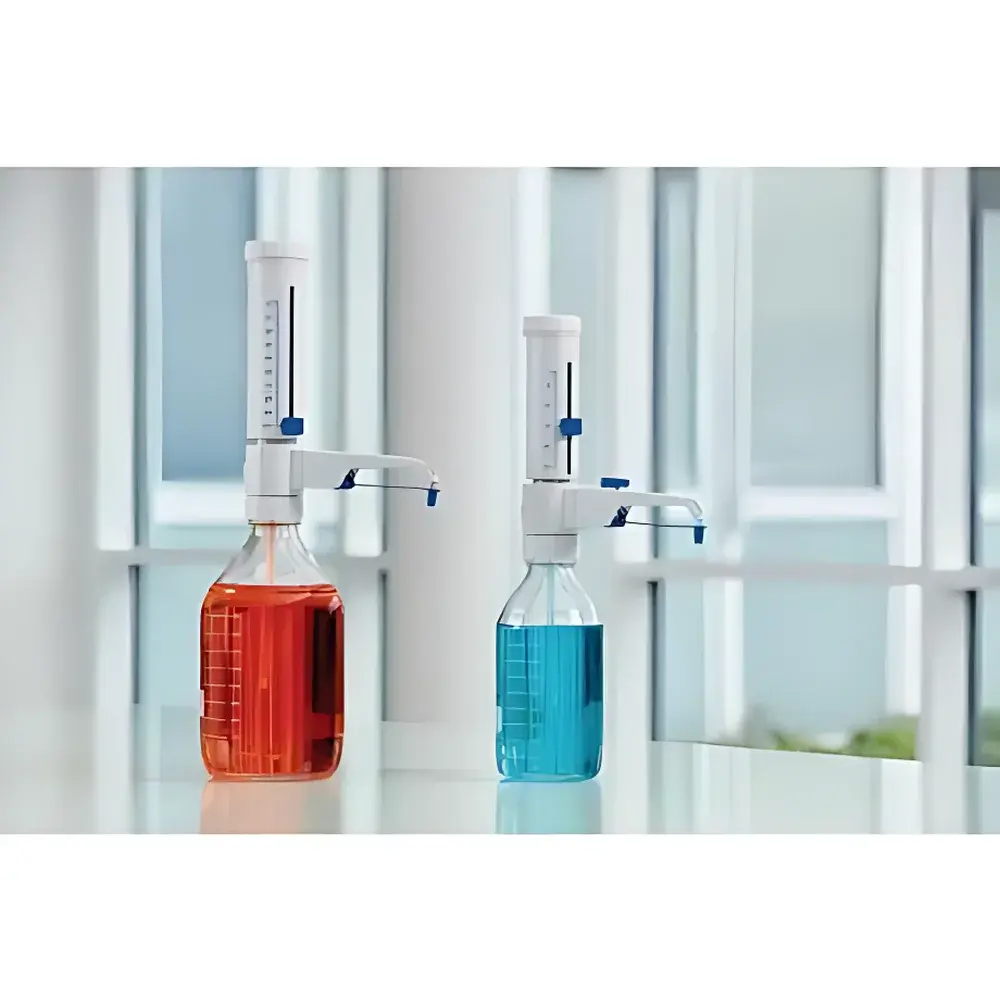
Eppendorf Varispenser 2 and Varispenser 2x Bottle Top Dispensers
| Brand | Eppendorf |
|---|---|
| Origin | Germany |
| Manufacturer Type | Original Equipment Manufacturer (OEM) |
| Import Status | Imported |
| Model | Varispenser 2 / Varispenser 2x |
| Instrument Type | Electronic Bottle Top Dispenser |
| Sterilization | Autoclavable (121 °C, 20 min, full unit) |
| Chemical Resistance | Full-body PTFE/ETFE/FEP/PFA/PP construction |
| Valve System | Precision piston-driven with integrated recirculation valve (Varispenser 2x only) |
| Dispensing Accuracy | ≤ ±0.5% CV (per ISO 8655-3) |
| Volume Range | Adjustable from 0.2 mL to 100 mL per dispense (model-dependent) |
| Operating Temperature | 10–40 °C |
| Humidity Limit | ≤ 80% RH (non-condensing) |
Overview
The Eppendorf Varispenser 2 and Varispenser 2x are precision-engineered electronic bottle top dispensers designed for reproducible, contamination-controlled liquid handling in regulated laboratory environments. Based on a positive-displacement piston mechanism—distinct from air-cushion or peristaltic systems—these dispensers deliver high volumetric accuracy and minimal carryover across a broad spectrum of challenging liquids. Their operation relies on calibrated mechanical displacement of the piston within a chemically inert chamber, ensuring consistent delivery independent of liquid density, viscosity, or vapor pressure. This principle enables reliable performance with aggressive reagents (e.g., concentrated acids, organic solvents), viscous solutions (e.g., glycerol, polymer stocks), foaming detergents, and low-surface-tension compounds—without reliance on calibration adjustments per fluid type. The Varispenser 2x variant incorporates an integrated recirculation valve that returns excess liquid to the reservoir during volume setting, eliminating waste and enabling precise, repeatable dispensing without priming loss—a critical advantage for high-value or hazardous reagents.
Key Features
- Fully autoclavable design (121 °C, 20 min, full-unit sterilization)—validated per ISO 17665-1 for GLP/GMP-compliant workflows.
- Chemically resistant wetted path constructed entirely from fluoropolymers (PTFE, ETFE, FEP, PFA) and polypropylene—compatible with >95% of common laboratory solvents, including HCl, HNO₃, NaOH, acetone, chloroform, and ethanol.
- Electronic volume adjustment via intuitive rotary dial with digital display (Varispenser 2x) or mechanical micrometer scale (Varispenser 2), supporting fine resolution down to 0.1 mL increments.
- DryGuard™ integrated drying tube prevents moisture ingress into the dispensing mechanism—essential for hygroscopic or water-sensitive reagents (e.g., thionyl chloride, lithium aluminum hydride solutions).
- Spiral discharge tube (optional accessory) enables continuous, drip-free dispensing at controlled flow rates; compatible with standard 28–400, 33–400, and 38–400 bottle neck threads.
- Ergonomic, low-effort dispensing lever with tactile feedback reduces operator fatigue during high-throughput protocols.
Sample Compatibility & Compliance
The Varispenser 2/2x accommodates liquids spanning dynamic viscosity ranges from 0.3 cP (water) to >10,000 cP (e.g., 50% w/v PEG 8000), vapor pressures up to 100 kPa, and densities from 0.6 g/mL (hexane) to 2.2 g/mL (brominated solvents). It is routinely deployed in applications requiring adherence to ASTM D1298 (density), USP (analytical instrument qualification), and ISO/IEC 17025:2017 (test method validation). Its full-unit autoclave compatibility supports compliance with ISO 13485 (medical device manufacturing) and FDA 21 CFR Part 11 when paired with Eppendorf’s audit-trail-enabled software modules (via optional USB interface). All materials meet USP Class VI biocompatibility requirements and EU REACH SVHC criteria.
Software & Data Management
While standalone operation requires no software, the Varispenser 2x supports optional USB connectivity for integration with Eppendorf’s LabManager Suite. This enables secure logging of dispensing events—including volume setpoint, date/time stamp, user ID, and cycle count—with tamper-evident audit trails compliant with 21 CFR Part 11 Annex 11. Calibration records, maintenance logs, and sterilization cycle reports can be exported in PDF or CSV format for quality documentation systems. Firmware updates are delivered via signed packages to ensure integrity and traceability throughout the instrument lifecycle.
Applications
- Quality control labs: Accurate dispensing of titrants, standards, and reference materials for ISO/IEC 17025-accredited testing.
- Pharmaceutical R&D: Aseptic transfer of cytotoxic compounds and sterile buffers under laminar flow hoods.
- Clinical diagnostics: Reproducible distribution of assay reagents onto microtiter plates with minimized cross-contamination risk.
- Academic research: Handling of pyrophoric, air-sensitive, or light-degradable reagents using inert gas-purged bottles and dry-tube configurations.
- Environmental testing: Precise dosing of EPA-certified extraction solvents (e.g., methylene chloride, hexane) for Soxhlet and QuEChERS workflows.
FAQ
Can the Varispenser 2/2x be used with hydrofluoric acid (HF)?
No—HF attacks all fluoropolymer components and glass-reinforced housings; use only HF-rated PFA-only dispensers with dedicated certification.
Is recalibration required after autoclaving?
No—mechanical calibration is factory-set and retained post-sterilization due to thermally stable ceramic piston guides and zero-drift elastomer seals.
What is the maximum recommended fill volume for a 1 L reagent bottle?
For optimal vapor headspace management and dispensing consistency, maintain ≥10% empty volume (i.e., ≤900 mL fill level) with volatile or expanding liquids.
Does the recirculation valve in the Varispenser 2x introduce carryover between different reagents?
No—the valve features a dual-seal architecture with purge-ready geometry; validated wash protocols using compatible solvents eliminate residual carryover to <0.001% (per ISO 8655-6).
Are replacement parts traceable to manufacturing lot numbers?
Yes—each piston assembly, seal kit, and valve block carries a serialized QR code linked to Eppendorf’s global quality database, supporting full component-level traceability for regulatory audits.



