
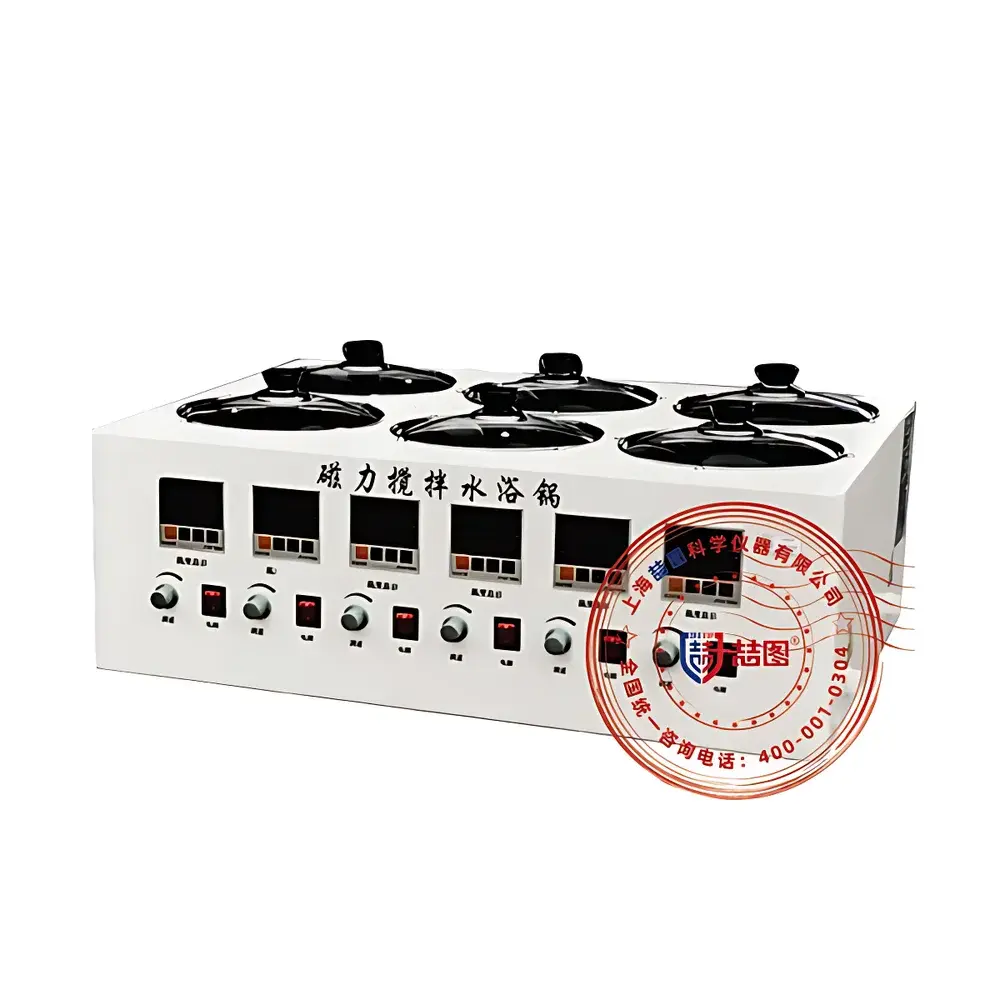
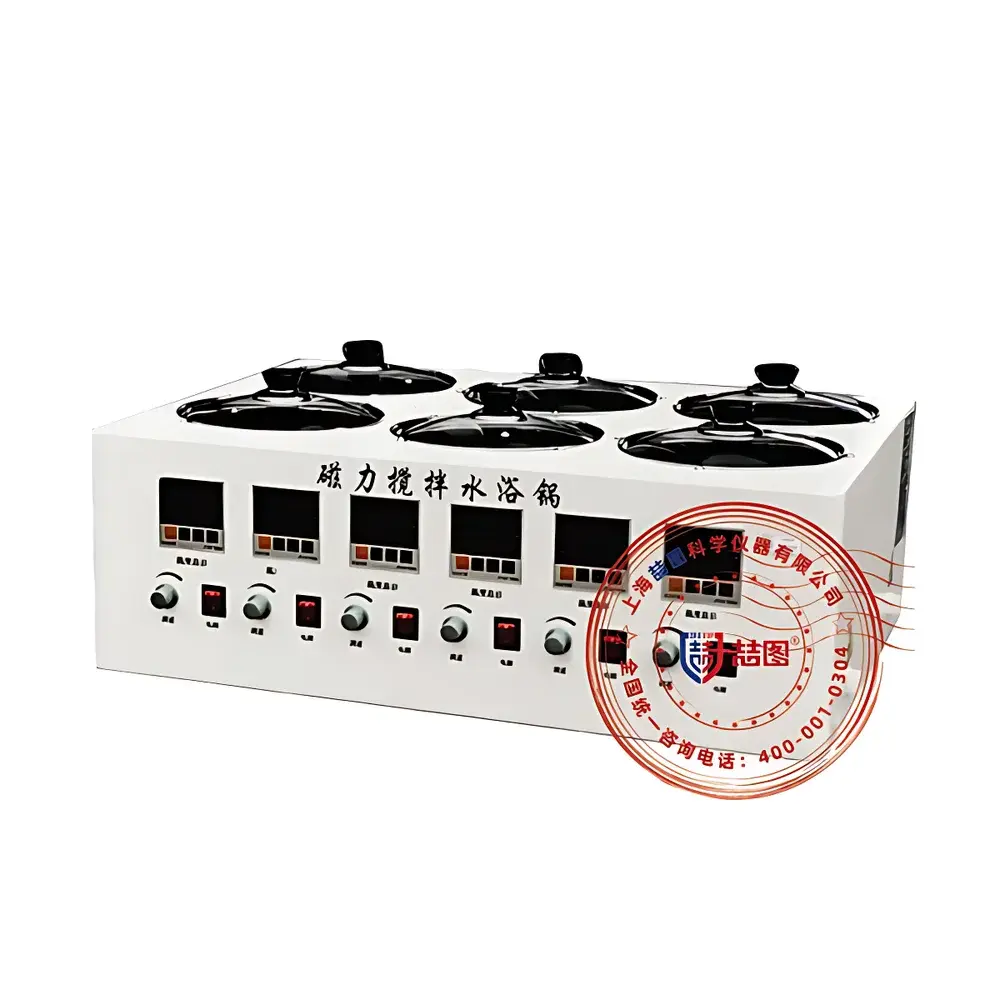
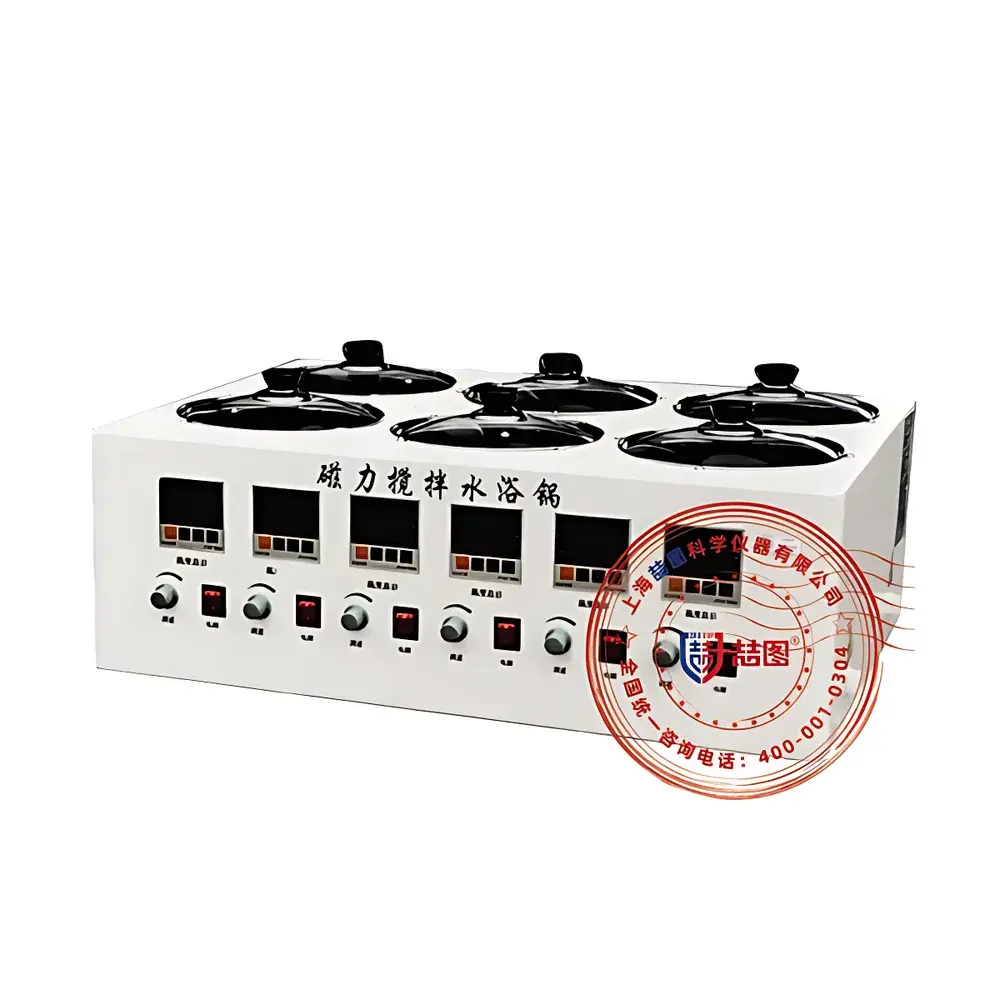
DRETOP JCS Series Magnetic Stirring Water Bath
| Brand | DRETOP |
|---|---|
| Origin | Shanghai, China |
| Model | JCS Series |
| Price Range | USD 370–1,150 (FOB) |
| Temperature Range | RT+5 to 100 °C |
| Temperature Control Accuracy | ±0.1 °C |
| Bath Capacity | 2–12 L |
| Heating Power | 300–1800 W |
| Stirring Speed | 0–2400 rpm |
| Stirring Capacity per Position | Up to 2000 mL |
| Number of Stirring Positions | 1–6 |
| Display | Dual LED digital display (set temperature & actual temperature) |
| Control System | PID microprocessor-based controller with timer function |
| Construction | Stainless steel inner tank and lid |
| Safety Features | Over-temperature alarm, power-failure parameter memory & auto-recovery, dry-run protection (optional) |
Overview
The DRETOP JCS Series Magnetic Stirring Water Bath integrates precise temperature regulation with contactless magnetic agitation in a single compact platform. Engineered for laboratories requiring simultaneous thermal control and homogeneous mixing—without mechanical shafts penetrating the bath medium—the system operates on the principle of electromagnetic induction: a rotating magnetic field generated beneath the stainless-steel bath bottom drives PTFE-coated magnetic stir bars immersed in sample vessels. This design eliminates seal wear, cross-contamination risk, and leakage associated with overhead stirrers, while ensuring uniform heat transfer via immersion-heating elements distributed around the bath perimeter. The unit maintains stable setpoints across its full operating range (RT+5 °C to 100 °C), with ±0.1 °C control accuracy and ±0.5 °C temperature uniformity (measured at 37 °C and 60 °C per ASTM E145-22 Annex A3 methodology). Its modular configuration—offering 1-, 2-, 4-, and 6-position variants—supports scalable workflow integration in QC labs, academic teaching facilities, and R&D environments.
Key Features
- PID-controlled microprocessor system with dual LED display showing both setpoint and real-time bath temperature
- Independent temperature regulation per position in multi-hole configurations (JCS-1024/JCS-1026)
- Stainless steel inner tank and lid resistant to corrosion from aqueous, saline, and mildly acidic solutions
- Electrostatic powder-coated exterior for mechanical durability and chemical resistance
- Integrated bottom-mounted drain valve enabling rapid, spill-free bath fluid replacement
- Programmable over-temperature alarm with audible alert and automatic heater cutoff
- Power-loss memory function retaining user-defined parameters and resuming operation upon restoration
- 0–2400 rpm continuous stirring speed control via front-panel knob or digital input
- PTFE-encapsulated magnetic stir bars rated for continuous use up to 100 °C and compatible with organic solvents, buffers, and cell culture media
- Optional accessories include vertical support rods and universal condenser clamps for reflux setups
Sample Compatibility & Compliance
The JCS Series accommodates standard laboratory glassware including beakers (50–2000 mL), Erlenmeyer flasks, and reaction tubes placed directly into the bath. Its open-bath geometry allows unobstructed access for pH probes, thermocouples, or sampling syringes. All electrical components comply with IEC 61010-1:2010 safety standards for laboratory equipment. The stainless steel construction meets ISO 8573-1 purity class requirements for non-particulate contamination in cleanroom-adjacent applications. While not certified for GLP/GMP production environments, the device supports traceable calibration protocols when used with NIST-traceable reference thermometers and documented SOPs—making it suitable for method development, stability testing, and educational validation exercises aligned with USP and ISO/IEC 17025 guidelines.
Software & Data Management
The JCS Series operates as a standalone instrument without proprietary software dependency. All operational parameters—including temperature setpoint, stirring speed, timer duration, and alarm thresholds—are configured locally via intuitive front-panel controls. For laboratories implementing electronic lab notebooks (ELNs) or LIMS integration, optional RS-232 or USB-to-serial adapters enable ASCII-based data logging of temperature and time stamps at user-defined intervals (e.g., every 10 seconds). Raw output is compatible with common spreadsheet and statistical analysis tools. No FDA 21 CFR Part 11 compliance features are embedded; however, manual audit trails can be maintained through timestamped operator logs and periodic calibration records.
Applications
- Temperature-controlled dissolution testing of pharmaceutical tablets and capsules (per USP )
- Enzyme kinetics assays requiring precise thermal stabilization during spectrophotometric monitoring
- Cell lysis and protein extraction protocols where gentle, uniform agitation prevents shear-induced denaturation
- Standardization of viscosity measurements using capillary or rotational viscometers calibrated in water baths
- Preparation of calibration standards for HPLC and GC systems under thermostatically controlled conditions
- Accelerated stability studies (ICH Q1A) for formulations exposed to elevated temperatures over defined durations
- Teaching laboratory demonstrations of Arrhenius reaction kinetics and equilibrium thermodynamics
FAQ
What is the maximum recommended liquid height for optimal temperature uniformity?
For best performance, maintain liquid level between 30 mm and 100 mm above the heating element plane. Custom bath depths >100 mm are available upon request but may require recalibration of sensor placement.
Can the JCS Series be used with organic solvents such as acetone or ethanol?
Yes—provided the solvent’s flash point exceeds the operating temperature and vapors are adequately ventilated. Avoid prolonged exposure to chlorinated solvents, which may degrade PTFE coatings over time.
Is external temperature probe input supported?
No. The system relies solely on its internal Pt100 sensor located near the bath center. External probe integration requires third-party data acquisition hardware.
How often should calibration verification be performed?
We recommend quarterly verification using a NIST-traceable thermometer at three points across the operating range (37 °C, 60 °C, and 95 °C), per ISO/IEC 17025 Clause 6.5.2.
Does the unit support continuous operation beyond 24 hours?
Yes—designed for unattended long-term incubation. Ensure adequate ventilation, stable power supply, and periodic inspection of bath fluid level and clarity.



