
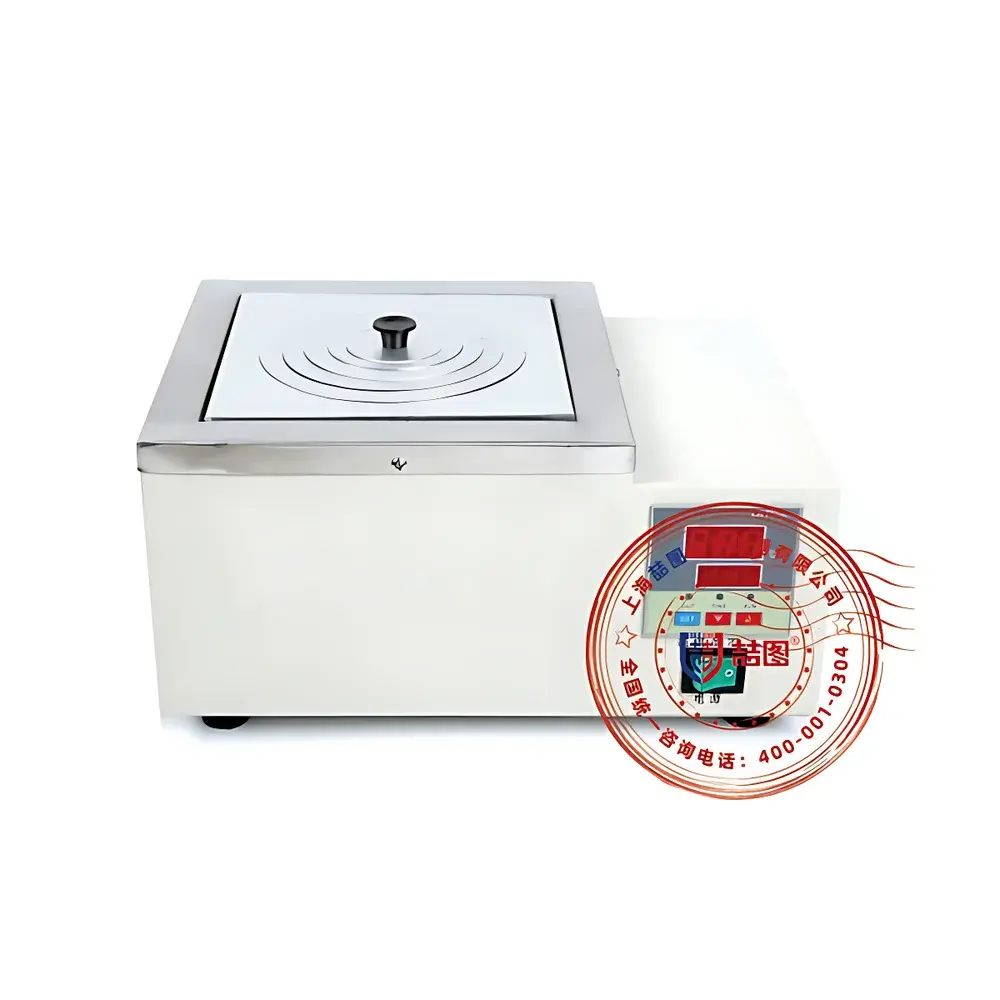
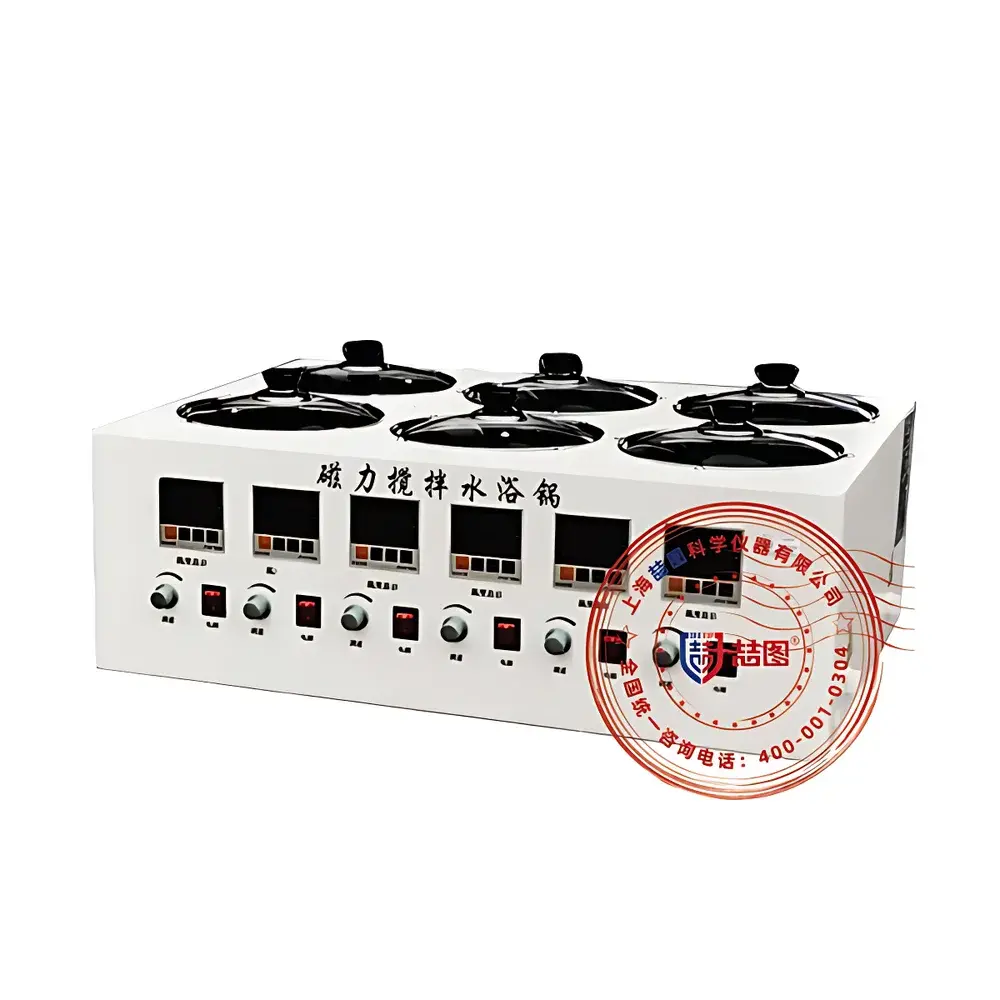
DRETOP JCY-1012 Magnetic Stirring Oil Bath Circulator
| Brand | DRETOP |
|---|---|
| Origin | Shanghai, China |
| Model | JCY-1012 |
| Bath Type | Oil/Water Bath |
| Temperature Range | Ambient +5°C to 300°C |
| Temperature Stability | ±0.5°C |
| Temperature Resolution | ±0.1°C |
| Input Power | 2 × 400 W = 800 W |
| Supply Voltage | 220 V, 50 Hz |
| Stirring Speed | 0–2400 rpm (adjustable), LED digital display |
| Max. Stirring Capacity | 2 × 2000 mL |
| Stirring Power | 2 × 25 W |
| Internal Tank Dimensions | Ø220 mm × 100 mm (customizable height >100 mm) |
| Drain Valve | Yes |
| Construction | Stainless steel inner tank & lid, electrostatically coated exterior |
| Safety Features | Power-loss memory, over-temperature alarm, auto-recovery on power restoration |
Overview
The DRETOP JCY-1012 Magnetic Stirring Oil Bath is a dual-function laboratory thermal platform engineered for precise temperature maintenance and homogeneous mechanical agitation in non-circulating bath environments. Unlike recirculating thermostats, this unit employs direct immersion heating—via ring-shaped heating elements embedded beneath the stainless steel bath chamber—combined with electromagnetic drive to rotate PTFE-coated magnetic stir bars within vessels placed directly in the thermal medium (oil or water). Its operational principle relies on resistive heating and contact-conduction heat transfer, delivering stable thermal conditions across a wide range from ambient +5°C to 300°C—making it suitable for high-boiling-point solvent reactions, polymerization studies, catalyst activation, and extended-duration stability testing where inert, non-aqueous media are required. Designed for routine use in academic teaching labs, QC/QA departments, and R&D facilities, the JCY-1012 prioritizes functional robustness, operator safety, and long-term calibration consistency over advanced automation.
Key Features
- Microprocessor-based PID temperature controller with dual digital display: simultaneous readout of setpoint and real-time bath temperature
- Backlit LCD interface with timer function for scheduled operation and unattended heating cycles
- High-sensitivity PT100-class temperature sensor integrated into the bath wall for rapid thermal response and minimized lag
- Double-layer insulated housing with waterproof sealing and bottom-mounted drain valve for safe, tool-free fluid replacement
- Electrostatically applied corrosion-resistant coating on outer casing; 304 stainless steel inner tank and lid for chemical compatibility and longevity
- Independent magnetic stirring control with 0–2400 rpm adjustment via rotary encoder or keypad input; LED speed indication
- PTFE-encapsulated neodymium stir bars included—rated for continuous operation up to 300°C, resistant to acids, bases, and organic solvents
- Power-fail data retention: all setpoints, timers, and alarm thresholds preserved during interruption; automatic system recovery upon re-energization
Sample Compatibility & Compliance
The JCY-1012 accommodates standard round-bottom flasks (up to 2000 mL each), beakers, and reaction vials immersed in silicone oil, mineral oil, or water-based baths. Its open-bath architecture supports condenser mounting via optional vertical support rods and clamps—enabling reflux, distillation, or gas-inlet configurations. While not certified to ISO/IEC 17025 or ASTM E2877 for metrological traceability, the device meets general-purpose laboratory equipment requirements under GB/T 25915 (Chinese national standard for lab instrument safety) and complies with basic electrical safety directives analogous to IEC 61010-1. It is routinely deployed in workflows aligned with USP , ISO 17025-accredited testing protocols, and internal GLP documentation systems where thermal uniformity and repeatability—not absolute NIST-traceable calibration—are the primary validation criteria.
Software & Data Management
The JCY-1012 operates as a standalone analog-digital hybrid instrument without USB, Ethernet, or cloud connectivity. All configuration and monitoring occur locally via front-panel controls and visual indicators. No proprietary software is required or provided. However, its analog output signal (0–5 V or 4–20 mA, optional upon request) can be interfaced with third-party data loggers or SCADA systems for time-stamped temperature trending. The built-in timer supports up to 99 hours 59 minutes of programmable duration, and the over-temperature alarm triggers both audible (buzzer) and visual (LED flash) alerts—critical for unmonitored overnight runs. Audit trails are maintained manually via lab notebook entries; no electronic audit trail or 21 CFR Part 11 compliance is implemented natively.
Applications
- Controlled-temperature synthesis of metal-organic frameworks (MOFs) and coordination polymers requiring prolonged heating in high-boiling solvents
- Enzyme kinetic assays at elevated temperatures using oil-mediated thermal transfer to avoid water evaporation artifacts
- Standardization of viscosity reference oils per ASTM D445 through isothermal bath stabilization prior to capillary viscometer use
- Accelerated stability testing of pharmaceutical suspensions and emulsions under ICH Q1A(R3) guidelines
- Preparation of calibration standards for FTIR, UV-Vis, and HPLC where thermal homogeneity across multiple sample vials is essential
- Heating and mixing of asphalt binders, lubricants, and polymer melts in materials science laboratories
FAQ
Does the JCY-1012 support external temperature probe input for vessel-specific feedback control?
No. Temperature sensing is fixed to the bath medium only; no external probe port or input channel is provided.
Can the unit maintain temperature stability when operating at 280°C with silicone oil?
Yes—within specified ±0.5°C stability tolerance—but requires proper ventilation, oil level above heater elements, and periodic oil quality verification per manufacturer recommendations.
Is the stainless steel tank compatible with aggressive solvents like chlorobenzene or DMF?
The 304 SS construction resists short-term exposure; however, prolonged contact with halogenated or strongly coordinating solvents may accelerate surface oxidation—use glass-lined inserts for critical applications.
What is the maximum recommended oil volume for optimal thermal uniformity?
Fill to 70–85% of internal tank capacity (approx. 3.5–4.2 L for Ø220 × 100 mm geometry); overfilling impedes convection and increases boil-over risk.
Are calibration certificates or factory calibration reports available for purchase?
DRETOP provides a basic conformity statement with shipment; accredited calibration per ISO/IEC 17025 must be arranged separately through authorized third-party labs.



