
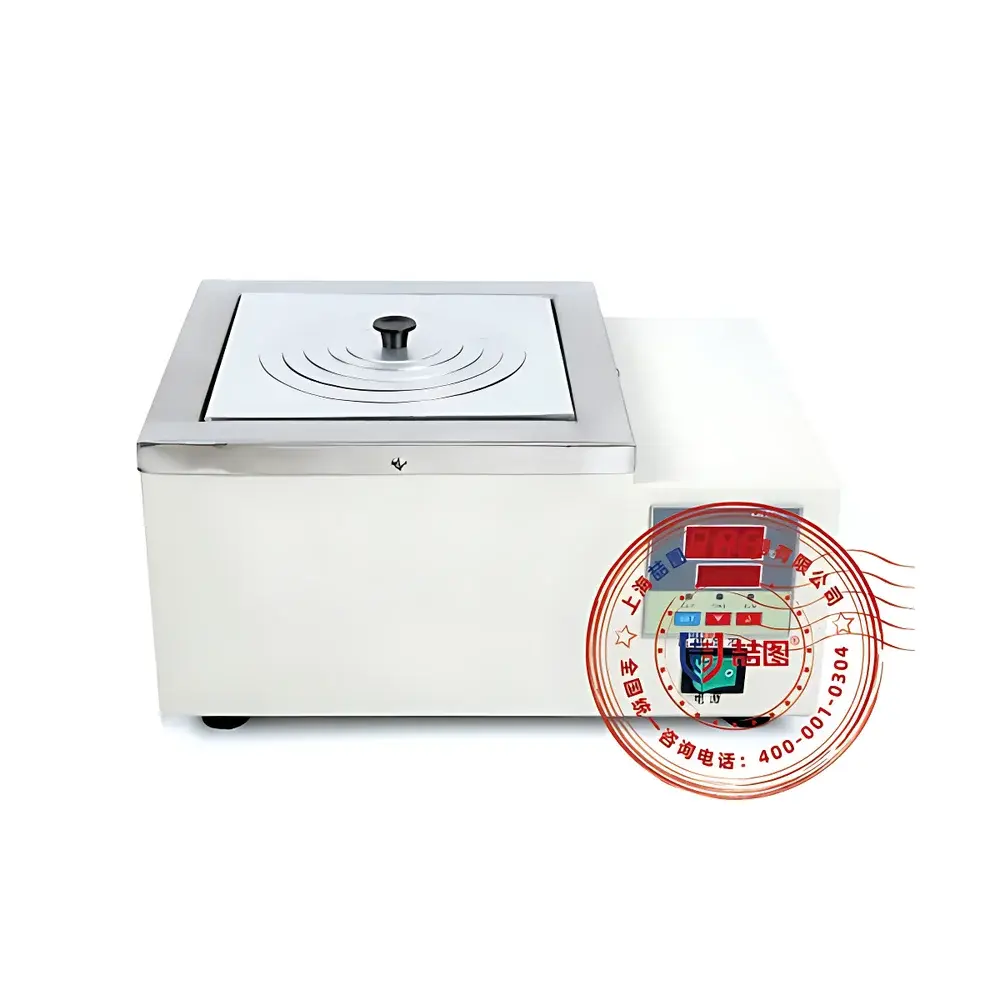
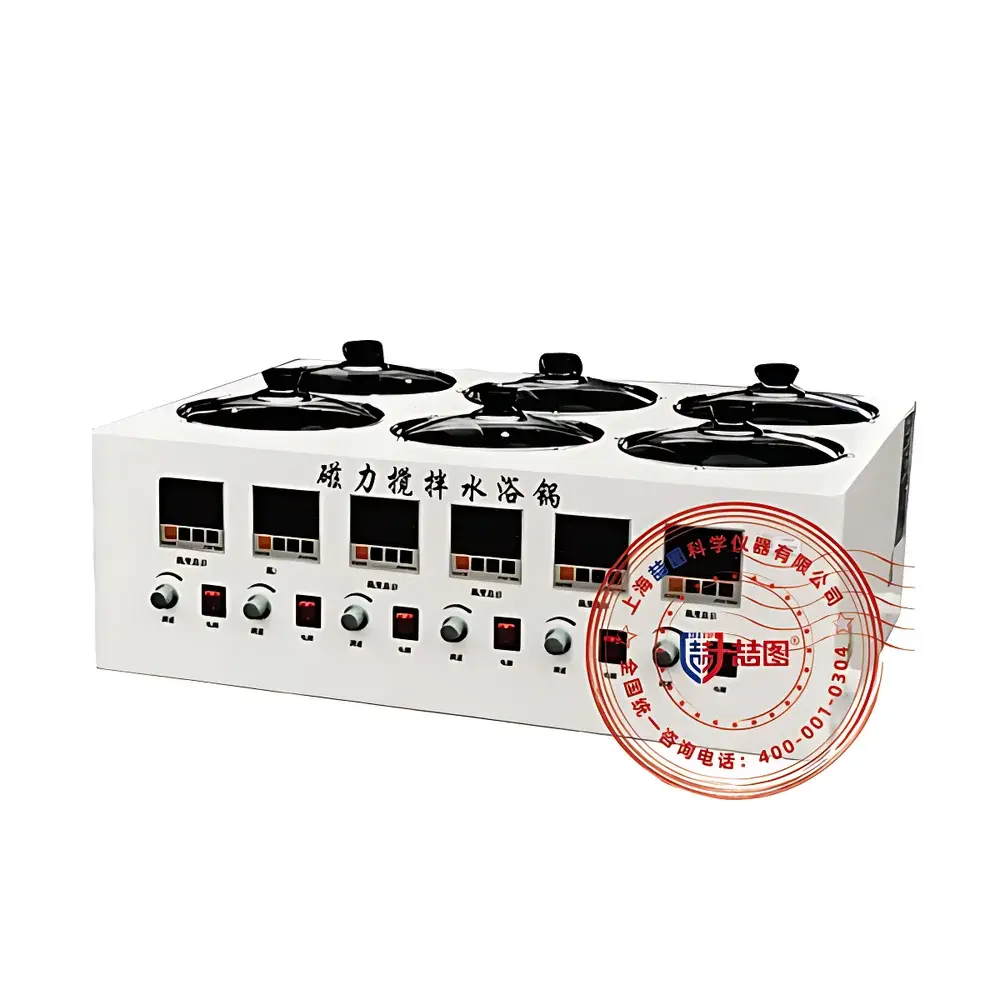
DRETOP JCY Series Magnetic Stirring Oil Bath
| Brand | DRETOP |
|---|---|
| Origin | Shanghai, China |
| Manufacturer Type | Authorized Distributor |
| Country of Origin | China |
| Model | JCY Series |
| Price Range | USD 495–1,275 (FOB) |
| Temperature Range | RT + 5°C to 300°C |
| Temperature Control Accuracy | ±0.1°C |
| Bath Capacity | 2 L to 12 L |
| Heating Power | 400 W to 2400 W |
| Stirring Speed | 0–2400 rpm (infinitely variable) |
| Stirring Motor Power | 25 W per position |
| Max. Stirring Volume per Position | 2000 mL |
| Bath Chamber Material | 304 Stainless Steel |
| Surface Finish | Electrostatic Powder Coating |
| Display | Dual LED Digital Display (Set Temp / Actual Temp) |
| Control System | Microprocessor-Based PID Controller with Timer & Auto-Restart Function |
| Safety Features | Over-Temperature Alarm, Power-Fail Data Retention, Auto-Cut-Off at Set Limit |
| Optional Accessories | Vertical Support Rod, Condenser Clamp, Custom Height Bath Vessel |
Overview
The DRETOP JCY Series Magnetic Stirring Oil Bath is an integrated laboratory thermal control and mixing system engineered for precise temperature regulation and homogeneous sample agitation under elevated thermal conditions. Unlike conventional water baths limited to 100°C, this series utilizes thermally stable silicone or mineral oil as the heat-transfer medium—enabling sustained operation from ambient +5°C up to 300°C. It operates on the principle of electromagnetic induction: a rotating magnetic field generated beneath the bath chamber drives PTFE-coated magnetic stir bars immersed in samples, eliminating mechanical shafts and ensuring leak-proof, low-maintenance operation. Designed for reproducible reaction kinetics, solvent reflux, viscosity measurements, and controlled crystallization, the JCY platform conforms to core operational requirements in ISO/IEC 17025-accredited laboratories—particularly where traceable temperature uniformity and stirring consistency are critical for method validation.
Key Features
- Microprocessor-controlled PID temperature regulation with dual LED display showing both setpoint and real-time bath temperature—ensuring ±0.1°C control accuracy and ±0.5°C uniformity across the working volume.
- Infinitely variable magnetic stirring (0–2400 rpm), digitally displayed and independently adjustable per station in multi-position configurations (JCY-1024/JCY-1026).
- Stainless steel 304 inner tank with electrostatic powder-coated exterior—resistant to corrosion from organic solvents, acids, and high-temperature oils; fully drainable via integrated bottom outlet.
- Intelligent safety architecture: programmable over-temperature alarm, automatic power cutoff upon deviation >±5°C from setpoint, and non-volatile memory preserving settings during unexpected power interruption.
- Modular design supporting single- or multi-station layouts (1-, 2-, 4-, or 6-position models), each with independent heating and stirring circuits—ideal for parallel synthesis or comparative thermal stability testing.
- Compliant with IEC 61010-1:2010 safety standards for laboratory electrical equipment; CE-marked for use in EU-regulated environments.
Sample Compatibility & Compliance
The JCY Series accommodates standard round-bottom flasks (50–2000 mL), test tubes, and custom vessels up to 100 mm in immersion depth (customizable). Its oil-compatible construction permits direct use with silicone oil (up to 300°C), heat-transfer fluids (e.g., Therminol VP-1), and non-aqueous media without degradation. All models meet material compatibility requirements per ASTM D2570 (thermal stability of lubricants) and support GLP-compliant workflows through auditable parameter logging (via optional RS-232 interface). The stainless steel bath interior resists attack from common reagents including acetone, ethanol, chloroform, and 1M HCl—validated per ISO 9227 salt spray testing (72 h, no pitting).
Software & Data Management
While standalone operation requires no software, the JCY Series supports external data acquisition via analog voltage output (0–5 V DC proportional to temperature) and optional RS-232 serial communication. When integrated with LabVIEW™, MATLAB®, or third-party SCADA systems, users can log time-stamped temperature/stirring profiles, generate calibration reports per ISO/IEC 17025 Clause 5.10.4, and enforce electronic audit trails compliant with FDA 21 CFR Part 11 when paired with validated middleware. Firmware updates (available via DRETOP technical portal) maintain alignment with evolving IEC 62304 medical device software standards.
Applications
- Controlled-temperature organic synthesis (e.g., Grignard reactions, esterifications, Suzuki couplings requiring >150°C oil baths)
- Thermal stability assessment of polymers and pharmaceutical excipients (per USP & Ph. Eur. general chapter <1225>)
- Calibration of reference thermometers and RTDs using fixed-point oil baths (ITS-90 traceable)
- Accelerated aging studies in materials science (ASTM D573, D865)
- Enzyme activity assays requiring simultaneous heating and gentle agitation (e.g., lipase kinetics in non-aqueous media)
- Preparation of nanomaterial dispersions where shear-sensitive colloids demand contactless mixing
FAQ
What oil types are compatible with the JCY Series?
Silicone oil (up to 300°C), mineral oil (up to 220°C), and synthetic heat-transfer fluids meeting ASTM D6722 specifications are recommended. Avoid glycerol or ethylene glycol above 150°C due to oxidative degradation.
Can the JCY bath be used for water-based applications?
Yes—but only below 100°C and with caution: prolonged use above 80°C increases evaporation and scaling risk. For aqueous work, DRETOP’s dedicated water bath line (WJ Series) is optimized for humidity control and anti-corrosion.
Is the stirring speed synchronized across multiple positions?
No—each station features independent speed control, enabling differential agitation rates for multi-sample optimization studies.
Does the unit support external temperature probe input for sample-specific feedback?
Not natively; however, the analog output port allows connection to external PID controllers with probe inputs for cascade control configurations.
What maintenance is required for long-term reliability?
Annual verification of PT100 sensor drift (±0.2°C tolerance), visual inspection of stir bar integrity, and replacement of bath oil every 12–18 months under continuous operation—per ISO 17025 internal calibration procedures.



