
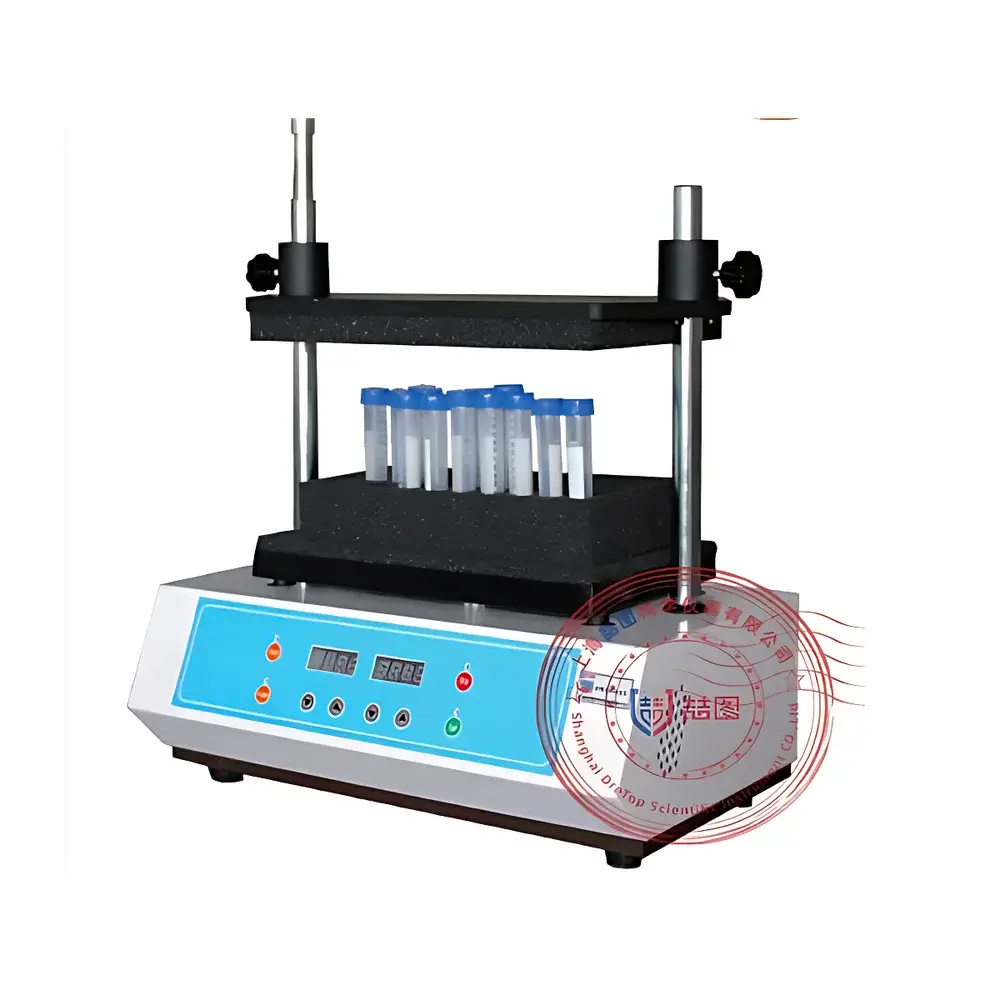
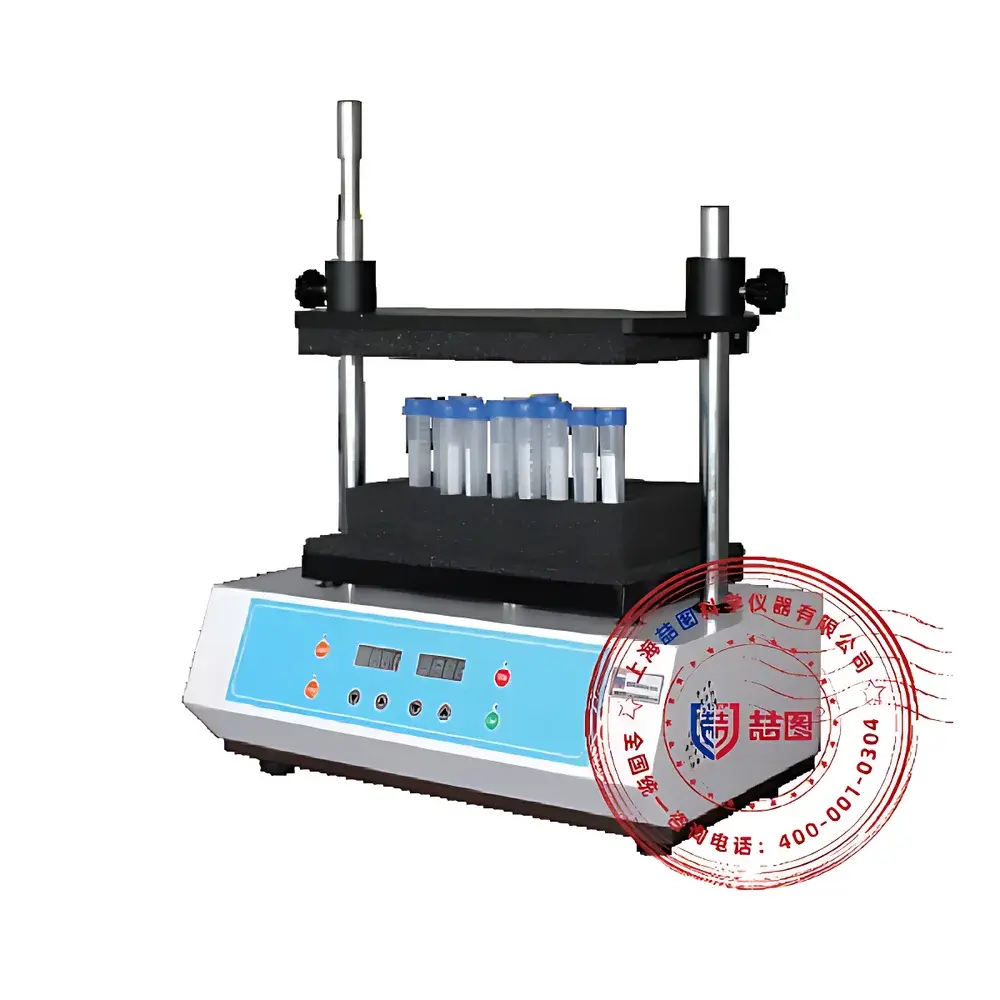
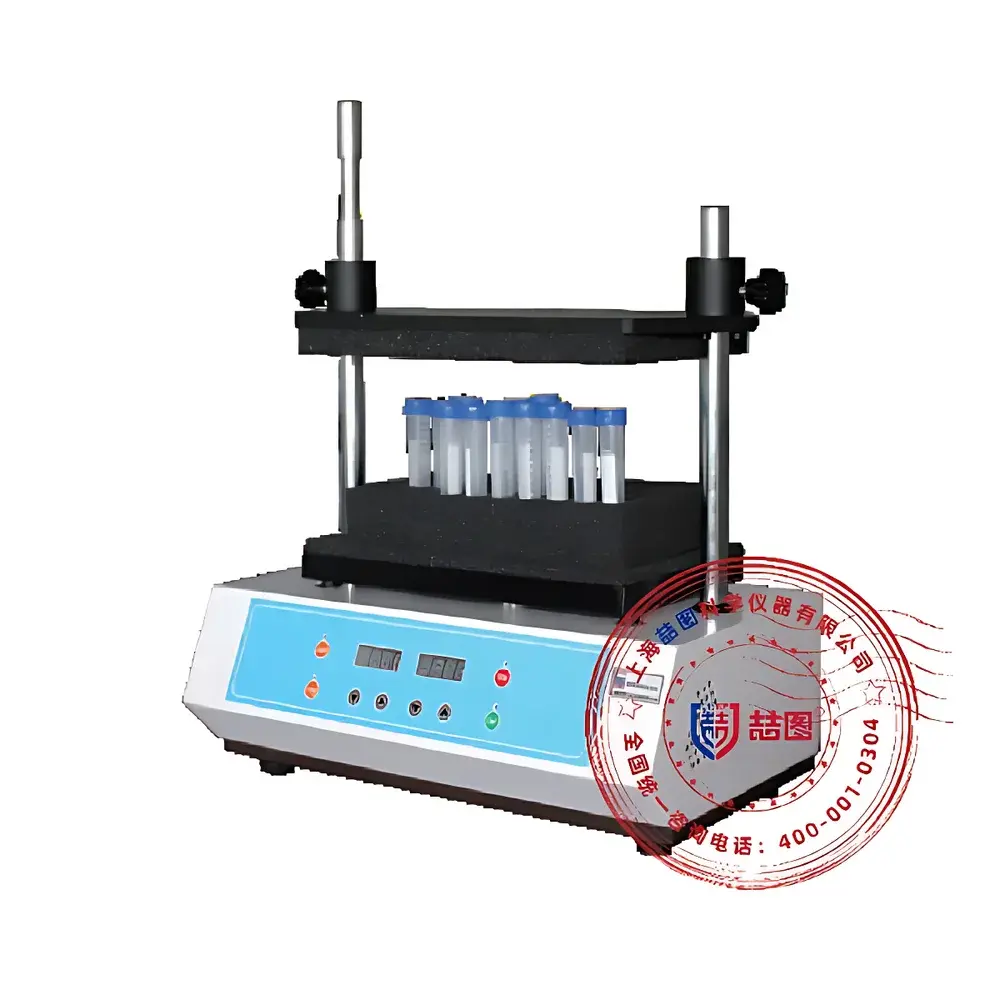
DRETOP DMT-2500 Multi-Tube Vortex Mixer
| Brand | DRETOP |
|---|---|
| Model | DMT-2500 |
| Origin | Shanghai, China |
| Type | Benchtop Multi-Tube Vortex Mixer |
| Operating Modes | Timed, Continuous, Intermittent, Pulse (Touch-Start) |
| Speed Range | 500–2500 rpm |
| Motion Type | Horizontal Orbital Shaking |
| Orbit Diameter | 4 mm |
| Display | LED Linear Speed Bar Graph |
| Max Load Capacity | 5000 g |
| Ambient Temperature Range | Room Temperature to 45 °C |
| Power Supply | 220 V, 50 Hz |
| Input Power | 100 W |
| Dimensions (W×D×H) | 240 × 420 × 430 mm |
| Standard Accessories | Two Foam Tube Holders (A250 & A515), Replaceable Tray Pad (B7) |
Overview
The DRETOP DMT-2500 Multi-Tube Vortex Mixer is an engineered benchtop solution for high-throughput sample homogenization in clinical, pharmaceutical, and research laboratories. Unlike conventional single-tube vortex mixers, the DMT-2500 employs horizontal orbital motion—based on the Couette flow principle—to generate consistent, low-shear agitation across multiple tubes simultaneously. This design ensures uniform mixing without splashing or foaming, making it particularly suitable for sensitive biological samples such as cell suspensions, enzyme assays, immunoassays, and nucleic acid preparations. Its robust aluminum alloy chassis and precision-machined drive mechanism deliver long-term mechanical stability under repeated daily use. The unit operates within a controlled ambient temperature range (up to 45 °C), supporting compatibility with temperature-sensitive workflows when used in climate-regulated lab environments.
Key Features
- Four programmable operating modes: timed (1–99 h 59 min), continuous, intermittent (user-defined on/off intervals), and pulse (instant activation via touch-sensitive start button)
- Wide speed range (500–2500 rpm) with real-time LED linear bar graph display for intuitive speed monitoring and reproducible setting recall
- Horizontal orbital motion with 4 mm orbit diameter—optimized for efficient mixing of viscous or particulate-laden solutions while minimizing tube stress and aerosol generation
- High-capacity platform accommodating up to 50 tubes per run, depending on selected foam holder configuration
- Microprocessor-based control system with non-volatile memory for parameter retention after power cycling
- Modular accessory system including six standardized foam tube holders (A150–A615) and acrylic microtube racks (B8), all dimensionally compatible with common labware (e.g., 1.5 mL, 2.0 mL, 15 mL, and 50 mL centrifuge tubes)
- Replaceable silicone-coated tray pad (B7) for enhanced vibration damping and tube positioning accuracy
Sample Compatibility & Compliance
The DMT-2500 supports a broad spectrum of sample containers—from microcentrifuge tubes to conical centrifuge tubes—when paired with appropriate holders. Its horizontal orbital action avoids vertical impact forces that may compromise fragile samples or cause premature precipitation. All foam holders are manufactured from closed-cell ethylene-vinyl acetate (EVA) foam, compliant with ISO 10993-5 for cytotoxicity and certified free of detectable leachables. While the instrument itself does not require regulatory certification as a standalone device, its operational repeatability and traceable speed control support compliance with GLP and GMP documentation requirements. When integrated into validated workflows (e.g., QC testing per USP or ISO 13485), users can implement audit-ready procedures using time-stamped operation logs generated externally via optional serial interface integration.
Software & Data Management
The DMT-2500 operates as a stand-alone hardware platform without embedded software or network connectivity. However, its microprocessor enables full parameter logging capability through external data acquisition systems via RS-232 or TTL-level serial output (optional adapter required). Users may export runtime metadata—including start/stop timestamps, total elapsed time, and average RPM—for inclusion in electronic lab notebooks (ELN) or LIMS platforms. For laboratories adhering to FDA 21 CFR Part 11, the mixer’s deterministic behavior (no firmware updates or user-modifiable calibration constants) simplifies validation protocols; only operational parameters (time, speed, mode) require verification during IQ/OQ/PQ phases.
Applications
- Routine re-suspension of bacterial pellets, yeast cultures, and mammalian cell monolayers prior to lysis or downstream analysis
- Pre-analytical preparation of clinical specimens—including whole blood, serum, plasma, and urine—for ELISA, PCR, and mass spectrometry workflows
- Homogenization of solid-phase extraction (SPE) cartridges and magnetic bead-based purification columns
- Accelerated dissolution testing of powdered pharmaceutical formulations in buffer media
- Uniform dispersion of nanoparticles, liposomes, and colloidal suspensions for characterization studies
- High-volume sample conditioning in environmental testing labs (e.g., soil extracts, water filtrates)
FAQ
What types of tubes are compatible with the DMT-2500?
Standard configurations include holders for 1.5 mL, 2.0 mL, 10 mm, 12 mm, 13 mm, 16 mm, 25 mm, and 29 mm diameter tubes—covering most common centrifuge and culture tubes.
Is the DMT-2500 suitable for use inside a cold room?
The unit is rated for ambient temperatures down to room temperature (typically ≥15 °C); operation below 15 °C is not recommended due to potential condensation and motor performance limitations.
Can I validate the mixing performance across all 50 positions?
Yes—users may perform positional uniformity testing using dye diffusion assays or viscosity-standardized glycerol solutions, following ASTM D2196 guidelines for rotational viscometer calibration transfer.
Does the mixer include safety interlocks or lid sensors?
No. As a Class I laboratory appliance without moving external guards, it relies on operator training and procedural controls per ISO/IEC 17025:2017 Section 5.4.2.
How often should maintenance be performed?
A visual inspection and cleaning of the platform surface and holder grooves is recommended after each shift; annual verification of motor torque and speed linearity is advised for regulated environments.



