
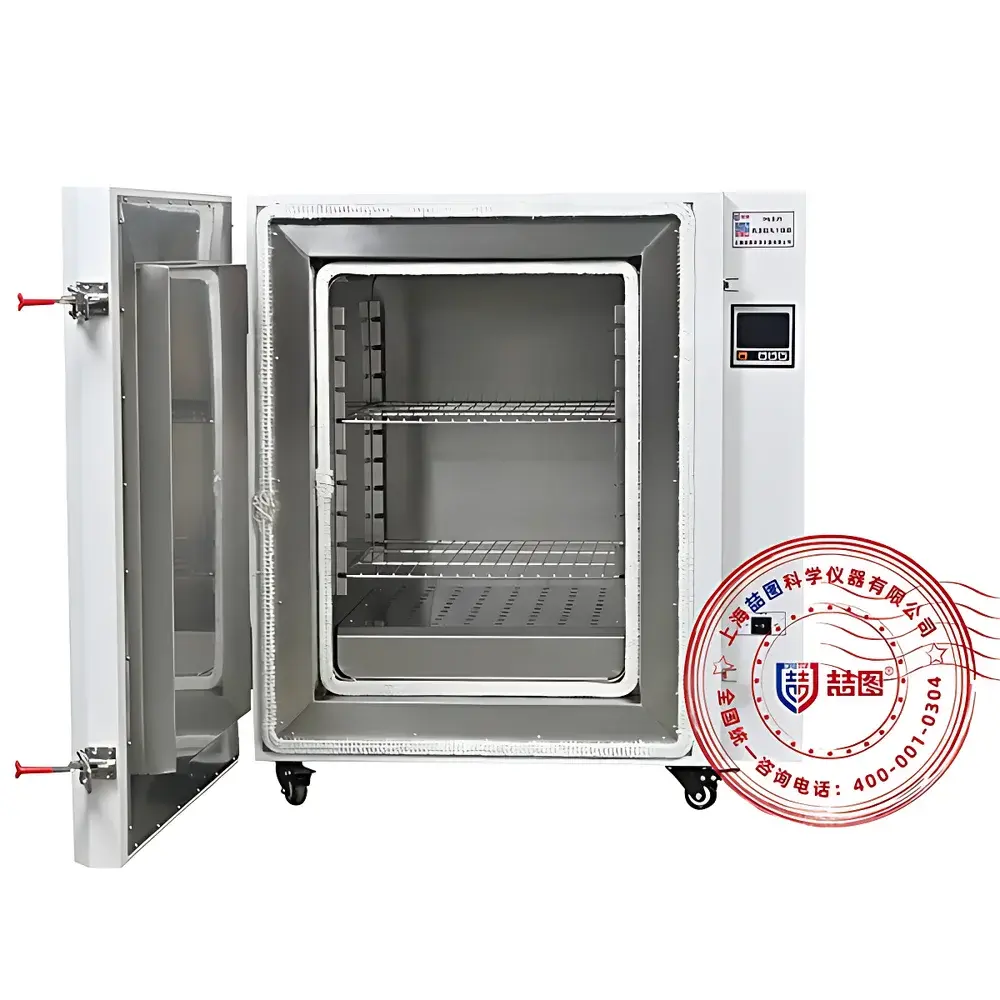
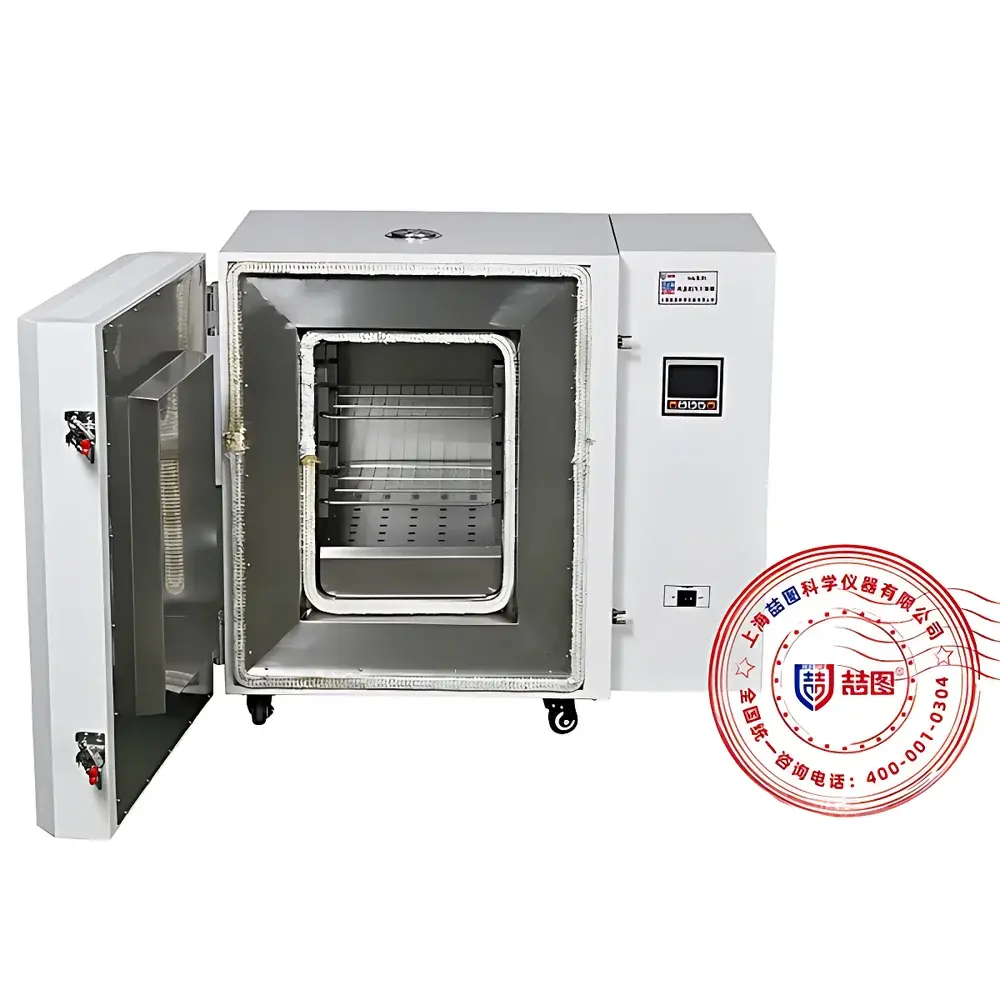
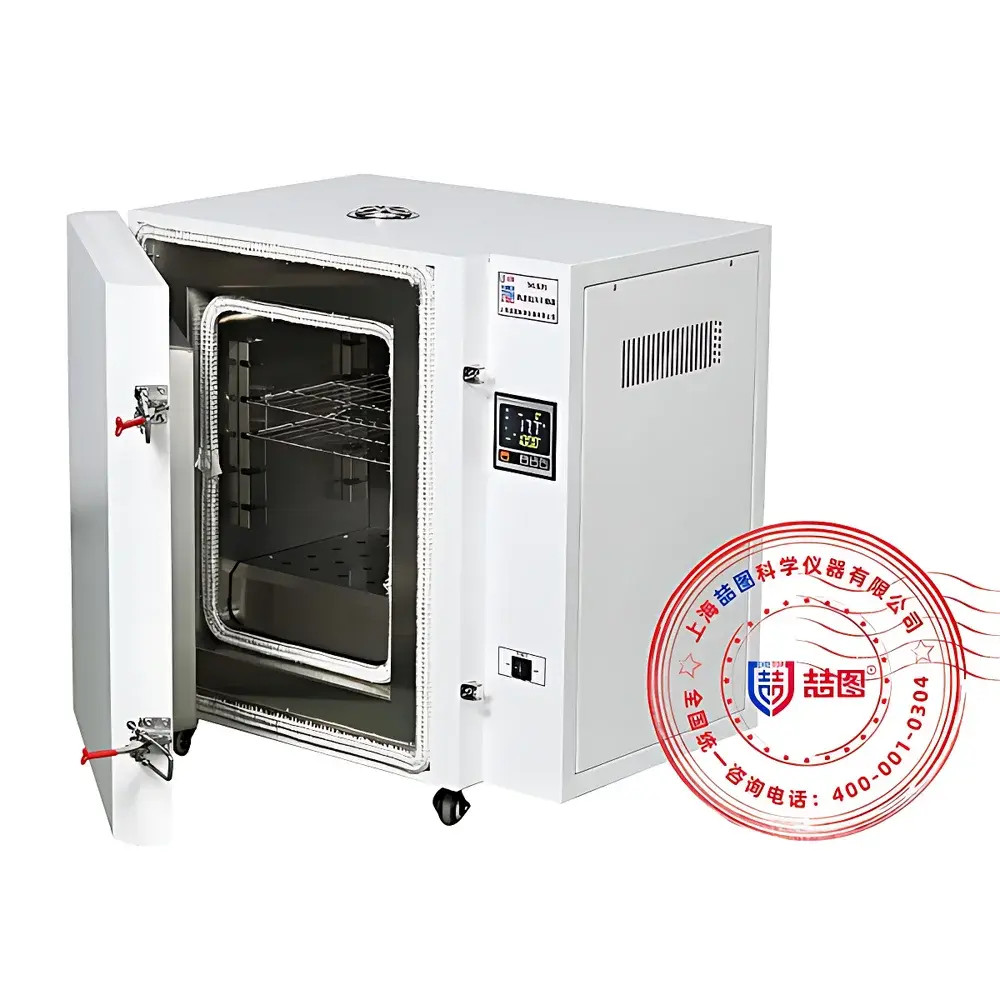
DRETOP STG-2000A Forced-Air Laboratory Drying Oven
| Brand | DRETOP |
|---|---|
| Origin | Shanghai, China |
| Model | STG-2000A |
| Instrument Type | General-Purpose Forced-Air Oven |
| Temperature Range | RT+10°C to 300°C |
| Temperature Uniformity | ±2.5°C (empty chamber, at 100°C) |
| Temperature Fluctuation | ±0.5°C |
| Temperature Resolution | 0.1°C |
| Chamber Dimensions (W×D×H) | 450×400×450 mm |
| External Dimensions (W×D×H) | 735×520×635 mm |
| Inner Chamber Material | Mirror-Finish Stainless Steel |
| Heating Method | Forced Convection with Adjustable Airflow |
| Control System | Microprocessor-Based PID Controller with Digital Display and Timer Function |
| Power Supply | AC 220 V, 50 Hz |
| Rated Power | 2500 W / 2800 W (dual-range configuration) |
Overview
The DRETOP STG-2000A is a precision-engineered forced-air laboratory drying oven designed for consistent thermal processing of non-volatile, non-flammable materials in research, quality control, and production environments. It operates on the principle of uniform convective heat transfer, utilizing a high-reliability centrifugal fan and optimized air duct architecture to ensure laminar airflow distribution across the entire working chamber. Unlike natural convection ovens, the STG-2000A’s active air circulation system minimizes thermal stratification and accelerates drying kinetics—critical for applications requiring reproducible moisture removal, dry-heat sterilization, or thermal stability assessment. Its operational envelope spans from ambient +10°C to 300°C, supporting both low-temperature conditioning (e.g., polymer annealing) and high-temperature dry-heat decontamination (e.g., glassware depyrogenation per USP ). The unit complies with fundamental safety and performance expectations outlined in IEC 61010-1 for electrical equipment used in laboratory settings.
Key Features
- Microprocessor-controlled PID temperature regulation with 0.1°C resolution and ±0.5°C stability—enabling tight process control across extended dwell periods.
- Mirror-finish stainless steel inner chamber (450 × 400 × 450 mm) resistant to corrosion, thermal oxidation, and cleaning agent degradation; facilitates visual inspection and residue-free maintenance.
- Dual-layer tempered glass observation window with integrated seal compression mechanism—provides real-time sample monitoring without compromising thermal integrity or operator safety.
- Adjustable, removable stainless steel shelving system with tool-free height positioning—supports flexible load configurations and rapid chamber reconfiguration.
- Self-diagnostic firmware with alphanumeric fault code display (e.g., E01 = sensor open circuit, E02 = overtemperature condition)—reducing troubleshooting time and supporting preventive maintenance protocols.
- Programmable timer (1–9999 minutes) with auto-shutdown and power-loss recovery memory—ensuring uninterrupted operation continuity after grid interruptions.
- Independent mechanical overtemperature cutoff (separate from main controller) with audible/visual alarm—meeting essential risk mitigation requirements under ISO 13850 and GLP Annex 11-aligned workflows.
- Electrostatically coated carbon steel exterior and high-temperature silicone gasketing—providing long-term dimensional stability and sealing integrity up to 300°C.
Sample Compatibility & Compliance
The STG-2000A accommodates a broad spectrum of inert and thermally stable samples, including but not limited to: borosilicate glassware, ceramic crucibles, metal calibration standards, pharmaceutical excipients, polymer films, geological core samples, and microbiological culture media plates. It is unsuitable for volatile solvents, flammable compounds, or biological agents requiring biosafety containment. The oven meets baseline conformity for general-purpose thermal treatment under ISO 17025-accredited laboratories when operated within specified environmental and procedural controls. While not certified to EN 60584 or ASTM E220 for thermocouple calibration, its temperature uniformity (±2.5°C at 100°C, empty) aligns with routine QC validation thresholds defined in USP for dry-heat sterilization qualification. Optional accessories—including RS-485 communication modules and USB data export—support traceability requirements aligned with FDA 21 CFR Part 11 for electronic records and signatures.
Software & Data Management
The STG-2000A features an embedded microcontroller interface with local parameter logging capability. Standard configuration includes real-time temperature display, elapsed time tracking, and alarm event flagging. Optional upgrades extend functionality: a USB interface enables direct export of time-stamped temperature logs to FAT32-formatted flash drives for offline analysis in Excel or MATLAB; an RS-485 port supports integration into centralized SCADA or LIMS platforms using Modbus RTU protocol; a programmable color touchscreen controller (optional) allows multi-step ramp-soak profiles with up to 30 segments, user-defined alarms, and CSV-formatted data streaming. All digital interfaces retain audit trail metadata—including operator ID, timestamp, parameter changes, and error events—to satisfy GLP/GMP documentation rigor.
Applications
- Dry-heat sterilization of reusable labware (e.g., pipette tips, Petri dishes, forceps) per ISO 15883 and USP guidelines.
- Moisture content determination in coal, soil, foodstuffs, and pharmaceutical raw materials (ASTM D3173, AOAC 950.46).
- Thermal aging studies of elastomers, adhesives, and encapsulants under controlled oxidative conditions.
- Baking and curing of thin-film coatings, printed circuit board substrates, and ceramic green bodies.
- Pre-drying of hygroscopic reference standards prior to gravimetric analysis or Karl Fischer titration.
- Stabilization of calibration weights and metrology artifacts following humidity exposure.
FAQ
What is the maximum operating temperature and corresponding safety certification?
The STG-2000A is rated for continuous operation up to 300°C. It conforms to IEC 61010-1:2010 for laboratory electrical equipment but does not carry UL/CSA listing; users must verify local regulatory acceptance prior to installation.
Can this oven be validated for GMP-compliant processes?
Yes—when equipped with optional data logging and alarm modules, it supports IQ/OQ/PQ documentation per Annex 15 of the EU GMP Guide. Calibration must be performed using NIST-traceable reference thermometers.
Is the airflow rate adjustable?
The fan speed is fixed for optimal uniformity at all setpoints; however, optional airflow dampers (sold separately) allow manual modulation of internal velocity for specialized drying protocols.
Does the oven support external temperature monitoring via PT100 probe input?
No—external probe input is not standard. Integration with third-party data loggers requires use of the RS-485 interface and custom Modbus register mapping.
What maintenance intervals are recommended for sustained accuracy?
Biannual verification of temperature uniformity and controller calibration is advised. Door gasket integrity should be inspected quarterly; replacement is recommended every 24 months under daily use at >200°C.



