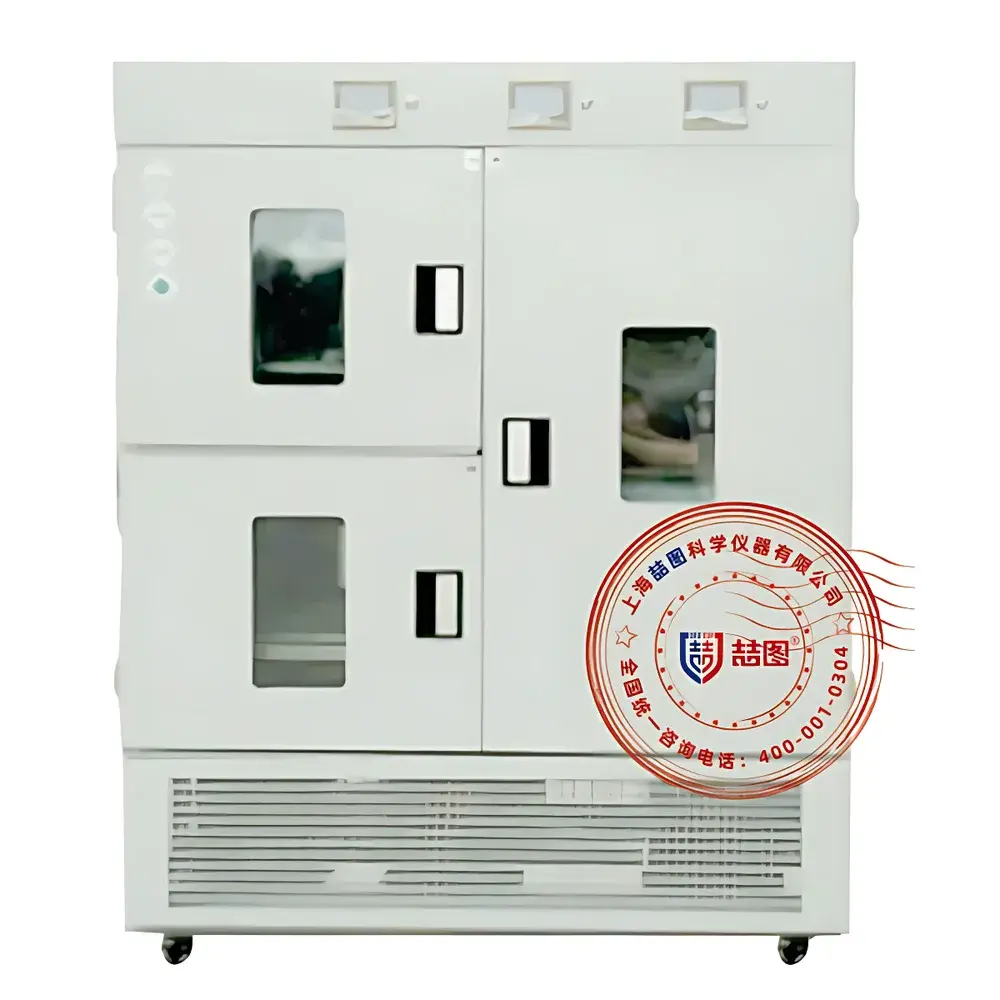
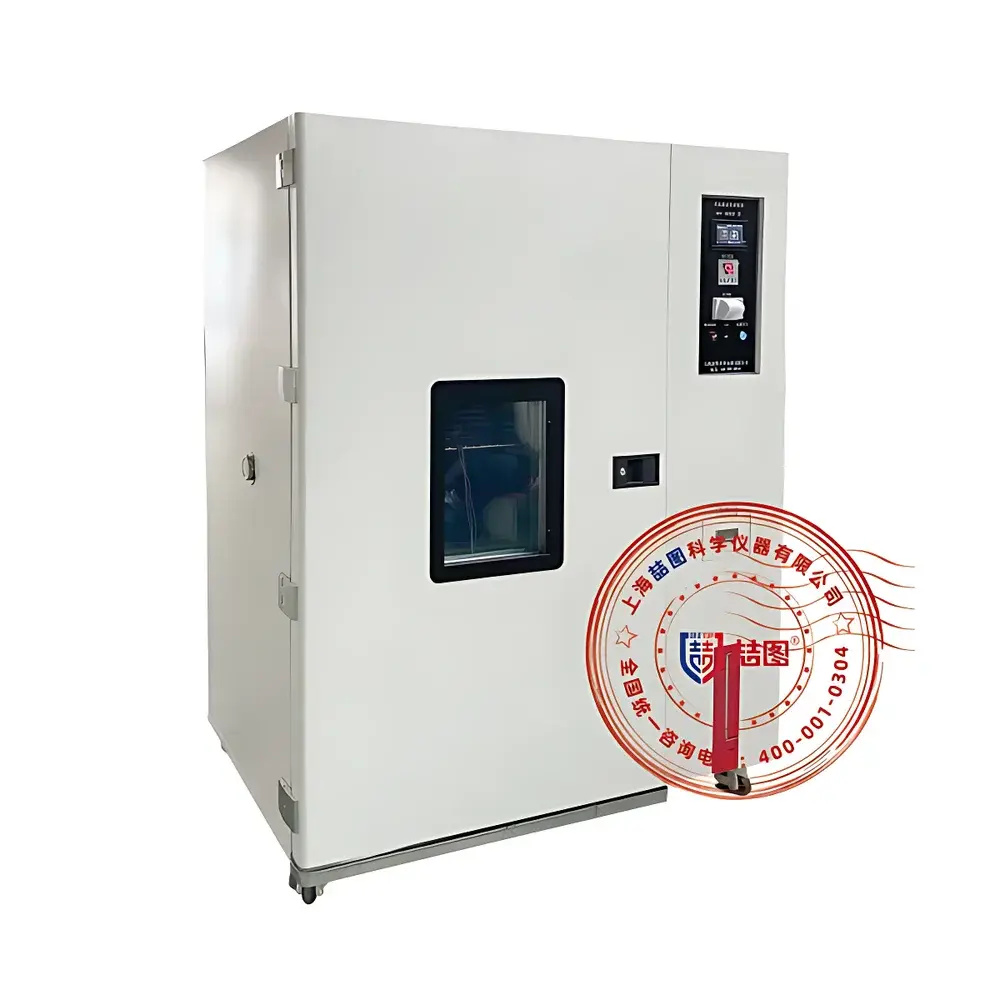
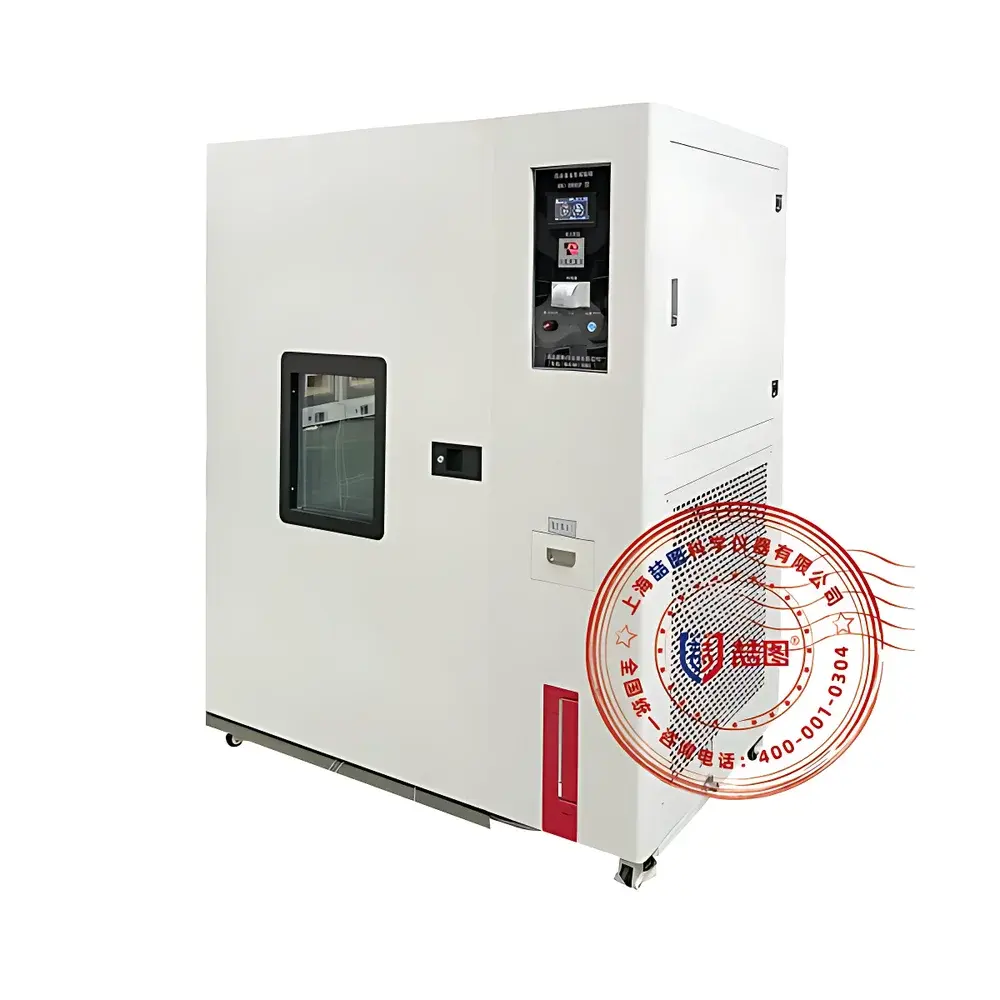
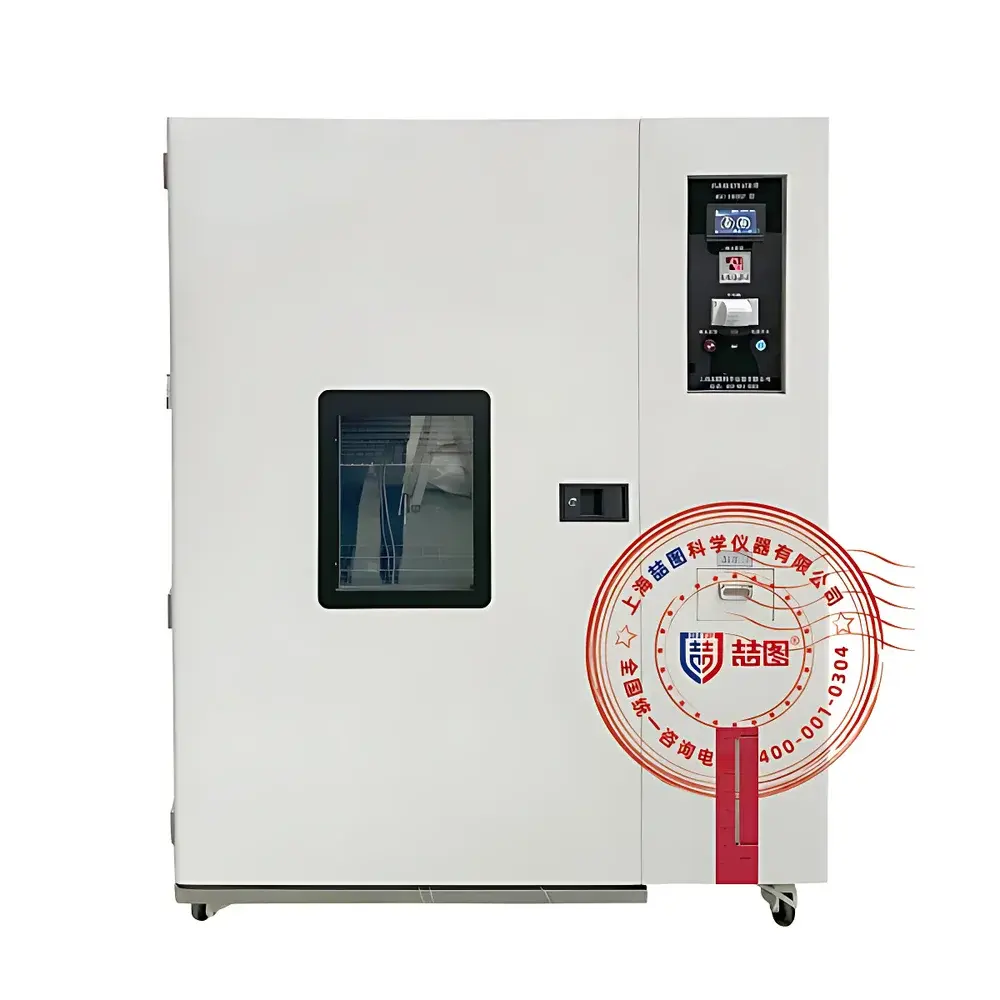
DRETOP GMC3-L425-I Multi-Chamber Comprehensive Drug Stability Testing Chamber
| Brand | DRETOP |
|---|---|
| Origin | Shanghai, China |
| Model | GMC3-L425-I |
| Chamber Configuration | 3 independent chambers (L425: 425 L total nominal volume, 145 L per chamber) |
| Temperature Range | 0–65 °C |
| Temperature Uniformity | ±1.5 °C |
| Temperature Fluctuation | ±0.5 °C |
| Humidity Range | 30–95 %RH (customizable to 20–98 %RH) |
| Humidity Deviation | ±3 %RH |
| Illumination | 0–25,000 lx, triple-face LED full-spectrum lighting, 6-level adjustable |
| Light Source | High-stability SMD LED array with spectral output compliant with ICH Q1B |
| Power Supply | AC 380 V, 50 Hz |
| Input Power | 6 kW |
| Construction | Exterior – electrostatically sprayed steel |
| Compliance | Designed to meet ICH Q1A(R2), Q1B, Q5C |
Overview
The DRETOP GMC3-L425-I Multi-Chamber Comprehensive Drug Stability Testing Chamber is an engineered environmental simulation platform designed for regulatory-grade pharmaceutical stability studies in accordance with ICH Q1 series guidelines. It integrates three physically isolated, independently controlled chambers—each with a nominal volume of 145 L—into a single compact footprint (total 425 L), enabling parallel execution of multiple test conditions under strict thermal, hygroscopic, and photometric control. Unlike single-chamber systems, this multi-zone architecture eliminates cross-contamination risk between protocols, supports concurrent long-term, accelerated, intermediate, and photostability trials, and ensures statistical independence of data sets required for ICH-compliant registration dossiers. The system employs dual-evaporator refrigeration with intelligent load balancing and non-interruptive defrosting—critical for maintaining uninterrupted exposure at ICH-recommended conditions such as 25 °C/60 %RH and 40 °C/75 %RH. Its control architecture is grounded in closed-loop PID algorithms with auto-tuning capability, delivering high reproducibility across extended durations (≥12 months) without drift or hysteresis.
Key Features
- Independent Triple-Chamber Design: Three sealed, thermally insulated compartments allow simultaneous execution of distinct stability protocols—including long-term (25 °C/60 %RH), accelerated (40 °C/75 %RH), and photostability (ICH Q1B) conditions—without interference or calibration compromise.
- ICH-Compliant Photostability System: Triple-face, full-spectrum LED illumination (0–25,000 lx, 6-level step adjustment) meets ICH Q1B spectral distribution requirements; light intensity is calibrated traceably to NIST-traceable lux meters and monitored continuously during exposure cycles.
- Dual-Evaporator Refrigeration Architecture: Separates cooling and dehumidification pathways to eliminate operational conflict between temperature and humidity control—enabling precise, stable RH maintenance even during rapid thermal transitions.
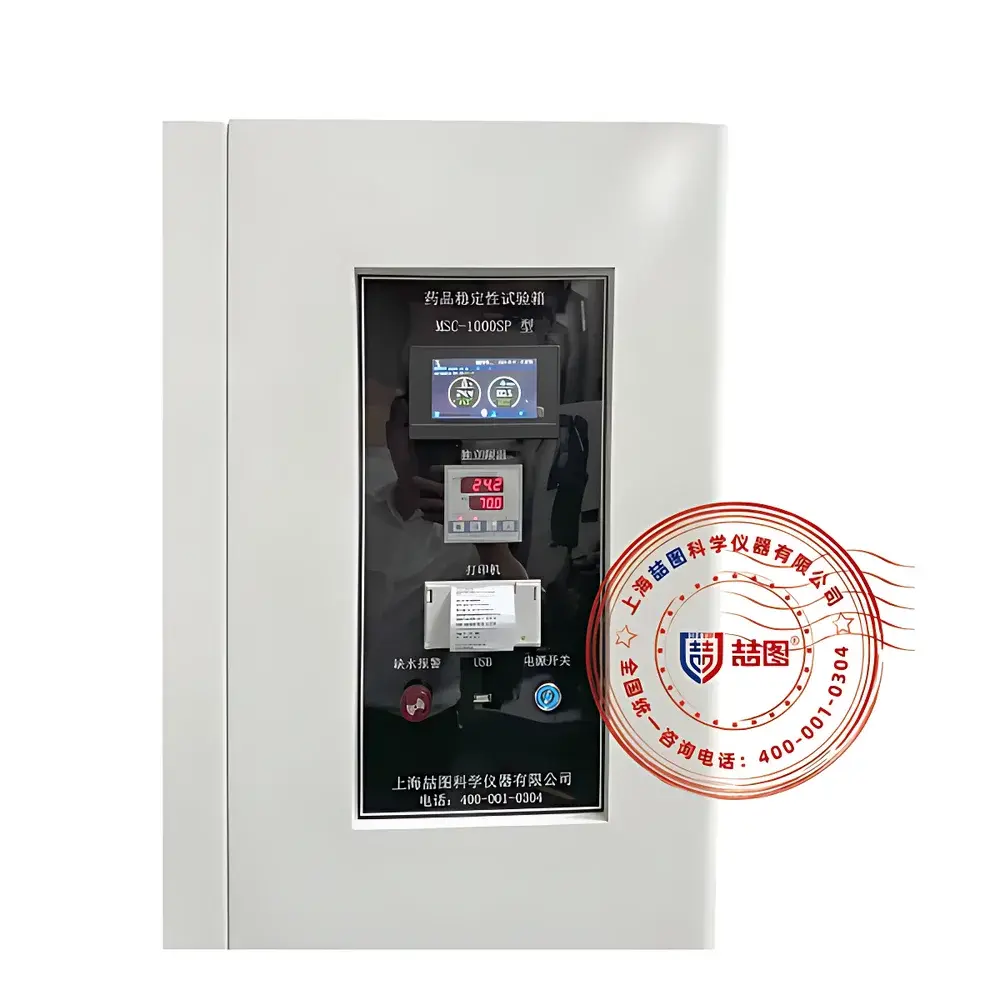
- GMP-Ready Human-Machine Interface: 7-inch color touchscreen with bilingual (English/Chinese) GUI, real-time graphical trend display (temperature, humidity, irradiance), and configurable user roles (Operator / Supervisor / Engineer) aligned with FDA 21 CFR Part 11 and EU GMP Annex 11 audit trail requirements.
- Robust Data Integrity Framework: Local storage of all process parameters (timestamped, with millisecond resolution), automatic U盘 export to CSV/Excel, built-in thermal printer for hard-copy logs, and RS485 Modbus RTU interface for integration into MES/LIMS platforms.
- Fail-Safe Engineering: Dual-compressor redundancy (active/standby mode), triple over-protection circuitry (overcurrent, compressor overtemperature, ground fault), and power-loss recovery with program continuity ensure 7×24 unattended operation suitable for GMP production environments.
Sample Compatibility & Compliance
The GMC3-L425-I accommodates diverse pharmaceutical sample formats—including blister packs, vials, syringes, ampoules, and bulk powders—across its three chambers, each fitted with adjustable 304 stainless-steel shelves and 25 mm diameter pass-through ports for sensor cabling or gas purging. Internal geometry (radius-corner construction, forced-air convection with low-turbulence impellers) ensures uniform environmental distribution per ICH Q1A(R2) spatial uniformity criteria (±1.5 °C temperature, ±3 %RH humidity). All materials contacting the test environment comply with USP extractables profiling and are non-outgassing under prolonged UV exposure. The system conforms to ISO 14644-1 Class 8 cleanroom-compatible operation and supports cleaning validation per ASTM E3106–17. Documentation packages include Factory Acceptance Test (FAT) reports, IQ/OQ templates aligned with ASTM E2500–22, and calibration certificates traceable to national metrology institutes.
Software & Data Management
Embedded firmware supports up to 100 programmable profiles, each containing up to 100 segments with individually defined setpoints for temperature, humidity, illumination intensity, duration, ramp rates, and dwell times. All parameter changes are logged with user ID, timestamp, and pre-/post-value in an immutable audit trail. Data export includes time-series CSV files with embedded metadata (protocol ID, chamber ID, operator signature, instrument serial number), PDF-formatted deviation reports, and Excel-based statistical summaries (mean, SD, min/max, trend coefficients). Optional network-enabled firmware adds TLS-secured HTTPS remote access, SNMP alerting, and cloud synchronization via MQTT or OPC UA—fully compatible with enterprise-grade laboratory informatics systems requiring ALCOA+ (Attributable, Legible, Contemporaneous, Original, Accurate, Complete, Consistent, Enduring, Available) compliance.
Applications
- ICH Q1A(R2)-mandated long-term stability studies (25 °C/60 %RH, 30 °C/60 %RH) and accelerated testing (40 °C/75 %RH) for small-molecule APIs and finished dosage forms.
- ICH Q1B photostability assessment of light-sensitive compounds (e.g., antibiotics, biologics, ophthalmic solutions) using controlled UV-Vis irradiation.
- Intermediate condition evaluation (30 °C/65 %RH) per Q1A(R2) decision trees for tropical climate zone submissions.
- Stability-indicating method development support—exposing reference standards and stressed samples under defined degradation conditions.
- GMP batch release testing and shelf-life extension studies for generics, biosimilars, and cell/gene therapy products requiring stringent environmental fidelity.
- Regulatory submission preparation for FDA, EMA, PMDA, and NMPA, with full data lineage and electronic signature support per 21 CFR Part 11 and NMPA “Measures for the Management of Records and Data in Pharmaceutical Production”.
FAQ
Does the GMC3-L425-I meet ICH Q1A(R2) and Q1B requirements for regulatory submissions?
Yes—the chamber’s temperature/humidity uniformity, photometric spectral output, and data integrity architecture are validated against ICH Q1A(R2) Annex 1 and Q1B Annex 2 specifications. Full validation documentation packages are available upon request.
Can the three chambers run different protocols simultaneously?
Yes—each chamber operates with fully independent controllers, sensors, and actuators. No shared air paths or thermal mass coupling ensures protocol isolation and statistical independence.
Is the system compliant with FDA 21 CFR Part 11 for electronic records?
Yes—role-based access control, electronic signatures, immutable audit trails, and data export controls satisfy Part 11 requirements. Optional PKI certificate integration is supported.
What is the maximum allowable sample load per chamber without compromising uniformity?
Per ICH guidance, loading should not exceed 30 % of chamber volume. For the 145 L chambers, this equates to ≤43.5 L of packaged product—verified during OQ using ISO 14644-1 particle-free thermocouple mapping.
How is photostability irradiance calibrated and maintained?
Each LED array is factory-calibrated against NIST-traceable lux meters; real-time monitoring via integrated silicon photodiodes enables automatic intensity compensation over lamp lifetime (rated ≥25,000 hours at 25 °C ambient).